Monday, October 29, 2007

I so expected extra innings...

"The Red Sox are so becoming America's team," said Chris Daly, 32, who watched the game at the Brendan Behan Pub in Jamaica Plain. "The curse is done and we'll start seeing, for better or worse, what money does. The World Series will be less sweet because they'll be more frequent. It's less punk rock, a little more corporate." (1)


He may be right. But for now, we celebrate a fantastic sweep!

Article

Monday, October 15, 2007

Blog Action Day: Credo

Bloggers Unite - Blog Action Day

This post is my contribution to Blog Action Day. I am one of over 15,000 blogs participating in this year's action: the Environment.

Credo: Why I choose

I was struck by how difficult it was to come up with a topic on which to write for Blog Action Day. This is not because there is any lack of “environmental” issues that catch my interest, but because it seemed impossible to prioritize desertification over deforestation, pollution over procreation, or climate control over conservation. It is that sense of impossibility, of moral inclusiveness, that defines my own environmentalism.

At a party several weeks ago, a friend brought up his skepticism about global warming. His basic argument (and it was a good one) was to ask: Why is global warming any more important than fighting AIDS, or cancer, or working to make sure people have clean drinking water? The quick and easy answer? It’s not. If we are going to make the fight against climate change a moral endeavor, we can’t say it is more important than trying to fight hunger or poverty. But at the end of the day, we all have choices to make. And there are many. So why have I picked Global Warming?

First, a disclaimer. I’m operating under two assumptions. One: Global Warming exists and is a problem. Two: Only we can do something about it. Because I believe that the evidence overwhelmingly points to these truths, I make my choices accordingly. For this reason, I’m not interested in mudslinging, catfighting, or even bantering, with those that argue the veracity of climate change. Consider it a type of figurative energy conservation.

My approach is to consider the biggest picture possible. The truth is that many of us living in the US could likely adapt to some of the worst case scenarios of climate change. We have what I would call “the privilege of adaptation.”* But my own sense of morality obligates me to look at the rest of the world and consider it, to some extent, my responsibility. While I cannot simultaneously plant trees in Kenya and combat desertification in Sudan, I can embrace those regions of the world under a blanket of global humanity. I see the fight against global warming as a fight that will work from the top down. I’m not working against AIDS advocacy, or water purification, or the sustainability movement. I’m working for them. I’m making those efforts worthwhile by fighting to ensure that the better world they are trying to create will still be here when they reach their goals. I want to be a steward of the planet to honor the work of those who are stewards of humanity.

There are plenty of people who would take my “environmentalism” to task. I eat meat, for example. Those interested in running a hypocrisy check could probably find a few environmental no-nos in amongst my compact fluorescents, water-saving showerheads, and devotion to public transit. Most human beings are incapable of all-or-nothing, and I will not argue with zealots or purists. At the end of the day, my mere awareness of a horizon bigger than the Boston skyline entitles me to walk confidently amidst my own ideas of activism.

I will continue to advocate for better emissions standards, alternative forms of transportation, energy efficiency, etc. all to combat what I consider to be human-induced climate change. I have to do this for the people whose relationship with the earth is not buffered by layers of technology and man-made construction. I will endeavor to make my government listen and take the lead in promoting environmental responsibility. And in the end, if it turns out I was wrong and global warming really was just a hoax, I will have no regrets because the things for which I will have worked so hard have merit outside “An Inconvenient Truth” and IPCC reports. I will have sustained an idea of global citizenship, and for that, I will have no apologies.

*I’m indebted to HM for a discussion on this topic.

I will be including other interesting Blog Action Day posts in my "Posts of Note" box to the right. Check them out!

Tuesday, October 09, 2007

October 15th: Blog Action Day

I know I've fallen behind in my posting, and I apologize for that. But stay tuned for my Oct. 15th post as I take part in Blog Action Day.

Friday, September 28, 2007

Burma/Myanmar

This has nothing to do with musicology, but it is important. If you haven't heard what's happening in Burma, the time is now. They've shut down internet access...

Blog (graphic pictures)

CNN article

Wednesday, September 19, 2007

How To Survive A Dissertation: Part II: COPING


COPING

While I had promised in my last post to regale you with tales of setting margins, choosing paper, adjusting styles in MS Word, and other fun tales, I received an IM this week that made me think this particular post is more important. Copyright permissions and the like will have to wait..


HOW TO COPE

You may be halfway to two-thirds toward reaching your day of glory, or maybe you are working on a proposal, or maybe the dissertation seems like this huge obstacle you'll be tackling in a year or so from now. No matter where you are in the process, know that writing a dissertation can be one of the most emotionally dynamic experiences of your life. As Joan Bolker says: "Whether or not writing turns out to be your practice, writing your dissertation will still have changed you for all time" (Writing your Dissertation in 15 Minutes a Day, 150).

The following list contains just a sampling of emotions you may experience during the course of the diss: frustration, joy, depression, confusion, satisfaction, despair, wonderment, excitement...Like I said, dynamic! So how does one cope under the stress of such an emotional roller-coaster? Well, let's rephrase that questions: How does one TRY to cope?

I Get By With A Little Help From My Friends

You can and will receive support from family and friends, but it is important that you have reasonable expectations of them. When you need support because of dissertation-related stress, I suggest using the following "hierarchy." This hierarchy is NOT a statement about the quality of the people or the friendships (so I'm looking for a different word), but instead a strategy for success when seeking empathy.

GROUP A: They've Been There

Aside from being repositories of helpful advice and information, these people do know what it is like. Seek out people who have completed their dissertation within the last ten years, so a) they aren't too emotionally removed from the process and b) they can relate to the struggles of a modern dissertation. Occasionally you may run into someone who was so traumatized by their experience they "don't want to talk about it," but more often than not, people will want to help you by sharing their own hard-won wisdom. Ideally, you'll find someone willing to both listen and share. This is also why it is a good idea to have a junior faculty member on your committee.


GROUP B: Misery Loves Company

To some extent this is true, but you want to make this interaction productive. Getting together with fellow dissertators for a huge venting session can be satisfying and healthy. But venting only gets you so far. Try to form a support/writing group that meets weekly. Give yourselves a pre-determined amount of time to chat/vent then get down to work. If you are all at the writing stage, exchange a couple pages every week with a partner and give constructive feedback to each other.*

*Peer advice can be very helpful and doesn't come wrapped up with the same psychology of receiving comments from a mentor or advisor.


GROUP C: We Love You Anyway

These folks are likely to be the people closest to you...the ones who are still there after you've bitten their heads off for the fiftieth time, whom you've told they "just have no idea," and who have been willing to listen to hour-long pontifications about the finer points of liturgical theory as it relates to ritual and the concertized Latin Mass. Not surprisingly, it is this group of people who you will most likely find yourself pushing away. Try to be aware of this. They love you, and no, they may not "get" everything, but they'll be there at the end of the day and want to celebrate your success.

Solitude


As far as dissertating goes, solitude can be both a blessing and a curse. Try to know when you need it and when you don't. I'm a people person, so I was much more comfortable working at a coffee shop, where the reminder of life was comforting and helped me focus. For others, holing up with a carrel at the library may be what they need. Sometimes you'll find yourself craving one or the other.

If you start thinking "I'm all alone," amber lights should start flashing. At best, it may just be periodic self-pity. More importantly, this can often be an indication of depression (even a minor form), because the truth is, you are NOT alone. Even if you don't have the flesh-and-blood colleagues around you to form a writing group, the internet has expanded our professional and social resources. Find an on-line dissertation support group (or start one!). Call and email your PhD and ABD friends. One helpful resource: The All-But-Dissertation Survival Guide (I recommend their newsletters).

Note on photo: I'm considering this fair-use, but I'll be happy to give credit, so if you took this photo, let me know.

Friday, September 14, 2007

How to Survive a Dissertation: Part I


Now that I am a bonafide PhD, I do not claim to know anything and everything about writing dissertations. (Nor do I resemble anything close to the above figure). I do know what helped me. Writing it here does NOT mean I always followed my own advice, but when I did, I reaped the rewards. I decided to consolidate my dissertation experiences into a helpful guide (I hope) and this idea has already received an enthusiastic endorsement from several friends who are dissertators. This post will offer some general advice that is applicable to any long writing project, not just a dissertation. I hope you find it useful!


1. Carry a moleskine, small notebook, whatever suits your purpose. Have another one on your bedside table, and another at your home work station.


Ideas have a bad habit of appearing at the most inconvenient times. As any good GTDer knows, the Ubiquitous Capture Tool (UCT) is of the utmost import. This is especially true for the dissertator. If you think you'll remember to write it down, you probably won't. Don't take chances. (Moleskines or a notebook with a pocket are especially helpful if you run into a dissertation contact who hands you their card). While PDAs can be good UCTs, generally they get a little overloaded if you have a flurry of inspiration and your idea translates into an entire paragraph or two of workable material.

2. Envision the end. Use your imagination.

When gravity is seemingly pulling you toward the molten core of the earth, stop what you are doing and allow yourself to daydream. For me, it helped to think about calling my college mentor and introducing myself as "Dr." For you, it might be something else: telling your parents, eating that pint of Ben & Jerry's you promised yourself, whatever. Allow yourself to fantasize. There is a whole lot of data out there about the positive effects of envisioning your goal. Close your eyes and let yourself really feel whatever emotions you'd like. This may sound cheesy, but it really does help when you feel isolated and like no one really cares if you finish.


3. Beware the Vices and the Stress

Watch the drinking, smoking, caffeine, (insert your own vice). Life will continue after the dissertation and you'll want to be healthy enough to enjoy it. Graduate School takes enough of a toll on your health without you helping! That said, I am not suggesting you become an ascetic. Just watch yourself. If you notice that you are using alcohol (for instance) as a crutch, something has to change. I promise that your dissertation won't get written any faster if you drink a martini, or two, or three. I can attest to this (lest you think I'm a hypocrite).

Make time to exercise. You've got to. Even if it is only a half hour of stretching, working on a Liszt piano concerto, whatever. While I didn't graph it, I'm fairly sure there was a direct correlation between the days I exercised and the days I was most productive.


Meditate. I don't mean that you have to sit on a mat in the lotus position and hum. That is an option, however. Just take some quiet time alone to concentrate on your breathing. This can be in your house, or in some nice outside locale. I recommend this especially before you sit down to write.

Take breaks and take them often. Do not even attempt to do three hours of uninterrupted dissertation work. If you have three hours of work in you, it will happen on its own. Set a more reasonable goal, even if it is only fifteen minutes (see book recommendation below). USE A TIMER. A general rule, however, is that the break should be shorter than the work time.

Posture. While this may seem like a no-brainer, most people who sit at the computer all day have terrible posture (myself included). This really will affect your emotional/psychological well-being and your ability to focus. Make sure you have a good chair with good lumbar support. Your abdominal muscles should be supporting your spine. Your arms should be supported on your desk when you type. Better carriage gives you more energy. I forget my posture at almost an hourly rate, so I have a post-it on my computer that says "POSTURE." Your chiropractor will thank you.

4. Fifteen Minutes a Day

I've read quite a few books on how to write a dissertation and I'll be reviewing them here. One of the best, in my opinion, is Joan Bolker's Writing Your Dissertation in Fifteen Minutes A Day: A Guide to Starting, Revising, and Finishing Your Doctoral Thesis. Bolker has numerous worthy suggestions and excellent practical advice, but what I'd like to focus on is the "fifteen minute" idea. EVERYONE has fifteen minutes.

The hardest part to writing (anything) is getting started. Sitting down to "draft a chapter" is a far more daunting task than sitting down to write fifteen minutes of material. More often than not, 15 minutes will turn into an hour without you thinking about it. But, on the days it doesn't, the likelihood is that you will have at least a couple sentences of usable material. If you are feeling really unmotivated, I suggest what I call "barfing it out" (elegant, yes?). Don't worry if it isn't pretty or doesn't even make logical sense...just get it out of your head and on to the paper. Leave it be, then return to it the next day to see what you can extract from the gobbeldygook. You may be surprised.


The next installment will feature more practical advice on maintaining bibliographies, MS Word strategies, backups and exciting topics like that! I look forward to comments and helpful tips from my readers!!

Thursday, September 06, 2007

Dora says it best...


I'll let you figure out who the troll was. :-)

PHEW! Guess I've got to change my blog blurb now!

EXTRA-CREDIT to anyone who can tell me what the lyrics say (I've got as far as "Lo Hicimos, the bridge and the troll... but she goes up the mountain and does WHAT? And it just goes downhill from there.)

I woke up this morning...

...and Pavarotti was dead.

Back in the day, when I loathed opera, when I associated opera with Saturday house-cleaning, when I didn't know how to listen to music, I knew Pavarotti. He was the emblem of opera. Word-association: opera = Pavarotti.

An icon.


And now, he's gone. May he rest in peace. I hope he is singing with Beverly, Jerry, and Regine. What a year.

Wednesday, September 05, 2007

Practicing self-control

I managed not to bite through my tongue, rip my hair out or dig my nails into my own flesh as the nice woman at Fed-Ex explained that the plane broke down and that is why my dissertation is sitting in the Fed-Ex in Memphis, TN instead of on the West Coast. She assures me that it will get to the final destination by TOMORROW morning at 10:30am PST. I even remembered to thank her for the information.

I think I will now go run around the block several hundred times.

I've Fed-Exed probably twenty packages in my short life. THIS had to be the one not to arrive on time? At least I gave myself a little bit of a cushion...very little.

Sunday, September 02, 2007

A true Laborious Labor Day Weekend


They go out on Tuesday via Fed-Ex (after a quick jaunt to the post office to get a postal money order--grrr.)

Then, we wait. No premature congrats, please. It ain't over til its over, but I've done my part. :-) I'll keep you posted.

Prayers, good thoughts, positive energy, etc...all gratefully accepted. :-)

Wednesday, August 29, 2007

50 Book Challenge #14: City of Ladies

50 Book Challenge #14: The City of Ladies by Christine de Pizan (trans. Rosalind Brown-Grant, Penguin Classics, 1999).

Christine de Pizan, writing in the year 1405, writes a treatise on feminist equality by way of a dialogue with personifications of Reason, Rectitude and Justice. These three "sisters" help Christine to edify and fortify her "City of Ladies" wherein women are able to celebrate their full potential, unhindered by the malevolent misogyny so prevalent to the time.

While Reason, Rectitude and Justice rattle off a laundry list of historical female exemplars, the real value of the treatise lies with Christine herself. While the Christine in the book plays the part of the virtuous, but naive, young woman, the subtext makes clear that Christine de Pizan is an intellectual force with which to be reckoned. She demonstrates a knowledge of literature, philosophy, and rhetoric that was inaccessible to many women of the time. If her argument fails in any sense, it is only in that she fails to address how women might rise above their station.

And while Christine focuses on negating the misogynistic assertions of other writers, her own feminist thought has its limits. She admits, through the voice of Reason, that it would "not be right for [women] to abandon their customary modesty and to go about bringing cases before a court." It is, however, necessary for Christine to abandon her own modesty, which she does in several instances, particularly through self-referencing her earlier related works. The dialogue style enables her to do this without too much self-aggrandizement.

While none of the ideas contained within The City of Ladies will shock the 21st century western mind, the larger lesson on the power of the word is invaluable.

Sunday, August 26, 2007

Another Quiz from Soho the Dog

Matthew Guerrieri offers another musically-minded quiz to aid me in my procrastination.

1. What's the best quotation of a piece of music within another piece of music?
Quote from Haydn Symphony no. 94 in Die Jahreszeiten. It certainly isn't the "best" but it happened to just come up on the iPod.

2. Name the best classical crossover album ever made.
I don't know about best, but I'll cast another vote for Yo-Yo Ma's Soul of the Tango (sorry, Elaine). Also a big fan of the Swingle Singers.

3. Great piece with a terrible title.
This is a tough one. I'll have to modify it to great piece with terrible text. I'll go with Kirke Mechem's Five Centuries of Spring which requires singing the following text: "not only underground are the brains of men, eaten by maggots" courtesy of Edna St. Vincent Millay.

Ah...I know! Marais' Le Tableau de l'Opération de la Taille.

4. If you had to choose: Benjamin Britten or Michael Tippett?
Britten

5. Who's your favorite spouse of a composer/performer? (Besides your own.)
It is a pity Alma is taken. I'll say Felicia Montealegre.

6. Terrible piece with a great title.
decline to state

7. What's the best use of a classical warhorse in a Hollywood movie?
Again, "best" is perhaps not the word I'm looking for. Strauss' Also Sprach Zarathustra in 2001: A Space Odyssey deserves mention since most of the world knows it as "the 2001 theme."

8. Name the worst classical crossover album ever made.
Worst? Probably something by Il Divo. I'll also submit Vanessa Mae's Storm.

9. If you had to choose: Sam Cooke or Marvin Gaye?
Sam Cooke

10. Name a creative type in a non-musical medium who would have been a great composer.
Milan Kundera (I'm still hoping). I don't know if he counts though, since he formally studied composition.

EXTRA CREDIT:

For early-music nerds: Name a completely and hopelessly historically uninformed recording that you nevertheless love.

I don't "love" this, but it is worthy of mention...the "lounge-chant" version of Haec Dies on the eighth edition of the Norton Recordings.

Tuesday, August 21, 2007

Sound vs. Sight

Roger Bourland posits, "Music has to be SEEN nowadays, and not just heard." He is understandably frustrated that people more readily click on YouTube video clips than mp3 examples. I also find myself discouraged by our increasingly visual culture.
While there is nothing wrong with visual arts, there does seem to be an unfair emphasis on the visual over the aural. I assert to my music appreciation students that while they are good hearers, they are not necessarily good listeners. Hearing is a sense, but listening is a cultivated skill. A parallel might be made between looking vs. seeing. With the increasing amount of input in today's world, I think listening and seeing are both falling by the wayside (bedfellows with critical thinking). However, a typical non-music major, when given the option between the two, will chose seeing over listening. I would also submit, that when an aural element is paired with a visual element, it is usually the former that gets short-changed. It is easier for most people to focus on the visual element and put the aural in the background. Perhaps this is because the aural (in particular music) is so often the background of our daily existence.
There have been many times I have had to close my eyes to remove a visual distraction in order to focus fully on my listening. I often have my students close their eyes (always an interesting exercise in self-consciousness) and nine times out of ten, they report being able to "hear" better. While I'm not sure wearing earplugs would necessarily enhance the visual experience (at least not immediately), this business of sensory isolation is important. It has long been agreed that people who are blind, deaf, etc...often have other enhanced senses to compensate. I wonder if those of us with all our senses compensate by dulling all of them. We couldn't possibly give priority to our smelling, tasting, touching, seeing, and listening all at the same time. So, we are forced to make choices.
More evidence that we prefer the visual over the aural is presented by the absence of those elements. More people will readily choose silence (some crave it, actually) over darkness. Not that absolute silence OR darkness are easy to come by, but it is relative. Silence in contrast to sound is discernible. Some film makers have inserted blank screens as sort of visual "grand pauses." But even then, the darkness is confined to the screen.
In the end, there has to be room for both seeing and listening. But until people become more practiced listeners, the visual will often overcome the aural. So what does this mean for music?
In the case of film music, I don't think the relationship is exactly symbiotic, even if it is meant to be. If I show a student a film and ask him/her to describe it (outside of a music class context), rarely do I hear anything about the music. Sometimes, when asked about the music directly, students will have something to say, but most often they tell me they've got to "watch it" again. Many composers (of operas, of films, etc...) wind up writing suites of their scores. Ostensibly, this is because it gives the music some sort of form and context outside of the film or opera. But does it then become something different? I think about Corigliano's Red Violin for instance. I wish I could erase my memory of the movie (just once) so that I could listen to the suite without superimposing images from the movie. I feel enslaved to the visual. While I recognize that the original material was composed to accompany the visual, it seems that the visual is forever bound to the aural, even when presented in isolation (as with a concert suite). Maybe that isn't necessarily a bad thing (in the case of film music), but I for one, would like the option.

Saturday, August 18, 2007

Ketchup (or "On the Value of Blogging")

Ok, so that should be "catch-up" but I'm sure you will forgive my jet-lagged version of wit.

While I deleted a few of my blog feeds, I still came home to over 200 posts and was reluctant to delete them indiscriminately. This was a concern I had voiced before I left and it proved to be true. I have a feeling my reluctance to delete without reading is akin to the need I had, as a child, to stay awake all hours whenever my parents had a dinner party. I would creep out into the upstairs hallway, with my face pressed against the staircase railing, and strain my ears to hear conversations which I never understood in the first place. In the case of blogging, comprehension is not an issue, but I do wonder why I am so scared to "miss out."

One of the more relevant discussions to take place while I was busy working on my German Latin and eating healthy dishes like Somlauer Nockerl and Eispalatschinken, was the discourse about the value of the blogosphere. Drew started it (at least this round) over at Amusicology, and Phil Ford (Dial M) and Barnet Bound picked it up. I posted a response over at Dial M, but realized the converse of my argument also applies.

My general advocacy of the blogosphere is based on the lack of censure and the speed at which information can be relayed. I realize now, that my general complaint about the blogosphere is based on the lack of censure and the speed at which information can be relayed. Occasionally, ignorance may be bliss. Of the several hundred blog posts I've sorted upon my return, I'm fairly certain my life would continue in its generally positive direction without them. I am, however, still plagued by the fear of being a Johnny-Come-Lately. Just as I wouldn't dream of attending a AMS conference without having read the latest issue of JAMS (well...I might dream of it), I'm reticent to jump back in to blogging without knowing what has happened while I was gaining umpteen pounds singing in the Haydnsaal.

All the same, like various other projects that have been on hold for the last two weeks (dissertation, articles, job-hunting), I'm diving back in. I'm going to be giving a lot of thought to the value/dangers/benefits of blogging (thanks to the aforementioned blog authors) and look forward to your thoughts.

Ah, yes...and one more link for those of you who are GTD-minded: Why GTD will allow you not to use GTD on your summer vacation (my title).

Sunday, July 29, 2007

Blogging Hiatus!

I'll be singing (in the Chorus) for Haydn's Harmoniemesse and Die Schöpfung here.
Back in mid-August!

Tschüss!

Saturday, July 28, 2007

50 Book Challenge #11 & #12: HP No. 7 and What is the What

No. 11
Harry Potter and the Deathly Hallows by JK Rowling (Scholastic, 2007)

In order to be "spoiler-free" this will be necessarily brief. Suffice to say, I felt this was one of the better books in the series. Rowling did a very good job of tying up most of the loose ends. I did feel she moved too quickly through the last parts of the book, breezing through points where I wished to linger. My harshest criticism of the book is the Epilogue--I found it incredibly juvenile (it brought Harry Potter back to the level of mundane chidren's literature) and unnecessary.


No. 12
What Is The What by Dave Eggers (McSweeney's, 2006).

To call this a "novel" might underestimate its truth and urgency. This is very much a work of non-fiction. The life of Valentino Achak Deng is representative of thousands upon thousands of lives in Sudan in its tales of struggle and oppression. While the book sensitively addresses a topic that is hurendous and heartbreaking in and of itself, the narration is not overly sentimentalized. Eggers and Deng weave in humor, joy, and small victories through the tragedies of the Lost Boys of Sudan.

Valentino Achak Deng is both evidence of the resiliency of the human spirit and a beacon of hope for the future. There are moments in the book that call us out of our comfortable existence, and there are moments when we recognize that from which we also seek refuge. It is a compelling read about the human condition and should be compulsory reading for anyone wishing to remain ignorant about the struggles of Africa. To ignore Sudan is to ignore humankind.

Thursday, July 26, 2007

Edward Hopper at the MFA

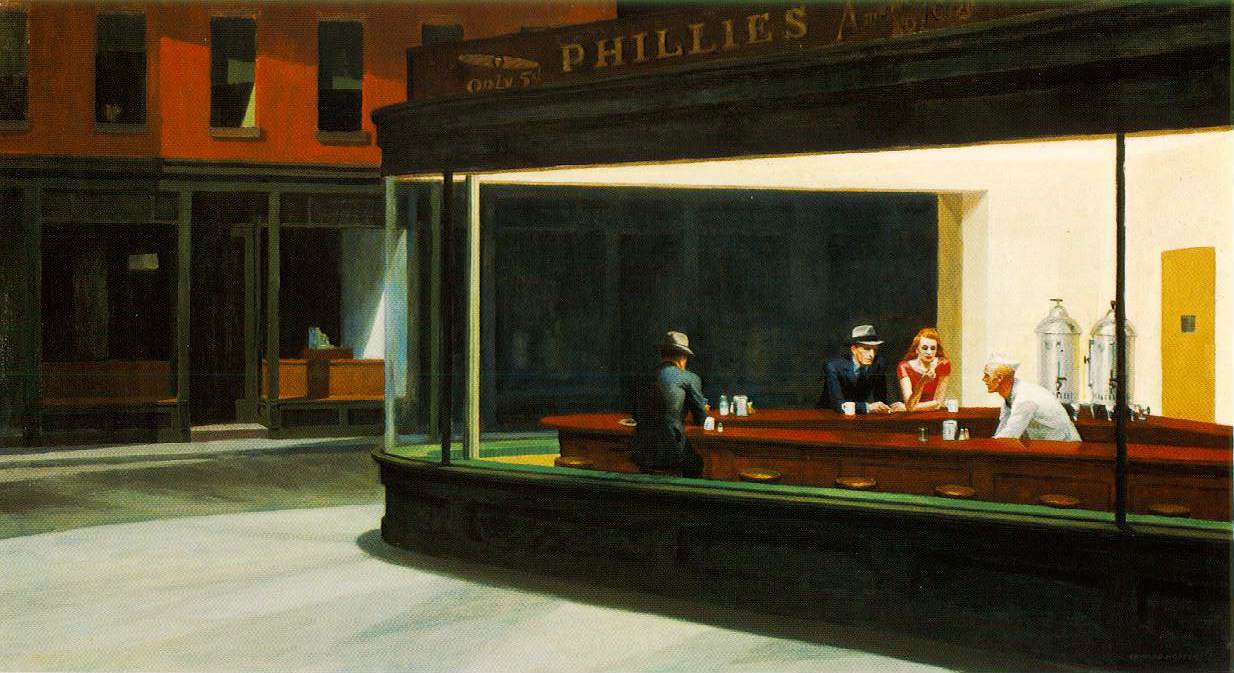
Edward Hopper has to be one of my all time favorite artists. The current exhibition at the Boston MFA is fantastic. In addition to what is arguably his most famous painting (Nighthawks, 1942), the museum hosts some of his very early works and some of his prints. Hopper was admired as a printmaker before he became known as a painter.

I was struck by the obvious maturation of Hopper's work. In music, we speak of the "mature style" and I sometimes feel this is unfair, as maturity, in both music and life, is a subjective concept. However, in spite of the subjectivity, we can usually agree that self-confidence is a sign of maturation. In Hopper's early work there is a sense that he is following a model, a pattern...he's painting how he is supposed to paint. As one moves into his works of the later twenties, he seems less afraid to admit shape...using watercolors almost as if they were oils, exploiting their capabilities for the opaque. In these paintings, the natural elements (such as background foliage) are given a more watery texture, whereas the solidity of man-made elements is emphasized.

I respect Hopper's eye. He isn't afraid to let tall edifices soar out of frame. While Uncle Jack's snapshots of the Eiffel Tower without its top don't quite cut it, Hopper manages to extend the idea beyond the page. We don't have to see all of the chimney in order to understand the roof.

The exhibit cited Hopper's interest in "vernacular architecture" as opposed to someone like Charles Sheeler, who, while somewhat similar stylistically, amplified the industrial (factories and the like). His paintings of lighthouses are especially exquisite...extraordinary, but not overly-romanticized.

Hopper's most intriguing paintings are those of women and couples (see Room in New York, 1932 pictured above). The sense of isolation is tangible, but not hopeless. In his famous New York Movie (1939), the usherette becomes the focus, not the movie or even those watching. Dimly illuminated by the aisle lights, we are pulled into her pensive daydreaming...the movie in her mind.

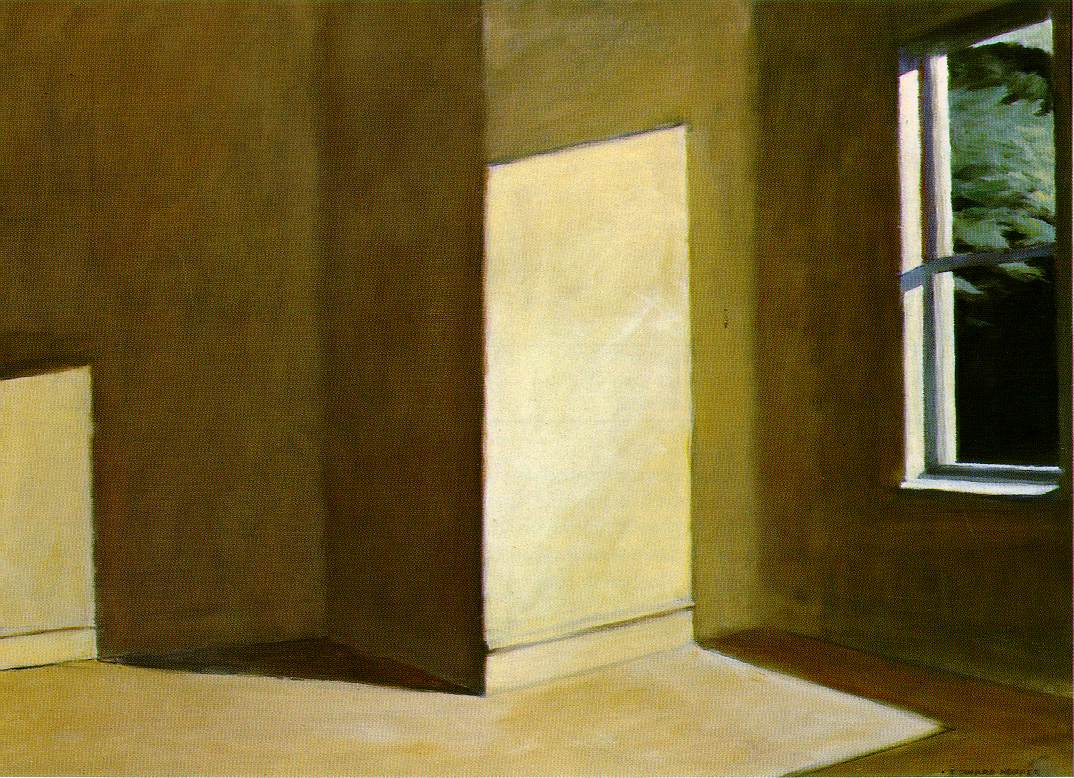
The very last painting in the exhibition chilled me for some reason...all the more ironic given that it is a painting of sunlight. Sun in an Empty Room, painted four years before he died, gave me such pause. Gone are the contemplative nudes and the estranged couples...only two elements remain...the room and light. There is a strong sense of geometry here. The three-dimensionality is subdued in favor of the demarcation of roles: shadow vs. light. The absent figures could occupy either type of space. It makes me want to seek out all of Hopper's figures to note where they stand, sit, or lounge. In the end, when we leave our rooms, the light and shadow remain. We are but visitors, with our hopes, dreams and burdens.

Monday, July 23, 2007

For Exceptional Theses Only...

For those of you out there with mediocre and substandard theses...I'm afraid I don't know where to buy the paper. Do let us know if you find out...at the very least it should be cheaper.

Wednesday, July 18, 2007

In Memoriam: Jerry Hadley (1952-2007)

Death is always sad. And sometimes it is tragic.
Sometimes we mourn the personal connection.
Sometimes we mourn the talent, and the fact we didn't know.
Sometimes we mourn an idea, a symbol.

But we always do mourn.

Jerry Hadley
Requiescat in pace.

Thank you for sharing your voice with me through hours and hours of dissertation work on Leonard Bernstein's Mass. You always helped me reconnect with the love of my labor. Thank you for your "Simple Song."

Now Listening: Leonard Bernstein's Mass--Deutsches Symphonie-Orchester Berlin, dir. Kent Nagano, with Jerry Hadley as Celebrant. (Harmonia Mundi, 2004)

Sunday, July 15, 2007

Because you never have a second chance...

I've decided to start a weekly (maybe more) feature called First Impressions in New Listening (FINL*).

Ideally, every day I'd like to hear a piece of music I've never heard before. At the present time, that is probably not practical.

The music can be recently composed, relatively "new," or an older piece with which I'm unfamiliar. I'm going to write down my first impressions. Keep in mind they are exactly that--FIRST impressions, based on a single hearing, without a score. My commentary will reflect that which "jumps" out at me (if anything).

If you are familiar with the piece, feel free to leave your own impressions (first or otherwise) in the comments.

This week, we start off with something relatively local:

Pozzi Escot, Concerto for Piano and Orchestra or Chamber Orchestra (1982)
ALBUM: POLYUTTERANCES
Peformers: New England Conservatory Chamber Orchestra, cond. Tamara Brooks, with Randall Hodgkinson, piano.

More of a "concerto" in the sense of Bartok's Concerto for Orchestra, this mini-concerto (just under six minutes) of three movements could be a single movement.
The opening movement is the yin to the yang of the closing movement. The first movement draws out a motive in the trumpet, like musical taffy. The final movement takes a related motive, but squeezes it and condenses it in a rush to the finish. The piano makes rather abrupt statements, but at no time is there ever a sense that there is one soloist.
These outer movements flank an inner movement of a more obligatory inward nature...atmospheric strings (recalling Ligeti) punctuated by the piano. This slower middle movement is most revealing of the concerto conception.

I enjoyed this piece and will listen to it several times. The texture is dense, so there is much to be unearthed.
----------------------------------------------------
*The irony of the acronym is unintentional.

MUSICALLY MISCELLANEOUS MAYHEM

Mostly Musicology, Teaching, and a bit of Miscellanea