I've now joined the reviewing "staff" at the Boston Musical Intelligencer. I've long admired their goal "to list every classical music concert in greater Boston." They also "intend to review as many as possible, especially those deemed most important and unjustly neglected by our editors."
I'm not sure what constitutes an "important" classical music concert, but neglected ones are not hard to find. Music criticism is fast becoming a lost art, with budget cuts at major papers. As musicologists, this should be cause for great concern because it is the critics who really end up being the chroniclers of concert life (if such a thing exists). Slonimsky's Lexicon of Musical Invective is a humorous read and supplement to any music history course, but it also provides some invaluable snapshots of reception history, context, and occasionally the music itself (!) I am not advocating invective as a norm, of course (in fact I hope the occasion that warrants it is rare), but when it comes to art and music, in particular, it cannot be separated from the aesthetic viewpoint (errant or otherwise). As a musicologist, it is easy enough to be critical of music on a recording, or by a composer long since dead. But I'd like to encourage my colleagues to get out there---put the book down, go to a concert---keep this tradition alive. Blog about the concerts you go to. Start your version of the Boston Musical Intelligencer in your own city. And really, it all comes down to basic economics ( a course in which I received the worst grade of my college career, incidentally)--supply and DEMAND. It doesn't have to be the BSO, or the LA or NY Phil. I bet you've got a community chorus in your area that worked long and hard on some amazing repertoire and could really use some constructive feedback. It is the subtext of many a choral song: anyone out there? Are you listening?
And speaking of choruses, a shameless plug for my own: Spectrum Singers. 30th Anniversary. 30 years, yes...in Boston. We've got an amazing concert coming up on November 21st. I'd really like for you to be there. Bach Magnificat, Schutz's Deutsches Magnificat, the third and sixth cantatas of Bach's Christmas Oratorio with orchestra members from Emmanuel Music. I've got discounted tickets. Leave a comment and I'll find you!

Showing posts with label reviews. Show all posts
Showing posts with label reviews. Show all posts
Tuesday, November 03, 2009


Wednesday, August 29, 2007
50 Book Challenge #14: City of Ladies
50 Book Challenge #14: The City of Ladies by Christine de Pizan (trans. Rosalind Brown-Grant, Penguin Classics, 1999).
Christine de Pizan, writing in the year 1405, writes a treatise on feminist equality by way of a dialogue with personifications of Reason, Rectitude and Justice. These three "sisters" help Christine to edify and fortify her "City of Ladies" wherein women are able to celebrate their full potential, unhindered by the malevolent misogyny so prevalent to the time.
While Reason, Rectitude and Justice rattle off a laundry list of historical female exemplars, the real value of the treatise lies with Christine herself. While the Christine in the book plays the part of the virtuous, but naive, young woman, the subtext makes clear that Christine de Pizan is an intellectual force with which to be reckoned. She demonstrates a knowledge of literature, philosophy, and rhetoric that was inaccessible to many women of the time. If her argument fails in any sense, it is only in that she fails to address how women might rise above their station.
And while Christine focuses on negating the misogynistic assertions of other writers, her own feminist thought has its limits. She admits, through the voice of Reason, that it would "not be right for [women] to abandon their customary modesty and to go about bringing cases before a court." It is, however, necessary for Christine to abandon her own modesty, which she does in several instances, particularly through self-referencing her earlier related works. The dialogue style enables her to do this without too much self-aggrandizement.
While none of the ideas contained within The City of Ladies will shock the 21st century western mind, the larger lesson on the power of the word is invaluable.
Christine de Pizan, writing in the year 1405, writes a treatise on feminist equality by way of a dialogue with personifications of Reason, Rectitude and Justice. These three "sisters" help Christine to edify and fortify her "City of Ladies" wherein women are able to celebrate their full potential, unhindered by the malevolent misogyny so prevalent to the time.
While Reason, Rectitude and Justice rattle off a laundry list of historical female exemplars, the real value of the treatise lies with Christine herself. While the Christine in the book plays the part of the virtuous, but naive, young woman, the subtext makes clear that Christine de Pizan is an intellectual force with which to be reckoned. She demonstrates a knowledge of literature, philosophy, and rhetoric that was inaccessible to many women of the time. If her argument fails in any sense, it is only in that she fails to address how women might rise above their station.
And while Christine focuses on negating the misogynistic assertions of other writers, her own feminist thought has its limits. She admits, through the voice of Reason, that it would "not be right for [women] to abandon their customary modesty and to go about bringing cases before a court." It is, however, necessary for Christine to abandon her own modesty, which she does in several instances, particularly through self-referencing her earlier related works. The dialogue style enables her to do this without too much self-aggrandizement.
While none of the ideas contained within The City of Ladies will shock the 21st century western mind, the larger lesson on the power of the word is invaluable.
Thursday, July 26, 2007
Edward Hopper at the MFA
 Edward Hopper has to be one of my all time favorite artists. The current exhibition at the Boston MFA is fantastic. In addition to what is arguably his most famous painting (Nighthawks, 1942), the museum hosts some of his very early works and some of his prints. Hopper was admired as a printmaker before he became known as a painter.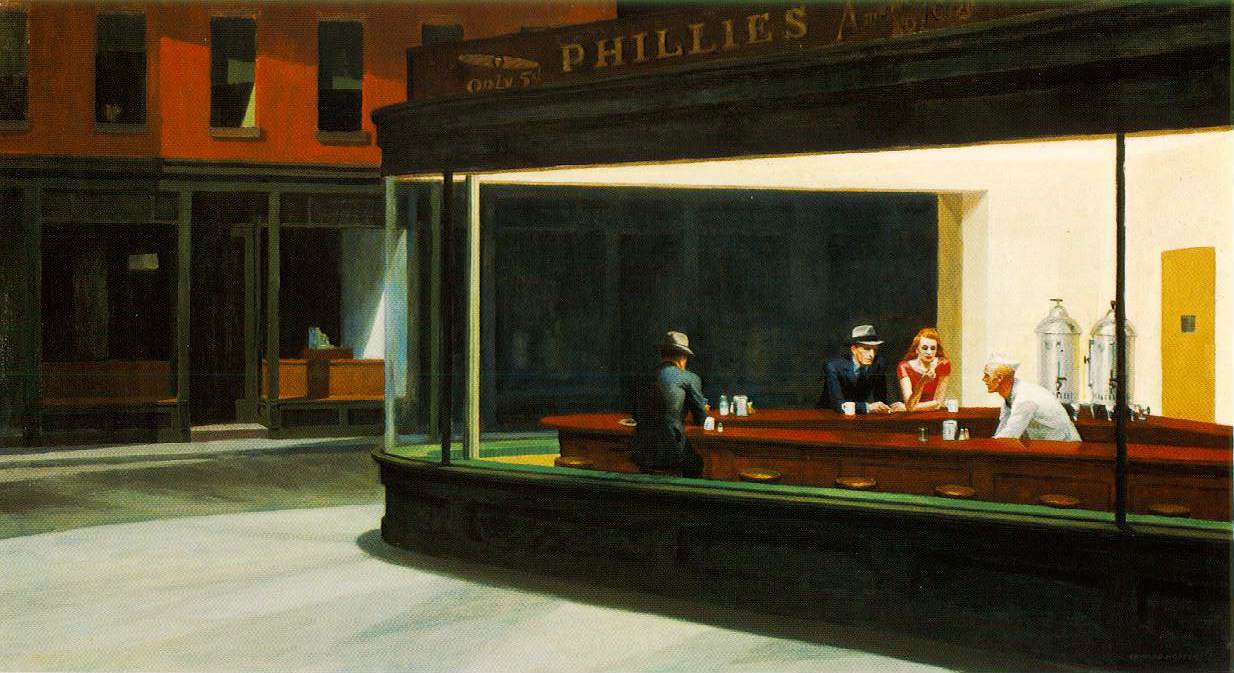
I was struck by the obvious maturation of Hopper's work. In music, we speak of the "mature style" and I sometimes feel this is unfair, as maturity, in both music and life, is a subjective concept. However, in spite of the subjectivity, we can usually agree that self-confidence is a sign of maturation. In Hopper's early work there is a sense that he is following a model, a pattern...he's painting how he is supposed to paint. As one moves into his works of the later twenties, he seems less afraid to admit shape...using watercolors almost as if they were oils, exploiting their capabilities for the opaque. In these paintings, the natural elements (such as background foliage) are given a more watery texture, whereas the solidity of man-made elements is emphasized.
I respect Hopper's eye. He isn't afraid to let tall edifices soar out of frame. While Uncle Jack's snapshots of the Eiffel Tower without its top don't quite cut it, Hopper manages to extend the idea beyond the page. We don't have to see all of the chimney in order to understand the roof.
The exhibit cited Hopper's interest in "vernacular architecture" as opposed to someone like Charles Sheeler, who, while somewhat similar stylistically, amplified the industrial (factories and the like). His paintings of lighthouses are especially exquisite...extraordinary, but not overly-romanticized.

Hopper's most intriguing paintings are those of women and couples (see Room in New York, 1932 pictured above). The sense of isolation is tangible, but not hopeless. In his famous New York Movie (1939), the usherette becomes the focus, not the movie or even those watching. Dimly illuminated by the aisle lights, we are pulled into her pensive daydreaming...the movie in her mind.
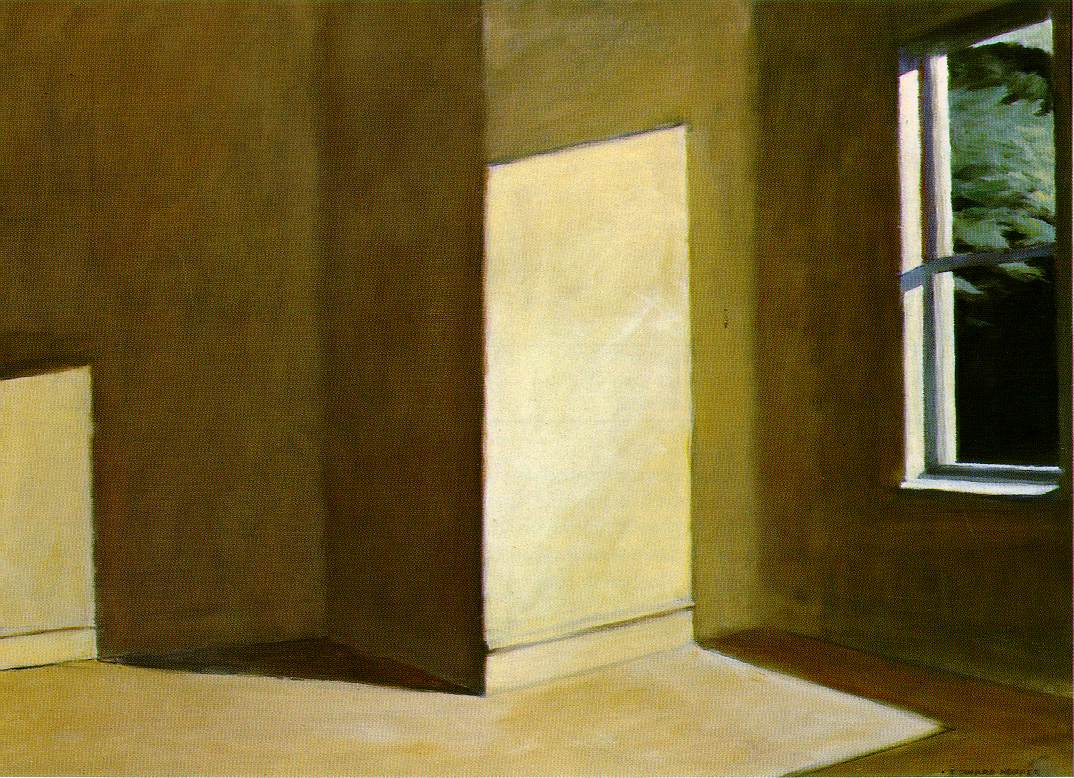
The very last painting in the exhibition chilled me for some reason...all the more ironic given that it is a painting of sunlight. Sun in an Empty Room, painted four years before he died, gave me such pause. Gone are the contemplative nudes and the estranged couples...only two elements remain...the room and light. There is a strong sense of geometry here. The three-dimensionality is subdued in favor of the demarcation of roles: shadow vs. light. The absent figures could occupy either type of space. It makes me want to seek out all of Hopper's figures to note where they stand, sit, or lounge. In the end, when we leave our rooms, the light and shadow remain. We are but visitors, with our hopes, dreams and burdens.
Subscribe to:
Comments (Atom)