Hopefully, the increased attention in the blogosphere will help convince the Atlanta Journal-Constitution to save their arts reviews.
See Jonathan Bellman and Elaine Fine's blogs for more.
Arts criticism (good arts criticism, that is) has always had a symbiotic relationship with the arts themselves. Critics are important for feedback, yes, but they also represent something even more important: critical thinking. This is a mode of mental operation that is becoming outdated in American classrooms. Many children are fed through a system that rewards them for memorizing state capitals rather than creative problem-solving. If our society begins to throw away the best examples of criticism, we condone the spoon-feeding model of education. Indeed, the arts are emblems of individual expression and criticism too, so one might wonder if we are not headed toward disaster here. If an orchestra is no longer worth writing about...why is it worth paying for a ticket? My point isn't to formulate great apocalyptic scenarious, but to offer that this is a very slippery slope.

Monday, May 28, 2007


Friday, May 25, 2007
The Economic Impact of the Arts
In a study released on May 22nd, Americans for the Arts made a case for the economic contribution of the non-profit arts and culture industry. This is important as many of the arguments for maintaining art and music programs in schools have been philosophical, not financial. The concept of "quality of life," while a noble thought, does not seem to resonate with a large segment of the American populace and many members of the government. If it did, global warming would be less of a battle, we'd be focused on the health and well-being of the children who are living as a priority over those unborn, and health care and poverty would be top priorities of any administration.
So, now we must speak in "important" terms.
• 5.7 million full-time equivalent jobs
• $104.2 billion in resident household income
• $7.9 billion in local government tax revenues
• $9.1 billion in state government tax revenues
• $12.6 billion in federal government tax revenues
The study can be found here. While quality of life is important to me, we best start translating our needs into economic terms for those who see the world spinning on a dollar.
Maybe someone should send it to the Atlanta Journal-Constitution which has already killed the staff book reviews and supposedly has plans to kill the staff positions for arts and music reviews. Read Robert Spano's letter at the website for the Atlanta Symphony Orchestra and sign the petition.
So, now we must speak in "important" terms.
• 5.7 million full-time equivalent jobs
• $104.2 billion in resident household income
• $7.9 billion in local government tax revenues
• $9.1 billion in state government tax revenues
• $12.6 billion in federal government tax revenues
The study can be found here. While quality of life is important to me, we best start translating our needs into economic terms for those who see the world spinning on a dollar.
Maybe someone should send it to the Atlanta Journal-Constitution which has already killed the staff book reviews and supposedly has plans to kill the staff positions for arts and music reviews. Read Robert Spano's letter at the website for the Atlanta Symphony Orchestra and sign the petition.
Wednesday, May 23, 2007
Administrative Note
As of today, I am making a distinction between my two blogs. My Live Journal blog will be for more personal, fluffy (and dare I say sometimes even frivolous) posts while this blog will be more substantive, focusing primarily on Music and Mayhem and not so much Miscellanea. For those of you who visit enough to care, you may want to adjust your RSS feeds accordingly.
Oh, and I reserve the right to cross-post whenever it so moves. :-)
Oh, and I reserve the right to cross-post whenever it so moves. :-)
Thursday, May 17, 2007
Hope really DOES spring eternal...
Maybe I'm getting more sentimental to counteract the effects of the weather here on the East Coast, but this particular blog post gave me the best kind of goosebumps. I've been following the trials of the OES after the terrible fire and I tell you, this is a true phoenix, risen from the ashes. I can't wait to hear them.
Wednesday, May 16, 2007
Well, THAT's unpacked!


Four boxes marked: "Unpack quickly! Dissertation!" I'm just grateful I turned in all the library books before I left. Good times ahead. Probably means less blogging for a bit, but who knows?
On the Street Where You Live???
Here in Boston and surrounding areas, there seems to be a city ordinance against street signs. Even our own street is unmarked which has already befuddled the Verizon repairman and the pizza delivery guy. It doesn't help that there is a sign for the street as it continues across the intersection--under a different name! I'm thinking one of my first little projects will be to make a nice little sign to replace the old one and then get a letter off to the Somerville City Council. At least they'll know I'm proactive.
So, as helpful as it is to have a Google Map with all the street names, it doesn't really help you at all once you are in the car. Even major intersections will be missing street signs. This brings me to my great idea:
I think there needs to be a Google Landmark Map...where navigation is done simply by landmarks and is updated frequently. While I know you can find various hotels, grocery stores, donut shops, etc on Google Maps, I'm suggesting that they be the primary indicators (the street names could stay just on the off chance they might be helpful to someone). So, if you needed to get to Whole Foods, lets say, the map would tell you to go around Union Square, pass one Dunkin' Donuts on your right, pass Inman Square and the All-Star Sandwich Shop, etc. I know they sell those touristy maps where all the historical landmarks, big shops, etc are drawn in, but those tend to have accuracy problems. That is why it would be so great to have an online version--especially with the way Dunkin' Donuts sprouts up out here!
So, as helpful as it is to have a Google Map with all the street names, it doesn't really help you at all once you are in the car. Even major intersections will be missing street signs. This brings me to my great idea:
I think there needs to be a Google Landmark Map...where navigation is done simply by landmarks and is updated frequently. While I know you can find various hotels, grocery stores, donut shops, etc on Google Maps, I'm suggesting that they be the primary indicators (the street names could stay just on the off chance they might be helpful to someone). So, if you needed to get to Whole Foods, lets say, the map would tell you to go around Union Square, pass one Dunkin' Donuts on your right, pass Inman Square and the All-Star Sandwich Shop, etc. I know they sell those touristy maps where all the historical landmarks, big shops, etc are drawn in, but those tend to have accuracy problems. That is why it would be so great to have an online version--especially with the way Dunkin' Donuts sprouts up out here!
Tuesday, May 15, 2007
Bigger is not always better...
WARNING: Fluff post!
While I'm certainly not going to complain about having a bigger kitchen (and truth be told, I'll take it over our old one any day), I have to mention the design of this kitchen makes me think the cabinetry and drawers were a mere afterthought.
We have three drawers (four, if you count the one you can't open unless you open the oven first). Each of these drawers is fairly large (meaning: no real silverware drawer). Presently we have them categorized 1) big pots and stuff 2) baking ware, small mixing bowls, and my favorite, 3)scary utensils drawer. And the latter is scary in that there are knives facing every which way mixed in with our everyday silverware and salad tongs and carrot peelers and bag clips and...you get the picture. Some of the problem will be alleviated once we are able to hang our silverware again.
As for the cabinetry? Well, I can reach them (an improvement), but they are very deep, rendering the back of the cabinet somewhat useless. We also have two corner cabinets which will only be useful with multi-tiered turntables. In the rare instance we were able to find a tiered turntable, the diameter was way too small. We currently have two entirely too small turntables sitting in there with a bunch of stuff crammed around them. If you are going to build a corner cabinet...build a turntable that goes with it!
That, is the end of my kitchen rant for the day. Truly, I am excited about the dishwasher and the increased counter space. I just think it is funny that I actually miss something about my old kitchen (I never thought that would happen!)
I blog this to spare anyone from having to actually listen to me talk about kitchen cabinets.
(Cross-posted at LJ...those lucky folks)
While I'm certainly not going to complain about having a bigger kitchen (and truth be told, I'll take it over our old one any day), I have to mention the design of this kitchen makes me think the cabinetry and drawers were a mere afterthought.
We have three drawers (four, if you count the one you can't open unless you open the oven first). Each of these drawers is fairly large (meaning: no real silverware drawer). Presently we have them categorized 1) big pots and stuff 2) baking ware, small mixing bowls, and my favorite, 3)scary utensils drawer. And the latter is scary in that there are knives facing every which way mixed in with our everyday silverware and salad tongs and carrot peelers and bag clips and...you get the picture. Some of the problem will be alleviated once we are able to hang our silverware again.
As for the cabinetry? Well, I can reach them (an improvement), but they are very deep, rendering the back of the cabinet somewhat useless. We also have two corner cabinets which will only be useful with multi-tiered turntables. In the rare instance we were able to find a tiered turntable, the diameter was way too small. We currently have two entirely too small turntables sitting in there with a bunch of stuff crammed around them. If you are going to build a corner cabinet...build a turntable that goes with it!
That, is the end of my kitchen rant for the day. Truly, I am excited about the dishwasher and the increased counter space. I just think it is funny that I actually miss something about my old kitchen (I never thought that would happen!)
I blog this to spare anyone from having to actually listen to me talk about kitchen cabinets.
(Cross-posted at LJ...those lucky folks)
Sunday, May 13, 2007
New Meaning for the Boston "Pops"
As I'm sure everyone knows by now, this past Wednesday's Boston Pops concert featured a brawl between a talker and a shusher in the second balcony. While most news features have capitalized on the incongruity between a brawl and a symphony concert, Jeremy Eichler's thoughtful review in the Globe asks some more important questions.
The audience that night was a mixed bag of Pops subscribers, benefit concert-goers, and Ben Folds fans--not the normal Symphony Hall makeup. In Eichler's opinion, the Pops could have better seized upon the opportunity with their programming of the first half. Instead of the ubiquitous Dvorak "Carnival" Overture, Eichler suggests:
"...a short, gnarly, and exhilarating work of 20th-century music, offering a quick glimpse of, say, the ecstatic washes of color in Messiaen, or the quivering extraterrestrial sound worlds of a Ligeti score?"
As an advocate of contemporary music, I give Eichler's suggestion a resounding "right on!" As a practical observer of concert audiences, however, I'm forced to note that the inclusion of such a piece would probably kill the "pops" ethos. But maybe therein lies the problem.
We tend to categorize and pigeonhole repertoire to such an extent there is little to no flexibility, even when the audience might afford the opportunity. We have "Early Music" concerts, "New Music" concerts, "Pops" concerts (that's where all the film music goes, folks!), and "Classics" concerts. In a recent article in the New Yorker, Alex Ross discusses how Esa-Pekka Salonen has tried valiantly to usher in contemporary music as part of the LA Phil's standard repertoire (with varying levels of success). Maybe the element of surprise should be more standard for concerts nowadays. Sure, reel the regulars in with a big seller, but have a couple of "TBAs" on the program. Vary it: a newly commissioned work (short), a film music suite, an oldie-but-a-goodie. I wonder what would happen if you had audiences coming to see one or two works, and being stretched just a little tiny bit.
It is truly hard to stand outside myself and speculate as to my reaction as a non-music specializing concertgoer. But I think that I'd be quite okay with hearing one or two of the Ligeti piano etudes, even if I came to hear the 1812 Overture or a medley of the best of John Williams. Idealistic? Maybe. Optimistic? Assuredly.
(Cross-posted at LiveJournal)
The audience that night was a mixed bag of Pops subscribers, benefit concert-goers, and Ben Folds fans--not the normal Symphony Hall makeup. In Eichler's opinion, the Pops could have better seized upon the opportunity with their programming of the first half. Instead of the ubiquitous Dvorak "Carnival" Overture, Eichler suggests:
"...a short, gnarly, and exhilarating work of 20th-century music, offering a quick glimpse of, say, the ecstatic washes of color in Messiaen, or the quivering extraterrestrial sound worlds of a Ligeti score?"
As an advocate of contemporary music, I give Eichler's suggestion a resounding "right on!" As a practical observer of concert audiences, however, I'm forced to note that the inclusion of such a piece would probably kill the "pops" ethos. But maybe therein lies the problem.
We tend to categorize and pigeonhole repertoire to such an extent there is little to no flexibility, even when the audience might afford the opportunity. We have "Early Music" concerts, "New Music" concerts, "Pops" concerts (that's where all the film music goes, folks!), and "Classics" concerts. In a recent article in the New Yorker, Alex Ross discusses how Esa-Pekka Salonen has tried valiantly to usher in contemporary music as part of the LA Phil's standard repertoire (with varying levels of success). Maybe the element of surprise should be more standard for concerts nowadays. Sure, reel the regulars in with a big seller, but have a couple of "TBAs" on the program. Vary it: a newly commissioned work (short), a film music suite, an oldie-but-a-goodie. I wonder what would happen if you had audiences coming to see one or two works, and being stretched just a little tiny bit.
It is truly hard to stand outside myself and speculate as to my reaction as a non-music specializing concertgoer. But I think that I'd be quite okay with hearing one or two of the Ligeti piano etudes, even if I came to hear the 1812 Overture or a medley of the best of John Williams. Idealistic? Maybe. Optimistic? Assuredly.
(Cross-posted at LiveJournal)
Saturday, May 12, 2007
We're here!
Well, our lack of DSL means no pictures for another couple of days, but I thought I'd post a little bit of our Boston experiences thus far.
Our phone jack was not working when we arrived, and this of course spelled disaster for me--not for the phone, but for the computer (of course). So we called Verizon (and I mean "we" as it took several calls) and the repairman came out to look at it (we already tested the connection in the Network Internface Device (NID) on the side of the house).
No, I don't plan to detail the excitement of having a phone jack tested, but I did have an interesting exchange with Mr. Verizon Man. After asking about where we had moved from, I replied "California." Response: "Hmm. Whereabouts in California?" I told him Santa Barbara. "Is that near San Diego, like Southern California?" I told him we are considered "Central Coast" (as if that would save me from some sort of disparaging comment).
What was tremendously funny and tender to me was that he looked me straight in the eye and said, with all sincerity ,"It's a whole different ballpark with the people out here, eh? Don't make it nothing personal. They're just like that." I'm not sure where he was from, but I thought I detected a southern inflection to his speech. But I think he was genuinely concerned that my happy-go-lucky California self might be offended by all the cranky Bostonians.
So that brings me to stereotypes. Clearly this man had an idea that all Californians act like Shirley Temple on the Good Ship Lollypop while all Bostonians make Severus Snape look downright ecstatic. While we have run into a few Snapes, most of the Bostonians we've met have been, while not cheery, friendly enough and "no b.s." I think places with harsh weather conditions give birth to a practicality about life that we don't see so often in "Paradise." There is a economy of energy for social niceties. That said, we've run into plenty of folks willing to spare a "hello" as we pass through the neighborhood.
So, so far so good. We successfully visited our Trader Joe's, local supermarket and local KMart, so life can go on.
Our phone jack was not working when we arrived, and this of course spelled disaster for me--not for the phone, but for the computer (of course). So we called Verizon (and I mean "we" as it took several calls) and the repairman came out to look at it (we already tested the connection in the Network Internface Device (NID) on the side of the house).
No, I don't plan to detail the excitement of having a phone jack tested, but I did have an interesting exchange with Mr. Verizon Man. After asking about where we had moved from, I replied "California." Response: "Hmm. Whereabouts in California?" I told him Santa Barbara. "Is that near San Diego, like Southern California?" I told him we are considered "Central Coast" (as if that would save me from some sort of disparaging comment).
What was tremendously funny and tender to me was that he looked me straight in the eye and said, with all sincerity ,"It's a whole different ballpark with the people out here, eh? Don't make it nothing personal. They're just like that." I'm not sure where he was from, but I thought I detected a southern inflection to his speech. But I think he was genuinely concerned that my happy-go-lucky California self might be offended by all the cranky Bostonians.
So that brings me to stereotypes. Clearly this man had an idea that all Californians act like Shirley Temple on the Good Ship Lollypop while all Bostonians make Severus Snape look downright ecstatic. While we have run into a few Snapes, most of the Bostonians we've met have been, while not cheery, friendly enough and "no b.s." I think places with harsh weather conditions give birth to a practicality about life that we don't see so often in "Paradise." There is a economy of energy for social niceties. That said, we've run into plenty of folks willing to spare a "hello" as we pass through the neighborhood.
So, so far so good. We successfully visited our Trader Joe's, local supermarket and local KMart, so life can go on.
Friday, May 11, 2007
Picture Post


So, I know I didn't blog about the rest of our trip, so I thought I'd quickly summarize with this picture post. Yes, those blurry spots you see are dead insects on the windshield, of course.
Friday, May 04, 2007
Denver 5-2 to 5-4
Ok, well technically, Thornton, but close enough. Our drive to Colorado was absolutely spectacular. While I'm sure the residents of the area take those Rocky Mts. for granted, I couldn't snap enough photos of their majesty.
The drive from Utah gave me the opportunity to practice my mountain driving at a 6% grade...not something I had the chance to do in Santa Barbara. I'm actually ok with not doing it very often.

I almost wish we had stopped at this particular rest stop...very tempting:

Thanks for the gracious hospitality of my college roomate and her husband, we stayed in a lovely house with lovely people in Thornton, CO. Happy to have a break from driving, we spent a good portion of the day in Boulder at the Pearl Street Mall. I could not stop photographing the tulips. Spring had most definitely sprung!


We had such a nice visit with K and G and their cutie-pie of a son! (Shout-out to Bixby! ;-))
Now, we are in our second time zone change. The drive to Kansas City, MO was, well...mind-numbingly boring. Even throwing in some more cows would have helped...but the topography was...non-existent. I wasn't expecting much, so I guess I wasn't that disappointed. I was hoping to be pleasantly surprised as I was with my first visit to Kansas City, MO. We are staying in the same hotel I stayed in for last year's visit to the Creston archive. It's a quick stay because we are out of here tomorrow and on our way to someplace near Chicago! After tomorrow, most of our drives will be 8 hours or less I believe. This makes me happy.

Rocky Mountain High
The drive from Utah gave me the opportunity to practice my mountain driving at a 6% grade...not something I had the chance to do in Santa Barbara. I'm actually ok with not doing it very often.

I almost wish we had stopped at this particular rest stop...very tempting:

Thanks for the gracious hospitality of my college roomate and her husband, we stayed in a lovely house with lovely people in Thornton, CO. Happy to have a break from driving, we spent a good portion of the day in Boulder at the Pearl Street Mall. I could not stop photographing the tulips. Spring had most definitely sprung!


We had such a nice visit with K and G and their cutie-pie of a son! (Shout-out to Bixby! ;-))
Now, we are in our second time zone change. The drive to Kansas City, MO was, well...mind-numbingly boring. Even throwing in some more cows would have helped...but the topography was...non-existent. I wasn't expecting much, so I guess I wasn't that disappointed. I was hoping to be pleasantly surprised as I was with my first visit to Kansas City, MO. We are staying in the same hotel I stayed in for last year's visit to the Creston archive. It's a quick stay because we are out of here tomorrow and on our way to someplace near Chicago! After tomorrow, most of our drives will be 8 hours or less I believe. This makes me happy.
Thursday, May 03, 2007
Zion National Park 5-1-07
Although it might seem glib to say that Zion National Park is the Grand Canyon turned upside down, those of you who know what the Grand Canyon means to me, will understand that this is not just a comment about the topography.
While we saw amazing rock facings at the GC last summer, they pale in comparison to Zion. My pictures won't do it justice, but I've selected a few. Like at the GC, I felt dwarfed, but this time, the huge walls of Navajo sandstone were almost comforting...as if we were simply nestled in the canyon.
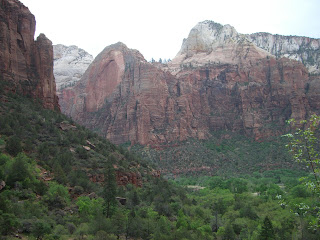
But the neatest element of our Zion experience was the contrast of water with the semi-arid climate. Life was so very abundant. Even the rocks seem to be alive. It makes perfect sense why native American mythology is filled with stories about living mountains.
Springdale, which lies just at the foot of the park, runs a shuttle up to the park which is amazingly convenient and so much better than the situation prior to 2000, when cars and trucks could drive all the way up. Being a weekday, the park was very quiet and for the first couple of hours we saw very few people. We got up to the park about 8:30 and decided to tackle the Emerald Pools (a far more elegant name than the Algae Pools, which would be more accurate). The "hike" was rather moderate and even paved in some areas. The lowest of the three pools was the most beautiful, and the largest. The springline from the mountains create temporary waterfalls which sprinkle down and create these gorgeous and calming pools. On our way back down, we began to see more people which made us grateful that we had hit this most popular trail very early on.

After a brief snack and a visit to a gift shop, we went on the "Riverwalk." It was fairly clear that we were tuckered out from the last few weeks and it was starting to catch up with us. The "River Walk" is a very easy pleasant walk along the Virgin River toward the place where the canyon narrows. One of the highlights was having this guy close enough to touch:

We watched a fairly cheesy but informative 22 minute film on Zion NP and then took the shuttle back to the hotel. There is so much more we'd like to do, but it is going to have to wait for another trip. I'm assuming I'll find my energy again sometime in September.
I seem to have this knack for visiting national parks immediately after a significant loss. And I always find the experience incredibly healing. I know this must mean something. Hopefully I'm not missing my true calling as a park ranger...
While we saw amazing rock facings at the GC last summer, they pale in comparison to Zion. My pictures won't do it justice, but I've selected a few. Like at the GC, I felt dwarfed, but this time, the huge walls of Navajo sandstone were almost comforting...as if we were simply nestled in the canyon.

But the neatest element of our Zion experience was the contrast of water with the semi-arid climate. Life was so very abundant. Even the rocks seem to be alive. It makes perfect sense why native American mythology is filled with stories about living mountains.
Springdale, which lies just at the foot of the park, runs a shuttle up to the park which is amazingly convenient and so much better than the situation prior to 2000, when cars and trucks could drive all the way up. Being a weekday, the park was very quiet and for the first couple of hours we saw very few people. We got up to the park about 8:30 and decided to tackle the Emerald Pools (a far more elegant name than the Algae Pools, which would be more accurate). The "hike" was rather moderate and even paved in some areas. The lowest of the three pools was the most beautiful, and the largest. The springline from the mountains create temporary waterfalls which sprinkle down and create these gorgeous and calming pools. On our way back down, we began to see more people which made us grateful that we had hit this most popular trail very early on.

After a brief snack and a visit to a gift shop, we went on the "Riverwalk." It was fairly clear that we were tuckered out from the last few weeks and it was starting to catch up with us. The "River Walk" is a very easy pleasant walk along the Virgin River toward the place where the canyon narrows. One of the highlights was having this guy close enough to touch:

We watched a fairly cheesy but informative 22 minute film on Zion NP and then took the shuttle back to the hotel. There is so much more we'd like to do, but it is going to have to wait for another trip. I'm assuming I'll find my energy again sometime in September.
I seem to have this knack for visiting national parks immediately after a significant loss. And I always find the experience incredibly healing. I know this must mean something. Hopefully I'm not missing my true calling as a park ranger...
Tuesday, May 01, 2007
Vegas, baby.
Four states in one day...not too shabby! Ok, so we basically cut the northeast corner of Arizona, but I'm going to let that count.
We hit the most important spot on the way to Vegas: The Mad Greek in Baker, California. I'm fairly sure there isn't a whole lot more in Baker, CA than the alleged "best gyro in the U.S.A." While the schlock factor was pretty high, we figured it was preparatory kitsch for Las Vegas. I have to say, the fresh strawberry shake was perfect since it was hotter than hell....I mean, Hades.
After our fill of Dionysian pleasures, we headed to Vegas. Our "trip to Vegas" probably registers a high "10" on the great scale of "lameness" but I don't care. After driving down the strip, we finally decided to park at the Luxor (covered parking lot) and check it out. We spent a total of $2 on the slot machines and came out with $2 less. I had a San Pellegrino and H had an iced tea. While I'm sure Vegas is much more exciting at night (and I'd actually like to go back with a few girlfriends), it really didn't do too much for me. I intellectually understand how gambling could be an addiction, but it really doesn't appeal to me. Of course daytime weekdays at casinos usually host the "regulars" who sit in front of the slot machines, their eyes glazed over...where they go, I don't know. All that said, it was pretty amazing to be in a place where people wander around spending money, losing money, making money and all with open beer bottles in their hands. I do regret not going in the evening so I could have seen things like the Bellagio fountains, so recommended by Barnet Bound. But Mandalay Bay and the Luxor were good enough samplings.
We rolled into Springdale, UT at around 8:30pm. We had an awesome dinner at the Spotted Dog Cafe (which was actually a rather elegant restaurant). Of course, with my sunflower seed-encrusted local trout, I felt obliged to try the local brew. And since this is Utah, that would be:

(Actually that's just what was on the glass...I had a local medium ale).
Tomorrow, Zion National Park!
We hit the most important spot on the way to Vegas: The Mad Greek in Baker, California. I'm fairly sure there isn't a whole lot more in Baker, CA than the alleged "best gyro in the U.S.A." While the schlock factor was pretty high, we figured it was preparatory kitsch for Las Vegas. I have to say, the fresh strawberry shake was perfect since it was hotter than hell....I mean, Hades.

After our fill of Dionysian pleasures, we headed to Vegas. Our "trip to Vegas" probably registers a high "10" on the great scale of "lameness" but I don't care. After driving down the strip, we finally decided to park at the Luxor (covered parking lot) and check it out. We spent a total of $2 on the slot machines and came out with $2 less. I had a San Pellegrino and H had an iced tea. While I'm sure Vegas is much more exciting at night (and I'd actually like to go back with a few girlfriends), it really didn't do too much for me. I intellectually understand how gambling could be an addiction, but it really doesn't appeal to me. Of course daytime weekdays at casinos usually host the "regulars" who sit in front of the slot machines, their eyes glazed over...where they go, I don't know. All that said, it was pretty amazing to be in a place where people wander around spending money, losing money, making money and all with open beer bottles in their hands. I do regret not going in the evening so I could have seen things like the Bellagio fountains, so recommended by Barnet Bound. But Mandalay Bay and the Luxor were good enough samplings.
We rolled into Springdale, UT at around 8:30pm. We had an awesome dinner at the Spotted Dog Cafe (which was actually a rather elegant restaurant). Of course, with my sunflower seed-encrusted local trout, I felt obliged to try the local brew. And since this is Utah, that would be:

(Actually that's just what was on the glass...I had a local medium ale).
Tomorrow, Zion National Park!
Sunday, April 29, 2007
Los Angeles 4/27 to 4/30

Stop One: Los Angeles
Home. Strange concept. Born and raised in LA, yet I feel very little attachment to it. In four years, Claremont felt more like "home" than Los Angeles ever did (and yes, I know lots of people who consider Claremont part of Los Angeles). But here I am referring to the city. Disregard these comments when we talk about my mother's house...that is "home" or at least what "home" means in this transitional stage of my life.
Home is where I can do laundry for free. Home is where I get fed and can sleep for free. Home is where I get hugs from my mother. Home is where my stepdad makes me a martini at the end of a very long day.
I have yet to start my "vacation." Today I pulled together a brand new cover letter (third job opportunity at the same institution demands originality). My mother just happened to have some beautiful linen ivory stock on hand so that was absolutely fortuitous. Our printer ran out of black ink (yes, we brought our printer with us!) so again, mom came to the rescue and I used hers. I updated my c.v. and will send it out to the dossier service tomorrow. These are all tasks I had not anticipated worrying about on my trip. But, opportunity, I realize, is RARELY convenient.
Part of me feels that we should have spent the weekend doing "LA" things. As it was, we did hit the first Trader Joe's that ever was (in Pasadena). I suppose that counts. But most of the weekend was spent revising the rest of our trip, pulling my job application together, shipping a box of stuff off to Somerville, and figuring out how to repack the car.
On the other hand, I did read an entire mystery novel from cover to cover--something I haven't done in a VERY long time. Well worth it. It was Peter Tremayne's Act of Mercy (1999). My mother and I both enjoy his Sister Fidelma series...what could be cooler than a 7th-c mystery-solving Irish nun?
Saturday, April 28, 2007
And we're off...

Well, it did happen. The VERY LARGE semi did come and did pick up all our stuff. We packed the car up and headed down to Los Angeles.
But, not without complications (of course!)
Turns out Allied (corporate) vetoed our request for a preferred delivery date of May 12th (AFTER we had signed our agreement for the date of 5/12). Corporate didn't tell our sales rep and our sales rep didn't follow up with corporate. SO, our driver shows up with his semi and says "Alright, so we're dropping off in Boston on the 9th." Say WHAT????
So, guess who gets to cut their vacation short?
Evidently, "corporate" also didn't communicate that our apartment was on the second floor--so the stairs were a bit of a surprise to our driver and his brother (the only two movers).
But, after a very very very long day, we saw our stuff go off on the truck and oddly enough, I felt relieved. You might think watching all your worldly possessions disappear with a man you've only known for less than 24 hours might be unsettling, but at that point, I basically just wanted it to "go away." The scary part was all that was left in our apartment.
We didn't leave SB the next day until 7pm (which was ok because we missed Friday night rush hour). By some miracle (basically called Deetie and Hubby) we fit just about everything into Guinevere (our Volvo). We gave away everything we could and threw away a few items we might not have otherwise, and we were off.
We barely would have made our truck deadline if it weren't for JDT and DM who spent a good portion of the weekend AND the night before helping pack up all our stuff (which I still contend was procreating when we weren't looking).
Yesterday was hard. Goodbyes are terrible. I'm sure it will REALLY hit me once we leave California. But when we arrived in LA yesterday, my stepdad made us martinis as we unloaded the car and I could tell that I was already feeling seriously blah.
My time in SB defines the quintessential "love-hate relationship." I've got a lot to sort out in the coming weeks.

Sunday, April 22, 2007
When packing gets boring


This is what I start doing to the boxes when packing just gets too humdrum. I'm SURE the movers will appreciate my efforts.
Actually, now that I think about it "Books & Bottles" is the perfect alliterative title for my dream enterprise: A Bookstore Bar!
Saturday, April 21, 2007
Microsoft does Mona
I find this frightening and astonishing at the same time. I also note the appropriation of "Kyrie eleison" in the soundtrack for future reference. (Eventually I will stop viewing the world through the lens of my dissertation...right?)
Friday, April 20, 2007
Goodbyes
In a month filled with goodbyes, I've just had two really hard ones in the last week. The permanency of those is hard to reconcile.
But life is full of goodbyes--constantly. Sometimes we say goodbye to ourselves, shed the old us for a new version. That brings me to yesterday's horoscope:
You appear to have all the requisite tools to remodel those aspects of your life that, according to you, need it most. What more is there to say but go for it?
Well, I'm going for it, that's for sure. But I'm taking some luggage with me (luggage--not baggage). Mementos are important...even the non-tangible ones.
It well may be
That we will never meet again
But in this lifetime
Let me say before we part
So much of me
Is made of what I've learned from you
You'll be with me,
Like a handprint on my heart
(from Wicked)
But life is full of goodbyes--constantly. Sometimes we say goodbye to ourselves, shed the old us for a new version. That brings me to yesterday's horoscope:
You appear to have all the requisite tools to remodel those aspects of your life that, according to you, need it most. What more is there to say but go for it?
Well, I'm going for it, that's for sure. But I'm taking some luggage with me (luggage--not baggage). Mementos are important...even the non-tangible ones.
It well may be
That we will never meet again
But in this lifetime
Let me say before we part
So much of me
Is made of what I've learned from you
You'll be with me,
Like a handprint on my heart
(from Wicked)
Wednesday, April 18, 2007
If you weren't feeling ill enough already...
...let these guys help.
From The Progress Report
From The Progress Report
"Where was the spirit of self-defense here?" mused John Derbyshire on the National Review's blog yesterday. "Why didn't anyone rush the guy? It's not like this was Rambo, hosing the place down with automatic weapons. He had two handguns for goodness' sake -- one of them reportedly a .22." Nathanael Blake, writing on Human Events's The Right Angle, agreed. "Something is clearly wrong with the men in our culture," wrote Blake. "Among the first rules of manliness are fighting bad guys and protecting others: in a word, courage. And not a one of the healthy young fellows in the classrooms seems to have done that." Though both pundits admit that they don't know if they "would live up to" their own notions of bravery, Blake says he would be "ashamed" of himself if he did not, suggesting that the innocent victims at Virginia Tech should feel embarrassed for "ducking, running and holding doors shut" to avoid the bullets of a killer. As MSNBC's Keith Olbermann said when he awarded them his "Worst Person in the World" award last night, "[I]t is John Derbyshire and Nathanael Blake who should be ashamed today."
Warning Signs
It's easy to understand how everyone has their own blame theories regarding the Virginia Tech shooting. It has to be someone's fault. Cho Seung-hui is dead, so there has to be some place palpable to put all that anger.
Some have taken the opportunity for political grandstanding, but I do think the many cries for gun control come from a sincere desire to DO something in the face of feeling helpless.
But gun control is not the only issue here. What is more pressing, in my opinion, is monitoring these students who are on the brink of explosion before they self-destruct, taking down others in the process. Ian MacFarlane, a former classmate of Cho's, has posted two of Cho's plays on his blog. I read the first and thought, "How on earth was he allowed to remain on campus?" It isn't because the plays were violent and graphic...we'd have to institutionalize most of Hollywood's greatest directors if that were the criteria. What is so scary about the play I read is that it is so clearly a diary entry. I don't know if Cho had a stepfather who molested him, but I can tell, clear as day, that this was an angry young man who was ready to burst at the seams. The play itself has little structure and is essentially a rant...a stream-of-consciousness display of rage.
Evidently the police referred Cho to counseling back in 2005. According to MacFarlane, he wrote these plays last fall, which would be 2006 by my understanding. MacFarlane notes:
Ah. What recourse do students have to "alert" authorities about their peer? What of the possible backlash? What happens if every quiet, morose, soul instantly becomes suspect? These are no easy answers. But I do believe that schools and colleges need to invest much, much more in their understanding of mental health issues.
I was fortunate enough to go to a small college where the students knew all the administrators and they knew most of the students. There was a young woman who had suffered a great loss and her reaction to this loss brought to light some very disturbing issues. Although I did not feel she was a danger to anyone else, I did think she was a danger to herself. Immediately after I became aware of her behavior, I ran to my voice lesson and called the Dean of Students. There was IMMEDIATE intervention. Her parents arrived within two days and she left campus. She did return a couple of years later I believe and finished her degree--healthier and stronger. She wrote an e-mail to some of us shortly after she had left, thanking us.
I'm not equating her set of problems with Cho's. What I am saying is that a student who is not fit to take a class with his peers has no business being in school, period. This situation should have been handled long before he even bought those guns.
Some have taken the opportunity for political grandstanding, but I do think the many cries for gun control come from a sincere desire to DO something in the face of feeling helpless.
But gun control is not the only issue here. What is more pressing, in my opinion, is monitoring these students who are on the brink of explosion before they self-destruct, taking down others in the process. Ian MacFarlane, a former classmate of Cho's, has posted two of Cho's plays on his blog. I read the first and thought, "How on earth was he allowed to remain on campus?" It isn't because the plays were violent and graphic...we'd have to institutionalize most of Hollywood's greatest directors if that were the criteria. What is so scary about the play I read is that it is so clearly a diary entry. I don't know if Cho had a stepfather who molested him, but I can tell, clear as day, that this was an angry young man who was ready to burst at the seams. The play itself has little structure and is essentially a rant...a stream-of-consciousness display of rage.
Evidently the police referred Cho to counseling back in 2005. According to MacFarlane, he wrote these plays last fall, which would be 2006 by my understanding. MacFarlane notes:
As far as notifying authorities, there isn't (to my knowledge) any system set up that lets people say "Hey! This guy has some issues! Maybe you should look into this guy!" If there were, I definitely would have tried to get the kid some help. I think that could have had a good chance of averting yesterday's tragedy more than anything.
Ah. What recourse do students have to "alert" authorities about their peer? What of the possible backlash? What happens if every quiet, morose, soul instantly becomes suspect? These are no easy answers. But I do believe that schools and colleges need to invest much, much more in their understanding of mental health issues.
I was fortunate enough to go to a small college where the students knew all the administrators and they knew most of the students. There was a young woman who had suffered a great loss and her reaction to this loss brought to light some very disturbing issues. Although I did not feel she was a danger to anyone else, I did think she was a danger to herself. Immediately after I became aware of her behavior, I ran to my voice lesson and called the Dean of Students. There was IMMEDIATE intervention. Her parents arrived within two days and she left campus. She did return a couple of years later I believe and finished her degree--healthier and stronger. She wrote an e-mail to some of us shortly after she had left, thanking us.
I'm not equating her set of problems with Cho's. What I am saying is that a student who is not fit to take a class with his peers has no business being in school, period. This situation should have been handled long before he even bought those guns.
Tuesday, April 17, 2007
50 Book Challenge: #5 and #6
50 BOOK CHALLENGE #5
Review: Bach Among the Theologians by Jaroslav Pelikan. (Eugene, OR: Wipf & Stock Publishers, 1986).
Pelikan's work is an unsentimental look at the influence of Pietism and evangelical thought on a composer who has been too often oversimplified as "staunchly Lutheran." He questions the assumptions we make based on a standardized "psychobiography."
Not surprisingly, there is not an in-depth engagement with the music (he relies heavily on Spitta, Schweitzer, etc.), but Pelikan does offer some excellent textual analyses. He promotes a re-reading of Bach's career, demonstrating that a lack of sacred output in Cöthen did not necessarily define a "low point" for the composer.
While the book as a whole seems to lack cohesion in some places, it does function very well as a set of separate essays. Particularly cogent are the chapters on ""Mediation on Human Redemption" in the St. Matthew Passion" and "Pietism, Piety and Devotion in Bach's Cantatas." The book is an important contribution to interdisciplinary dialogue about the figureheads of classical music and should be embraced in that spirit.
50 BOOK CHALLENGE #6
Review: 40 Days & 40 Bytes: Making Computers Work for your Congregation by Aaron Spiegel, Nancy Armstrong and Brent Bill. (Herndon, VA: Alban Institute, 2004)
40 Days & 40 Bytes is an excellent resource for congregations who may be in the beginning stages of electronic fortification or who may be looking to streamline their electronic efficiency. While not focused heavily on websites and e-evangelism, the book offers a thorough review of all considerations when buying CMS (congregational management software), computers, and setting up a network. It offers several helpful appendices that serve as checklists, including: "Congregational Culture Questions" and a "Technology Assessment Form."
The book is set up in such a way that you can skip irrelevant sections (some chapters are devoted to the general basics, like defining a CPU, for example). Infused with good humor and an ecumenical spirit, 40 Days & 40 Bytes is one of the best resources I have seen for the non-techie layperson interested in helping move their congregation into the 21st century.
Review: Bach Among the Theologians by Jaroslav Pelikan. (Eugene, OR: Wipf & Stock Publishers, 1986).
Pelikan's work is an unsentimental look at the influence of Pietism and evangelical thought on a composer who has been too often oversimplified as "staunchly Lutheran." He questions the assumptions we make based on a standardized "psychobiography."
Not surprisingly, there is not an in-depth engagement with the music (he relies heavily on Spitta, Schweitzer, etc.), but Pelikan does offer some excellent textual analyses. He promotes a re-reading of Bach's career, demonstrating that a lack of sacred output in Cöthen did not necessarily define a "low point" for the composer.
While the book as a whole seems to lack cohesion in some places, it does function very well as a set of separate essays. Particularly cogent are the chapters on ""Mediation on Human Redemption" in the St. Matthew Passion" and "Pietism, Piety and Devotion in Bach's Cantatas." The book is an important contribution to interdisciplinary dialogue about the figureheads of classical music and should be embraced in that spirit.
50 BOOK CHALLENGE #6
Review: 40 Days & 40 Bytes: Making Computers Work for your Congregation by Aaron Spiegel, Nancy Armstrong and Brent Bill. (Herndon, VA: Alban Institute, 2004)
40 Days & 40 Bytes is an excellent resource for congregations who may be in the beginning stages of electronic fortification or who may be looking to streamline their electronic efficiency. While not focused heavily on websites and e-evangelism, the book offers a thorough review of all considerations when buying CMS (congregational management software), computers, and setting up a network. It offers several helpful appendices that serve as checklists, including: "Congregational Culture Questions" and a "Technology Assessment Form."
The book is set up in such a way that you can skip irrelevant sections (some chapters are devoted to the general basics, like defining a CPU, for example). Infused with good humor and an ecumenical spirit, 40 Days & 40 Bytes is one of the best resources I have seen for the non-techie layperson interested in helping move their congregation into the 21st century.
| |
6 / 50 (12.0%) |


Friday, April 13, 2007
Another lost voice
When the last living thing
has died on account of us,
how poetical it would be
if Earth could say,
in a voice floating up
perhaps
from the floor
of the Grand Canyon,
“It is done.”
People did not like it here.
from Requiem by Kurt Vonnegut (1922-2007) Resquiat in pace
Monday, April 09, 2007
Holey Scholarship
In a thought-provoking discussion with DK on Thursday, we talked about the idea that in academia, nothing you ever publish will be all that you want it to be. In some sense, all articles, conference papers, etc., have that feeling of the night-before-it's-due seminar paper. You could have always done more and there will always be an imperfect paragraph or an underdeveloped idea.
Initially, I was disheartened by this thought. I used to be a perfectionist and this goes against that tendency. But, giving it some thought, maybe that's what perpetuates our field! Just like God would cease to be if people of faith had all the answers, maybe the "holes" in our work are absolutely necessary to sustain scholarship.
That said, I am NOT advocating lazy scholarship There are divots, and then there are deep, gaping chasms. I guess we have to set our own guidelines, in some respects. Maybe that's where we should start...ask ourselves "What is important?" What is important might change in different contexts, sure. But there should be some sort of baseline intellectual integrity that we establish for ourselves...some minimum level of "I've done my work" even if the work isn't polished or finessed.
I think most of us do that naturally and I'd venture that we've all had those moments where we knowingly sacrificed that integrity (and probably got the response we deserved). The hard part is establishing that integrity as some sort of uniform mandate. We know that there are the "scholars" who basically amount to yellow journalists. If they have holes in their research, they either plagiarize or simply manufacture the facts. Sometimes this is because they are lazy or opportunists. But I wonder how much of this has been stimulated by an ever-increasing need fill in every last hole in order to establish any kind of real credibility.
I once heard a paper based entirely on someone else's gap in another paper. It was not a large gap, just a reasonable question mark that, once answered, would have perpetuated exploration into different and exciting offshoots. But instead, this paper chose to belabor the point to the extent that the whole reason for the topic ceased to exist. It was obvious, at least to me, that this person had absolutely nothing new to contribute, but only wanted to jump up and down and alert everyone to the emperor's nakedness. Even that fails to be all that useful at some point.
So, to summarize this meandering and hole-ridden post....here's to gaps, and holes, and divots, and cracks. Let's try to fill them in, but not at the cost of forgetting the joy of inquiry as our impetus.
(Cross-posted to LiveJournal)
Initially, I was disheartened by this thought. I used to be a perfectionist and this goes against that tendency. But, giving it some thought, maybe that's what perpetuates our field! Just like God would cease to be if people of faith had all the answers, maybe the "holes" in our work are absolutely necessary to sustain scholarship.
That said, I am NOT advocating lazy scholarship There are divots, and then there are deep, gaping chasms. I guess we have to set our own guidelines, in some respects. Maybe that's where we should start...ask ourselves "What is important?" What is important might change in different contexts, sure. But there should be some sort of baseline intellectual integrity that we establish for ourselves...some minimum level of "I've done my work" even if the work isn't polished or finessed.
I think most of us do that naturally and I'd venture that we've all had those moments where we knowingly sacrificed that integrity (and probably got the response we deserved). The hard part is establishing that integrity as some sort of uniform mandate. We know that there are the "scholars" who basically amount to yellow journalists. If they have holes in their research, they either plagiarize or simply manufacture the facts. Sometimes this is because they are lazy or opportunists. But I wonder how much of this has been stimulated by an ever-increasing need fill in every last hole in order to establish any kind of real credibility.
I once heard a paper based entirely on someone else's gap in another paper. It was not a large gap, just a reasonable question mark that, once answered, would have perpetuated exploration into different and exciting offshoots. But instead, this paper chose to belabor the point to the extent that the whole reason for the topic ceased to exist. It was obvious, at least to me, that this person had absolutely nothing new to contribute, but only wanted to jump up and down and alert everyone to the emperor's nakedness. Even that fails to be all that useful at some point.
So, to summarize this meandering and hole-ridden post....here's to gaps, and holes, and divots, and cracks. Let's try to fill them in, but not at the cost of forgetting the joy of inquiry as our impetus.
(Cross-posted to LiveJournal)
Sunday, March 25, 2007
On Leadership
Not the most productive of weekends, I'm afraid. Saturday morning found me at a "leadership workshop" at church which was time well-spent, but time spent away from the big D. "Productivity" is very difficult when it is all based on one goal. However, I will reflect a bit on the workshop because I learned quite a bit.
There are supposedly five components to leadership (according to the global strategists Booz Allen Hamilton at a conference in 1996): 1) Challenging the Process, 2) Inspiring a Shared Vision, 3) Enabling Others to Act, 4) Modeling the Way and 5) Encouraging the Heart. Our facilitator, Joy Leach, asked us to examine these five components of leadership and think about our strengths and weaknesses accordingly.
I decided my weak areas were 1 and 2. Sometimes I don't challenge the process when I should, simply to avoid confrontation. I dislike conflict immensely, but have probably failed to realize its necessity in certain processes. However, although I may not like conflict, I do tend toward cynicism and this gets in the way of no. 2's "shared vision." I'm never pessimistic right off the bat, but I can get discouraged when there is a lack of enthusiasm (e.g. from my students). I'm wondering, as a leader (read: teacher) how MUCH of that responsibility is mine? After all, I can teach the same material, using the same text, etc., in two different institutions and have completely different experiences. Is there a point to where you simply cannot adjust your leadership to adapt to a given environment?
I thought my strengths were no. 3 and no. 5. Enabling others to act involves "fostering collaboration" and I love this. I love working together toward a common goal. Of course, sometimes there is conflict about just what that goal is. And here I could use a little work. One of the things I learned from the workshop is that it is imperative to constantly reassess one's goals. (That about sums up my entire dissertation experience). In a group setting, there must be a free and open flow of dialogue in order for this to occur. I think my mistake in the past has been fostering that dialogue without doing anything about it. I have witnessed this in the extreme as well.
Number Five: Encouraging the Heart. I appreciated Joy's explanation of this. It isn't as touchy-feely as it sounds. Leaders need to recognize how to FIND people's heart as some people express it though empathy, some through intellect and some through action. Personally, I think I do all three, although I tend to rely most on my empathy and intellect.
After all of this, I find myself wanting to "go back" and re-do so many things: Music 15 Associateship, Lead TA, etc. etc. But there is no going back. I can only hope that I will have other opportunities to lead (I've already got two instances presently to which I can apply what I've learned). But it has also made me conscious of something else--how to be a follower. One of the repeated mantras of yesterday's workshop was that it is the followers who determine the leaders. I'd add that this is a functional model, rather that a dysfunctional one. So here "leader" and "follower" are almost spiritual terms...at least inasmuch as there should be an empathy of spirit.
As for the Diss, I've started in on Chapter Five (Harrison Chapter). The holes here are quite large, but I think I've got everything I need (hopefully). I just re-read Harrison's Music Primer which was a wonderful way to re-engage with this chapter. If you aren't familiar with his fifty page little treatise on...eh, everything, I really do recommend it. It will take less than an hour to read and you will get such a wonderful glimpse of the composer and some generally wonderful musings. One of my favorites:
"Originality, personality, or style, can neither be encouraged nor prevented. Forget the matter."
Here's the most recent "map" for this next stretch:
WRITE Bernstein examples permission letter
WF: response from Korach at Boosey & Hawkes
WF: response from McCarthy at B & H!
Review sources on melodicles, chant, etc.
Bookmarked MUSA page in "Dissertation"
HARRISON'S CHRISTIAN WORKS:
Section on Melodicles/Chant? (WHERE?) See below (separate?)
Section on "Solemn Song" (Music Primer)? HERE?
1945 Alleluia (DK's edits)
Section on "Sanctus"
READ THROUGH ENTIRE CH. DRAFT
Rest of DK's comments
Decide on Music Examples
SCAN Music Examples
Permissions for Harrison Examples
(Cross-posted at LiveJournal)
There are supposedly five components to leadership (according to the global strategists Booz Allen Hamilton at a conference in 1996): 1) Challenging the Process, 2) Inspiring a Shared Vision, 3) Enabling Others to Act, 4) Modeling the Way and 5) Encouraging the Heart. Our facilitator, Joy Leach, asked us to examine these five components of leadership and think about our strengths and weaknesses accordingly.
I decided my weak areas were 1 and 2. Sometimes I don't challenge the process when I should, simply to avoid confrontation. I dislike conflict immensely, but have probably failed to realize its necessity in certain processes. However, although I may not like conflict, I do tend toward cynicism and this gets in the way of no. 2's "shared vision." I'm never pessimistic right off the bat, but I can get discouraged when there is a lack of enthusiasm (e.g. from my students). I'm wondering, as a leader (read: teacher) how MUCH of that responsibility is mine? After all, I can teach the same material, using the same text, etc., in two different institutions and have completely different experiences. Is there a point to where you simply cannot adjust your leadership to adapt to a given environment?
I thought my strengths were no. 3 and no. 5. Enabling others to act involves "fostering collaboration" and I love this. I love working together toward a common goal. Of course, sometimes there is conflict about just what that goal is. And here I could use a little work. One of the things I learned from the workshop is that it is imperative to constantly reassess one's goals. (That about sums up my entire dissertation experience). In a group setting, there must be a free and open flow of dialogue in order for this to occur. I think my mistake in the past has been fostering that dialogue without doing anything about it. I have witnessed this in the extreme as well.
Number Five: Encouraging the Heart. I appreciated Joy's explanation of this. It isn't as touchy-feely as it sounds. Leaders need to recognize how to FIND people's heart as some people express it though empathy, some through intellect and some through action. Personally, I think I do all three, although I tend to rely most on my empathy and intellect.
After all of this, I find myself wanting to "go back" and re-do so many things: Music 15 Associateship, Lead TA, etc. etc. But there is no going back. I can only hope that I will have other opportunities to lead (I've already got two instances presently to which I can apply what I've learned). But it has also made me conscious of something else--how to be a follower. One of the repeated mantras of yesterday's workshop was that it is the followers who determine the leaders. I'd add that this is a functional model, rather that a dysfunctional one. So here "leader" and "follower" are almost spiritual terms...at least inasmuch as there should be an empathy of spirit.
As for the Diss, I've started in on Chapter Five (Harrison Chapter). The holes here are quite large, but I think I've got everything I need (hopefully). I just re-read Harrison's Music Primer which was a wonderful way to re-engage with this chapter. If you aren't familiar with his fifty page little treatise on...eh, everything, I really do recommend it. It will take less than an hour to read and you will get such a wonderful glimpse of the composer and some generally wonderful musings. One of my favorites:
"Originality, personality, or style, can neither be encouraged nor prevented. Forget the matter."
Here's the most recent "map" for this next stretch:
WF: response from McCarthy at B & H!
Review sources on melodicles, chant, etc.
Bookmarked MUSA page in "Dissertation"
HARRISON'S CHRISTIAN WORKS:
Section on Melodicles/Chant? (WHERE?) See below (separate?)
Section on "Solemn Song" (Music Primer)? HERE?
1945 Alleluia (DK's edits)
Section on "Sanctus"
READ THROUGH ENTIRE CH. DRAFT
Rest of DK's comments
Decide on Music Examples
SCAN Music Examples
Permissions for Harrison Examples
(Cross-posted at LiveJournal)
Friday, March 23, 2007
Gould and Euro-Trash Opera, all in one quiz!
The following quiz is one from Matthew Guerrieri's blog and I've decided that this quiz is NOT a waste of time given the depth and musicological nature of the questions. If you aren't familiar with Matthew's blog, I say, "check it out!" Go to Soho the Dog!
1. Name an opera you love for the libretto, even though you don't particularly like the music.
Unfortunately, if the music didn't do it for me, I probably short-changed the libretto. Can't answer this one.
2. Name a piece you wish Glenn Gould had played.
Every piece he didn't? Well, if we can include the impossible, I'd love to hear Gould play Ligeti's Musica ricercata.
3. If you had to choose: Charles Ives or Carl Ruggles?
Unfair choice since I'm more familiar with Charles Ives. I'll go with Ives, but make a note to get my hands on some Ruggles.
4. Name a piece you're glad Glenn Gould never played.
I could dig into the list of piano pieces I don't like, but doing the research as to whether or not Gould played them seems like too arduous a task for this evening. What I love about Gould is that I'm glad for EVERY piece he ever played...even if it isn't my favorite performance, I always hear Gould in it (and I'm not talking about the muttering). I'm drawn to performers who have something individual to say.
5. What's your favorite unlikely solo passage in the repertoire?
Gould's repertoire? Opera repertoire? Piano repertoire?
6. What's a Euro-trash high-concept opera production you'd love to see? (No Mortier-haters get to duck this one, either—be creative.)
Peter Sellars doing Copland's The Tender Land. Only he could Euro-trashify that particular opera (and I mean that as a compliment, actually).
7. Name an instance of non-standard concert dress you wish you hadn't seen.
Flourescent pink dress with fru-fru bow for a performance of a Haydn mass at a little Pfarrkirche in Burgenland. I might mention it was part of a Mass service. Nothing says solemnity like day-glo.
8. What aging rock-and-roll star do you wish had tried composing large-scale chorus and orchestra works instead of Paul McCartney?
Eddie Van Halen. Does he qualify as "aging?"
9. If you had to choose: Carl Nielsen or Jean Sibelius?
How about throwing myself in the River Guden or Torne (respectively) instead?
10. If it was scientifically proven that Beethoven's 9th Symphony caused irreversible brain damage, would you still listen to it?
Damage is in the eye of the beholder? Answer is probably yes. Definitely yes if it was Mahler.
1. Name an opera you love for the libretto, even though you don't particularly like the music.
Unfortunately, if the music didn't do it for me, I probably short-changed the libretto. Can't answer this one.
2. Name a piece you wish Glenn Gould had played.
Every piece he didn't? Well, if we can include the impossible, I'd love to hear Gould play Ligeti's Musica ricercata.
3. If you had to choose: Charles Ives or Carl Ruggles?
Unfair choice since I'm more familiar with Charles Ives. I'll go with Ives, but make a note to get my hands on some Ruggles.
4. Name a piece you're glad Glenn Gould never played.
I could dig into the list of piano pieces I don't like, but doing the research as to whether or not Gould played them seems like too arduous a task for this evening. What I love about Gould is that I'm glad for EVERY piece he ever played...even if it isn't my favorite performance, I always hear Gould in it (and I'm not talking about the muttering). I'm drawn to performers who have something individual to say.
5. What's your favorite unlikely solo passage in the repertoire?
Gould's repertoire? Opera repertoire? Piano repertoire?
6. What's a Euro-trash high-concept opera production you'd love to see? (No Mortier-haters get to duck this one, either—be creative.)
Peter Sellars doing Copland's The Tender Land. Only he could Euro-trashify that particular opera (and I mean that as a compliment, actually).
7. Name an instance of non-standard concert dress you wish you hadn't seen.
Flourescent pink dress with fru-fru bow for a performance of a Haydn mass at a little Pfarrkirche in Burgenland. I might mention it was part of a Mass service. Nothing says solemnity like day-glo.
8. What aging rock-and-roll star do you wish had tried composing large-scale chorus and orchestra works instead of Paul McCartney?
Eddie Van Halen. Does he qualify as "aging?"
9. If you had to choose: Carl Nielsen or Jean Sibelius?
How about throwing myself in the River Guden or Torne (respectively) instead?
10. If it was scientifically proven that Beethoven's 9th Symphony caused irreversible brain damage, would you still listen to it?
Damage is in the eye of the beholder? Answer is probably yes. Definitely yes if it was Mahler.
Wednesday, March 21, 2007
Four down, two to go.
Chapter drafts, that is. :-) (Not including the Intro and Conclusion).
I didn't even scream this time when the scanner did its weird loud clicking "refuse-to-scan" thing. I simply pulled out the power supply and reset it. I handled the whole "Word will now crash after running spell-check" thing pretty well too--especially since I think it actually COMPLETED the check this time. (When you have a bunch of Hebrew, German and Latin in your document, spell-checking takes on new meaning).
I even managed to eat three healthy meals today and pick up the dry-cleaning! Not bad. Now I will reward myself by watching LOST.
READ AEP's article for dance reference
FINISH Kaddish Symphony section
FINISH Chichester Psalms section
INCLUDE note about "Vat II" works
FILL IN gaps on Berrigan Bros.
WRITE "Latin Works" section
INSERT "Gloria" as chant ex.
FINISH Mass Reception section
SCAN any remaining music exs.
INSERT any remaining music exs.
READ THROUGH/SPELL CHECK
WRITE permissions letters
(Cross-posted at LiveJournal)
I didn't even scream this time when the scanner did its weird loud clicking "refuse-to-scan" thing. I simply pulled out the power supply and reset it. I handled the whole "Word will now crash after running spell-check" thing pretty well too--especially since I think it actually COMPLETED the check this time. (When you have a bunch of Hebrew, German and Latin in your document, spell-checking takes on new meaning).
I even managed to eat three healthy meals today and pick up the dry-cleaning! Not bad. Now I will reward myself by watching LOST.
READ AEP's article for dance reference
decide on examples
decide on examples
READ The Anderson PapersREAD Generation on FireInclude Gottlieb's reasoning (quotes in Agnus dei)
I
WRITE permissions letters
(Cross-posted at LiveJournal)
Help the Oregon East Symphony!
If you're not already aware, a fire gutted the offices of the Oregon East Symphony in Pendleton, Oregon on Thursday. They're in a bad way, and if you have a few bucks or other stuff that might be useful, they've set up a fire recovery fund. They do a lot of educational outreach in areas that don't always get that kind of attention—they're the good guys, in other words.
(Reblogged from the New Music Reblog. I normally wouldn't make a habit of this, but I think it is a good cause and hopefully the blogworld will forgive me).
Original post can be found at Soho the Dog, another favorite blog.
We are on a tight budget preparing for our move across the country. My donation wasn't big, but I think it is important to support efforts in the arts, ESPECIALLY the small ones. I will also note that it is a tax-deductible donation.
(Reblogged from the New Music Reblog. I normally wouldn't make a habit of this, but I think it is a good cause and hopefully the blogworld will forgive me).
Original post can be found at Soho the Dog, another favorite blog.
We are on a tight budget preparing for our move across the country. My donation wasn't big, but I think it is important to support efforts in the arts, ESPECIALLY the small ones. I will also note that it is a tax-deductible donation.
Sunday, March 18, 2007
What We Know
Author's Note: I write this piece in partial penance for all the times I have held colleagues to my standard of pre-determined "must know" information. (E.g. "Surely, you must know Symphony No. XYZ of Joe Blow").
What We Know
A discussion with one of my advisers prompted me to consider a problem all scholars face: how much background?
What can we "assume" of our audience? Of course a conference paper and a pre-concert talk are going to be very different creatures in that regard. If I give a paper at an American Music conference can I assume a different basic set of knowledge than if I'm giving the paper at a larger American Musicological Society conference? The canon is always shifting depending on the context.
My adviser thought it was better to err of the safe side. Even if there are ten people in the audience who think you are an absolute idiot for "explaining the basics" the likelihood is there are more people who will be grateful (especially if their interest in your paper was only peripheral or limited to one aspect of your topic).
Of course, one must be careful about "the basics." If I'm giving a paper titled "A Schenkerian Analysis of Haydn's Symphony 104" (which, thankfully, I'm not!) I don't need to explain terms like "Urlinie," for example. However, as scholarship gets more and more interdisciplinary, we are likely to run into fields about which we have little knowledge. So the trick, especially in a 20-40 minute conference paper, is to treat it like an hors d'oeuvres sampler. The audience can enjoy just enough stuffed mushrooms and prosciutto-wrapped melon to fend off their hunger, even if they haven't indulged in an entrée.
That brings me to the dissertation. Who is my readership? Well, my committee, for starters. And then the handful of people (probably also writing their own dissertations) who will order it through ILL (interlibrary loan) as it pertains to their own topic in some way. My suspicion is that most of these people will a) be specialists in a similar field or b) interested in one particular chapter. Therefore, it may not be necessary to get into the nitty-gritty of Paul Tillich's fundamental aesthetic theories (which are somewhat important, but not crucial, to understanding my topic).
However, since we are all supposed to think about turning our dissertation into a book, that changes things substantially. My feeling about scholarly books, articles and conference papers is that they should draw you in even if you have little interest in the topic. I've read articles that I thought were "very good" even though I could have cared less about a little-known 15th-century Spanish composer's connection to Heinrich Isaac (this topic has been completely fabricated to protect the innocent). What I enjoyed about these articles was the sense that the author approached her topic with vigor, used sound research and reasoning, and came to an interesting conclusion. I guess I'm saying I enjoy scholarship in general.
So, my conclusion, friends, is to play it safe. There are ways of sharing information without being patronizing. Help those people who won't ever dare to raise their hand and say "What the heck are you talking about?" because they are surrounded by 65-year old scholars nodding their heads in that "knowing way." We don't have to give in to academic pretension. Let it be ok to say "For those of you who may not know..." Maybe it would be healthy for some people to realize that no, not EVERYONE is familiar with the basics of hermeneutics or Adorno's more obscure theories.
In written formats, we can be thankful for footnotes! In spoken formats, we've just got to adjust to our audience.
In the end, I think it really comes down to the idea of sharing knowledge, not simply demonstrating your own.
Copyright 2007 Rebcamuse's Musings
(Cross-posted at LiveJournal)
What We Know
A discussion with one of my advisers prompted me to consider a problem all scholars face: how much background?
What can we "assume" of our audience? Of course a conference paper and a pre-concert talk are going to be very different creatures in that regard. If I give a paper at an American Music conference can I assume a different basic set of knowledge than if I'm giving the paper at a larger American Musicological Society conference? The canon is always shifting depending on the context.
My adviser thought it was better to err of the safe side. Even if there are ten people in the audience who think you are an absolute idiot for "explaining the basics" the likelihood is there are more people who will be grateful (especially if their interest in your paper was only peripheral or limited to one aspect of your topic).
Of course, one must be careful about "the basics." If I'm giving a paper titled "A Schenkerian Analysis of Haydn's Symphony 104" (which, thankfully, I'm not!) I don't need to explain terms like "Urlinie," for example. However, as scholarship gets more and more interdisciplinary, we are likely to run into fields about which we have little knowledge. So the trick, especially in a 20-40 minute conference paper, is to treat it like an hors d'oeuvres sampler. The audience can enjoy just enough stuffed mushrooms and prosciutto-wrapped melon to fend off their hunger, even if they haven't indulged in an entrée.
That brings me to the dissertation. Who is my readership? Well, my committee, for starters. And then the handful of people (probably also writing their own dissertations) who will order it through ILL (interlibrary loan) as it pertains to their own topic in some way. My suspicion is that most of these people will a) be specialists in a similar field or b) interested in one particular chapter. Therefore, it may not be necessary to get into the nitty-gritty of Paul Tillich's fundamental aesthetic theories (which are somewhat important, but not crucial, to understanding my topic).
However, since we are all supposed to think about turning our dissertation into a book, that changes things substantially. My feeling about scholarly books, articles and conference papers is that they should draw you in even if you have little interest in the topic. I've read articles that I thought were "very good" even though I could have cared less about a little-known 15th-century Spanish composer's connection to Heinrich Isaac (this topic has been completely fabricated to protect the innocent). What I enjoyed about these articles was the sense that the author approached her topic with vigor, used sound research and reasoning, and came to an interesting conclusion. I guess I'm saying I enjoy scholarship in general.
So, my conclusion, friends, is to play it safe. There are ways of sharing information without being patronizing. Help those people who won't ever dare to raise their hand and say "What the heck are you talking about?" because they are surrounded by 65-year old scholars nodding their heads in that "knowing way." We don't have to give in to academic pretension. Let it be ok to say "For those of you who may not know..." Maybe it would be healthy for some people to realize that no, not EVERYONE is familiar with the basics of hermeneutics or Adorno's more obscure theories.
In written formats, we can be thankful for footnotes! In spoken formats, we've just got to adjust to our audience.
In the end, I think it really comes down to the idea of sharing knowledge, not simply demonstrating your own.
Copyright 2007 Rebcamuse's Musings
(Cross-posted at LiveJournal)
Thursday, March 15, 2007
OMG, It is working!
Two days of productivity in a row! I'm absolutely exhausted (given that I'm not enjoying 85% of the work), but I'm getting through it at a steady pace. Of course it would have been great to have this revelation oh, two years ago, or so, but I guess I just wasnt ready to discipline myself.
Speaking of revelations, I'll share another. When I started this project, @#$@ years ago, I really was not a big fan of Leonard Bernstein's Mass. I would explain that I was "dealing with it" simply because I felt I had to. I never imagined that I would come to really like the piece! I mean, REALLY like it. (I'm almost ready to say "love" but there are parts I could definitely do without). I've spent so much time with it, learned its ins and outs, that I feel an affinity I would have never guessed after my initial listening. Given this, I'm wondering how many works have thus suffered under my quick criticism? Isn't listening to a piece of music once the same as "judging a book by its cover?" How far past the cover can we get with just one listening? To carry the analogy further, I can think of a few books that did not appeal to me (in regard to their cover) but that I ended up really enjoying once I dug into them (Umberto Eco's Baudolino is NOT among these). However, most of the time, these particular books were mandatory reading. I tend not to pick up books off the shelf that carry no appeal at first glance.
So here's my question: Should we hold music to the same standard? Does there need to be some immediate aesthetic appeal for us to go home after the concert and buy the CD? Or is it fair to say that if a piece doesn't grab you right away it probably isn't worth the time? I hardly think that's fair. If "deep listening" isn't part and parcel of really understanding music, I don't know why we waste our time with it in Music Appreciation classes.
I know we don't have the time (or even the inclination) to give every piece of music the listening it might deserve. As a musicologist, sitting down with the score and reading up on the history only adds to the piece for me. But all this makes me wonder how many other pieces I've failed to appreciate simply because I figured my quick aesthetic judgement was enough.
At any rate, here's my documented progress on Chapter four (unfortunately with some items added!). Of course the page numbers have completely changed, but I know where they are!!!
p.1 double negative? (check)
p.2 Berrigan brothers section (see also p. 14)
check Sheppard
WF: Gottlieb article via ILL
WF: call back from Fordham (doubtful that this will happen)
p. 4 expand footnote on Paul Simon's contribution
p. 7 two examples of folk drama
p. 8 need example of "commentary on the liturgy"
p. 13 look at AEP's comments regarding liturgical dance
WF: Du Fay's Last Works (Journal of Musicology)
p. 14 clarify Jesuit bit (see also p. 2)
p. 15 year for Paul Liebold quote
p. 15 finesse Table 1 (Mass Liturgy Comparison Chart)
p. 20 clarify the "Amidah" and "Kedushah"
p. 25 section on Vatican II and Judaism
WF: research
p. 25 change icky subsection title and fill in the blanks in first sentence
p. 26 check on clothes of Celebrant
p.26 cite outside source regarding Vat II church music
p. 26 mi-sol...where does it go?
p. 27 footnote pun with examples from early literature
p. 29 Music Example (scan)
p. 30 need synonym for "chaos," cite Andre on Haydn (p. 34) and footnote about flute
WF: check Paukenmesse score at UCSB
p. 30 Music Example (scan)--Winchester Epistle v. Bernstein
p. 30 Footnote (n. 44) needs full citation
p. 31 Music Example (scan)
Finish Kaddish section
p. 31 Info on Chichester Psalms
p.32 Sections of Dybbuk, Jeremiah, Jubilee Games? (may cut)
p. 32 brief section on Latin works (Missa Brevis, Lark Choruses)
p. 33 Mass Reception & Conclusion
Example Permissions!!!
Gottlieb's reasoning for Berrigan bros.
UCSB: Haydn Paukenmesse, DuFay Article, Hold item at Main Libr, Anderson Papers
(Cross-posted at LJ)
Speaking of revelations, I'll share another. When I started this project, @#$@ years ago, I really was not a big fan of Leonard Bernstein's Mass. I would explain that I was "dealing with it" simply because I felt I had to. I never imagined that I would come to really like the piece! I mean, REALLY like it. (I'm almost ready to say "love" but there are parts I could definitely do without). I've spent so much time with it, learned its ins and outs, that I feel an affinity I would have never guessed after my initial listening. Given this, I'm wondering how many works have thus suffered under my quick criticism? Isn't listening to a piece of music once the same as "judging a book by its cover?" How far past the cover can we get with just one listening? To carry the analogy further, I can think of a few books that did not appeal to me (in regard to their cover) but that I ended up really enjoying once I dug into them (Umberto Eco's Baudolino is NOT among these). However, most of the time, these particular books were mandatory reading. I tend not to pick up books off the shelf that carry no appeal at first glance.
So here's my question: Should we hold music to the same standard? Does there need to be some immediate aesthetic appeal for us to go home after the concert and buy the CD? Or is it fair to say that if a piece doesn't grab you right away it probably isn't worth the time? I hardly think that's fair. If "deep listening" isn't part and parcel of really understanding music, I don't know why we waste our time with it in Music Appreciation classes.
I know we don't have the time (or even the inclination) to give every piece of music the listening it might deserve. As a musicologist, sitting down with the score and reading up on the history only adds to the piece for me. But all this makes me wonder how many other pieces I've failed to appreciate simply because I figured my quick aesthetic judgement was enough.
At any rate, here's my documented progress on Chapter four (unfortunately with some items added!). Of course the page numbers have completely changed, but I know where they are!!!
WF: call back from Fordham (doubtful that this will happen)
WF: Du Fay's Last Works (Journal of Musicology)
p. 29 Music Example (scan)
p. 30 Music Example (scan)--Winchester Epistle v. Bernstein
p. 31 Music Example (scan)
Finish Kaddish section
p. 31 Info on Chichester Psalms
p. 32 brief section on Latin works (Missa Brevis, Lark Choruses)
p. 33 Mass Reception & Conclusion
Example Permissions!!!
Gottlieb's reasoning for Berrigan bros.
UCSB: Haydn Paukenmesse, DuFay Article, Hold item at Main Libr, Anderson Papers
(Cross-posted at LJ)
Wednesday, March 14, 2007
GTD and Writing: Update
Not that this is of great interest to anyone else, but I feel like publishing it here will hold me somewhat more accountable. It might be reasonably helpful for those who feel stuck when they get to this point in the process.
I did map out my goals for Ch. 4, as I said I would. Of course I only got started at 1pm, but I put in three and half hours of focused work and accomplished a great deal. This part of the process is very painful. It is easier (in some respects) to create prose ad nauseum (I call it "vomiting my thoughts) and worry about tuning it later. Now I am in the "fill in the gap" stage which is not as creatively rewarding.
At any rate, my approach really did seem to work. I ended up with two and half pages of items (handwritten) and set the goal to get through the first page at the very least. I was reasonably successful and didn't feel overwhelmed like when I had all of it floating around in my head.
Of course some of these items take less than five minutes, and some could take the better part of an hour or two. "WF" means, in GTD language: "Waiting For." I tried to take things as far as I could and just left a note when I couldn't go any farther with what I had at my disposal.
So, for accountability purposes, here we have it:
p.1 double negative? (check)
p.2 Berrigan brothers section (see also p. 14)
check Sheppard
WF: Gottlieb article via ILL
WF: call back from Fordham
p. 4 expand footnote on Paul Simon's contribution
p. 7 two examples of folk drama
p. 8 need example of "commentary on the liturgy"
p. 13 look at AEP's comments regarding liturgical dance
WF: Du Fay's Last Works (Journal of Musicology)
p. 14 clarify Jesuit bit (see also p. 2)
p. 15 year for Paul Liebold quote
p. 15 finesse Table 1 (Mass Liturgy Comparison Chart)
p. 20 clarify the "Amidah" and "Kedushah"
p. 25 section on Vatican II and Judaism
WF: research
p. 25 change icky subsection title and fill in the blanks in first sentence
p. 26 check on clothes of Celebrant
p.26 cite outside source regarding Vat II church music
p. 26 mi-sol...where does it go?
p. 27 footnote pun with examples from early literature
p. 29 Music Example (scan)
p. 30 need synonym for "chaos," cite Andre on Haydn (p. 34) and footnote about flute
p. 30 Music Example (scan)--Beneventan Epistle v. Bernstein
p. 30 Footnote (n. 44) needs full citation
p. 31 Music Example (scan)
p. 31 Info on Chichester Psalms
p.32 Sections of Dybbuk, Jeremiah, Jubilee Games? (may cut)
p. 32 brief section on Latin works (Missa Brevis, Lark Choruses)
p. 33 Mass Reception & Conclusion
Example Permissions!!!
Betcha can't wait to read it, right? ;-)
(cross posted at LiveJournal)
I did map out my goals for Ch. 4, as I said I would. Of course I only got started at 1pm, but I put in three and half hours of focused work and accomplished a great deal. This part of the process is very painful. It is easier (in some respects) to create prose ad nauseum (I call it "vomiting my thoughts) and worry about tuning it later. Now I am in the "fill in the gap" stage which is not as creatively rewarding.
At any rate, my approach really did seem to work. I ended up with two and half pages of items (handwritten) and set the goal to get through the first page at the very least. I was reasonably successful and didn't feel overwhelmed like when I had all of it floating around in my head.
Of course some of these items take less than five minutes, and some could take the better part of an hour or two. "WF" means, in GTD language: "Waiting For." I tried to take things as far as I could and just left a note when I couldn't go any farther with what I had at my disposal.
So, for accountability purposes, here we have it:
WF: Gottlieb article via ILL
WF: call back from Fordham
WF: Du Fay's Last Works (Journal of Musicology)
p. 25 section on Vatican II and Judaism
WF: research
p. 25 change icky subsection title and fill in the blanks in first sentence
p. 26 check on clothes of Celebrant
p.26 cite outside source regarding Vat II church music
p. 26 mi-sol...where does it go?
p. 27 footnote pun with examples from early literature
p. 29 Music Example (scan)
p. 30 need synonym for "chaos," cite Andre on Haydn (p. 34) and footnote about flute
p. 30 Music Example (scan)--Beneventan Epistle v. Bernstein
p. 30 Footnote (n. 44) needs full citation
p. 31 Music Example (scan)
p. 31 Info on Chichester Psalms
p.32 Sections of Dybbuk, Jeremiah, Jubilee Games? (may cut)
p. 32 brief section on Latin works (Missa Brevis, Lark Choruses)
p. 33 Mass Reception & Conclusion
Example Permissions!!!
Betcha can't wait to read it, right? ;-)
(cross posted at LiveJournal)
#4: The Curtain by Milan Kundera
Review: The Curtain: An Essay in Seven Parts by Milan Kundera. Trans. from French by Linda Asher. (New York: Harper Collins, 2005) 168pp.
Milan Kundera's essay draws the curtain back to reveal the treasures of "die Weltliteratur" as he traces the threads of continuity in novels by Rabelais, Cervantes, Fielding, Dostoevsky, Kafka and many more. He eschews the cultural "isms" that weigh down our understanding of literature.
Although a work of non-fiction, The Curtain is a beautiful exposition on aesthetics as it is applied not only to literature, but to music as well. Kundera tells us to read and re-read with new eyes, unfettered by pre-imposed cultural and socio-economic distinctions.
As Kundera outlines the "fragility of human certainties" found is so much of the world's great literature and implores us to understand the true worth of the novel so that we can embrace both its history and its essence. This is a poetic work of literary criticism that will be a worthwhile read for anyone interested in literary art.
Milan Kundera's essay draws the curtain back to reveal the treasures of "die Weltliteratur" as he traces the threads of continuity in novels by Rabelais, Cervantes, Fielding, Dostoevsky, Kafka and many more. He eschews the cultural "isms" that weigh down our understanding of literature.
Although a work of non-fiction, The Curtain is a beautiful exposition on aesthetics as it is applied not only to literature, but to music as well. Kundera tells us to read and re-read with new eyes, unfettered by pre-imposed cultural and socio-economic distinctions.
As Kundera outlines the "fragility of human certainties" found is so much of the world's great literature and implores us to understand the true worth of the novel so that we can embrace both its history and its essence. This is a poetic work of literary criticism that will be a worthwhile read for anyone interested in literary art.
| |
4 / 50 (8.0%) |
Tuesday, March 13, 2007
GTD and Writing
One of the things GTD has taught me to do is to write everything down so that it is out of my head. It is true that this has decreased my general level of anxiety quite dramatically.
I'm thinking I need to figure out how to apply this to my writing...bring it down to a more microcosmic level. As I was plowing through Chapter Four today, I was working on my Alvin Ailey section but my mind kept straying to all the other loose-ends that needed to be tied up. As a result, my Alvin Ailey section lacks focus and seems rather loosely strung together. I found myself getting bored/distracted and moving on to one of several other "blue sections" (I use blue font for missing sections or point for further investigation).
So, tomorrow, I think I will try a different approach. I will sit down with a piece of paper and map all the blue sections. Just like the "Processing" of my inbox, I will deal with the first one on the list. If I have the resources on hand, I'll finish it. If I need something further, it will go in a figurative "Pending" file. I'm hoping "Trash" doesn't apply in this case (although I did scrap quite a few paragraphs last week as I restructured the entire chapter).
Once more, I am forced to say "What they don't teach you in grad school..."
Well, I suppose I can rejoice in this journey of self-discovery.
(cross-posted at LiveJournal)
I'm thinking I need to figure out how to apply this to my writing...bring it down to a more microcosmic level. As I was plowing through Chapter Four today, I was working on my Alvin Ailey section but my mind kept straying to all the other loose-ends that needed to be tied up. As a result, my Alvin Ailey section lacks focus and seems rather loosely strung together. I found myself getting bored/distracted and moving on to one of several other "blue sections" (I use blue font for missing sections or point for further investigation).
So, tomorrow, I think I will try a different approach. I will sit down with a piece of paper and map all the blue sections. Just like the "Processing" of my inbox, I will deal with the first one on the list. If I have the resources on hand, I'll finish it. If I need something further, it will go in a figurative "Pending" file. I'm hoping "Trash" doesn't apply in this case (although I did scrap quite a few paragraphs last week as I restructured the entire chapter).
Once more, I am forced to say "What they don't teach you in grad school..."
Well, I suppose I can rejoice in this journey of self-discovery.
(cross-posted at LiveJournal)
Friday, March 02, 2007
Pittsburgh, 3/2/07
Pittsburgh
Friday, March 2, 2007
NOTE: Unless you think I have some strange equilibrium problem wherein I take photos with the point of interest off to the far right, that is not the case.
I'm here at the joint conference of the Society for American Music and the Music Library Association and I'm having a great time. The highlight for today was a three hour tour of Oakland (an area of Pittsburgh where the U of Pitt is located) which included: The Carnegie Library, The Cathedral of Learning, The Stephen Foster Memorial and Heinz "Chapel" (you'll understand why I use the quotes when you see the photos below.
The Carnegie Library
The first thing I learned is that it is pronounced "car-NEG-gie" which is unfortunately a whole lot less elegant than the way most people pronounce it: "CAR-neg-gie." Despite the name, the edifice was impressive (NOT as aesthetically pleasing as the Boston Public Library) but impressive in its own right. We toured the Philadelphia room (home to genealogy records and local history resources) and the Music collection. One of the highlights was this tablecloth signed by such notables as Lorin Maazel, Koussevitsky, Bernstein, etc....the signatures were then embroidered (ingenious!). The music holdings of the library are very very impressive, especially when you consider it is a free library.

The Cathedral of Learning
If you want an impressive edifice, this tops the list. It is the second tallest educational building in the world (surpassed only by University of Moscow, I believe, which "cheated" by putting an antenna on top). In the 1930s, John Bowman, then Chancellor of U of Pitt, believed that the model for a university should be only a few buildings on a small amount of land, but built vertically (soaring and lofty educational aspirations and all....). It soon turned out not to be very practical (elevators between classes were nightmares), but is an absolute gem of neo-gothic architecture. Within the "cathedral" are classrooms known as the Nationality Classrooms. These rooms represent different ethnic and cultural groups from the Pittsburgh area and continue to be built today. We visited the Yugoslav, French, Norwegian, and Chinese Rooms. Most of the rooms are still used as actual classrooms, even though they are ill-equipped for any kind of media use. The new ones, currently proposed, will have A/V set ups (still in the style of the nationality). I've included some pictures, but be sure to check out the Wikipedia article that lists all the rooms.

Wall detail from the Yugoslav Room:

Ceiling detail from Chinese Room:

Stephen Foster Memorial
Pittsburgh is Stephen Foster Central. Right in front of the Cathedral of Learning is the Stephen Foster Memorial which is home to the Center for American Music. The memorial itself is small, but has an impressive display of sheet music, ephemera, and other wonderful items. The Stephen Foster Archive is host to an amazing collection.


Heinz Chapel
We ended our tour at the Heinz Memorial "Chapel." A gift from Mr. Ketchup himself, H.J. Heinz, to honor his mother in memoriam, the building far surpasses most ideas of "chapel." I'll let the photos speak for themselves, but I encourage an exploration of their website to read about the history. I will mention that one of the highlights of the experience was meeting "Digby" the senior docent of the chapel. We weren't able to take the tour due to a wedding rehearsal (I'm sure they were absolutely thrilled by our presence!) but we were able to walk down the side aisles and up into the choir loft. Digby entertained us in the narthex with several entertaining anecdotes and a personality that was more colorful than the stained glass windows!


It was a gorgeous, if windy, day for a tour. It only started to rain a bit when we reached Heinz Chapel. Mariana Whitmer, executive director of SAM, led the tour, which really made it all the more special (rather than some impersonal tour guide we didn't know). It was certainly the best tour I have experienced at a conference and I'm grateful that SAM set aside the time.
Friday, March 2, 2007
NOTE: Unless you think I have some strange equilibrium problem wherein I take photos with the point of interest off to the far right, that is not the case.
I'm here at the joint conference of the Society for American Music and the Music Library Association and I'm having a great time. The highlight for today was a three hour tour of Oakland (an area of Pittsburgh where the U of Pitt is located) which included: The Carnegie Library, The Cathedral of Learning, The Stephen Foster Memorial and Heinz "Chapel" (you'll understand why I use the quotes when you see the photos below.
The Carnegie Library
The first thing I learned is that it is pronounced "car-NEG-gie" which is unfortunately a whole lot less elegant than the way most people pronounce it: "CAR-neg-gie." Despite the name, the edifice was impressive (NOT as aesthetically pleasing as the Boston Public Library) but impressive in its own right. We toured the Philadelphia room (home to genealogy records and local history resources) and the Music collection. One of the highlights was this tablecloth signed by such notables as Lorin Maazel, Koussevitsky, Bernstein, etc....the signatures were then embroidered (ingenious!). The music holdings of the library are very very impressive, especially when you consider it is a free library.
The Cathedral of Learning
If you want an impressive edifice, this tops the list. It is the second tallest educational building in the world (surpassed only by University of Moscow, I believe, which "cheated" by putting an antenna on top). In the 1930s, John Bowman, then Chancellor of U of Pitt, believed that the model for a university should be only a few buildings on a small amount of land, but built vertically (soaring and lofty educational aspirations and all....). It soon turned out not to be very practical (elevators between classes were nightmares), but is an absolute gem of neo-gothic architecture. Within the "cathedral" are classrooms known as the Nationality Classrooms. These rooms represent different ethnic and cultural groups from the Pittsburgh area and continue to be built today. We visited the Yugoslav, French, Norwegian, and Chinese Rooms. Most of the rooms are still used as actual classrooms, even though they are ill-equipped for any kind of media use. The new ones, currently proposed, will have A/V set ups (still in the style of the nationality). I've included some pictures, but be sure to check out the Wikipedia article that lists all the rooms.
Wall detail from the Yugoslav Room:
Ceiling detail from Chinese Room:
Stephen Foster Memorial
Pittsburgh is Stephen Foster Central. Right in front of the Cathedral of Learning is the Stephen Foster Memorial which is home to the Center for American Music. The memorial itself is small, but has an impressive display of sheet music, ephemera, and other wonderful items. The Stephen Foster Archive is host to an amazing collection.
Heinz Chapel
We ended our tour at the Heinz Memorial "Chapel." A gift from Mr. Ketchup himself, H.J. Heinz, to honor his mother in memoriam, the building far surpasses most ideas of "chapel." I'll let the photos speak for themselves, but I encourage an exploration of their website to read about the history. I will mention that one of the highlights of the experience was meeting "Digby" the senior docent of the chapel. We weren't able to take the tour due to a wedding rehearsal (I'm sure they were absolutely thrilled by our presence!) but we were able to walk down the side aisles and up into the choir loft. Digby entertained us in the narthex with several entertaining anecdotes and a personality that was more colorful than the stained glass windows!
It was a gorgeous, if windy, day for a tour. It only started to rain a bit when we reached Heinz Chapel. Mariana Whitmer, executive director of SAM, led the tour, which really made it all the more special (rather than some impersonal tour guide we didn't know). It was certainly the best tour I have experienced at a conference and I'm grateful that SAM set aside the time.
Thursday, February 22, 2007
Why performers get a bad rap
You can momentarily see this in my "shared items" list (to your right) as well. I hope people will check this out because it saves me forwarding a billion emails to you all.:-)
Anyway:
"Why performers get a bad rap"
This is a distressing bit of information (if true) on all sorts of levels. If I was a performer, a violinist in particular, I'd be seething. Given her rather illustrious career, it does seem that ignorance is truly bliss.
Mind you, there are plenty of non-performing music scholars out there who also have no idea what they're saying most of the time. But that doesn't feed into that given stereotype. Musicologists get the reverse stereotype: It is generally assumed that those of us who spend our time talking ABOUT music, know little of actually PLAYING it.
Oh, and you'll have to read the response to Alex Ross in the comments to know about whom he is speaking (eh, well, writing).
Cross-posted at LiveJournal.
Anyway:
"Why performers get a bad rap"
This is a distressing bit of information (if true) on all sorts of levels. If I was a performer, a violinist in particular, I'd be seething. Given her rather illustrious career, it does seem that ignorance is truly bliss.
Mind you, there are plenty of non-performing music scholars out there who also have no idea what they're saying most of the time. But that doesn't feed into that given stereotype. Musicologists get the reverse stereotype: It is generally assumed that those of us who spend our time talking ABOUT music, know little of actually PLAYING it.
Oh, and you'll have to read the response to Alex Ross in the comments to know about whom he is speaking (eh, well, writing).
Cross-posted at LiveJournal.
Monday, February 19, 2007
I stopped listening...why?
Ok, I'm not going to talk about the Joyce Hatto scandal seeing as every major music blog has already covered that territory. Suffice to say, even if this doesn't turn out to be the "crime of the century," I do think it will dredge up a lot of darker workings in the recording industry.
Jessica Duchen's blog posts on the topic are a good place to start if you have no idea what I'm talking about. Think "Milli Vanilli meets Classical Piano."
Here's what's on my mind tonight. Chironomy aside, I think Mitsuko Uchida must spend a lot more time listening to music than I do (see video below). I've decided that's a really big problem...I've become a musicologist with a whole lot of "ology" and not a lot of "music." I'm going to work really hard to fix that in the coming weeks. There are pieces in the "standard repertoire" I should know and don't. There are pieces that I've read about extensively but to which I have never listened. What is the point of THAT?
I sometimes feel that all musicology books should come with an accompanying CD of musical examples. Yes, I can usually plunk out melodies and do minimal score reading, but that's not really very helpful in the long-run (and absolutely useless when dealing with a lot of extended techniques in modern music).
It is time to redirect my energies back into music. Academia is the backdrop, but music is the star of the show.
Mitsuko Uchida shows us how it is done.
(Cross-posted at LiveJournal)
Jessica Duchen's blog posts on the topic are a good place to start if you have no idea what I'm talking about. Think "Milli Vanilli meets Classical Piano."
Here's what's on my mind tonight. Chironomy aside, I think Mitsuko Uchida must spend a lot more time listening to music than I do (see video below). I've decided that's a really big problem...I've become a musicologist with a whole lot of "ology" and not a lot of "music." I'm going to work really hard to fix that in the coming weeks. There are pieces in the "standard repertoire" I should know and don't. There are pieces that I've read about extensively but to which I have never listened. What is the point of THAT?
I sometimes feel that all musicology books should come with an accompanying CD of musical examples. Yes, I can usually plunk out melodies and do minimal score reading, but that's not really very helpful in the long-run (and absolutely useless when dealing with a lot of extended techniques in modern music).
It is time to redirect my energies back into music. Academia is the backdrop, but music is the star of the show.
Mitsuko Uchida shows us how it is done.
(Cross-posted at LiveJournal)
Sunday, February 18, 2007
Legos on the Beach
Forget puppet operas...now we have:
LEGO OPERA!
I see a real future for this. Enjoy Einstein on the Beach. I'm waiting for Nixon in China, personally. Thanks to Barnet Bound for this fascinating discovery.
Until I figure out how to actually embed this thing without screwing up the formatting of my ENTIRE blog, here's the URL:
http://www.youtube.com/watch?v=4ys7IP8mtN4
LEGO OPERA!
I see a real future for this. Enjoy Einstein on the Beach. I'm waiting for Nixon in China, personally. Thanks to Barnet Bound for this fascinating discovery.
Until I figure out how to actually embed this thing without screwing up the formatting of my ENTIRE blog, here's the URL:
http://www.youtube.com/watch?v=4ys7IP8mtN4
Thursday, February 15, 2007
CONCERT REVIEW: Dawn Upshaw
REVIEW: Dawn Upshaw, soprano Molly Morkoski, Piano
February 14, 2007 Lobero Theatre, Santa Barbara, CA 8pm
She walked out on stage, with her bald head, a figure of dignity and joy--joy to be singing once again. She spoke to the audience as she would a friend, apologizing and begging for patience as she cut certain numbers from the program.
But Dawn Upshaw's performance wasn't simply good "for a recent cancer patient," it was downright spiritual. Recovering from cancer and a head cold, to boot, Upshaw graced the audience with pieces as diverse as Stephen Foster's "If You've Only Got a Moustache " to Ruth Crawford Seeger's "White Moon." Upshaw was not a martyr, but instead a witness to her own victory. While frustrated by her own limitations, she knew them (how many people really do?) and carefully selected the pieces that she could sing successfully.
Her power was reserved, but steady. Her work in the lower registers was simply stunning, and she was careful not to push it with the higher notes. Her basic approach to the evening was to do what she could do well, not simply "get through it." Because of this, it was a shorter evening, but an evening of craft and beauty.
Molly Morkoski was a fabulous collaborator. She watched Upshaw with the concern of a friend, but with the respect of a musician. She let Upshaw call the shots and played as if it had been planned that way all along. She graced the audience with a performance of Charles Ives "Alcott" movement from the Concord Sonata. She played with humility, conscious that most of the audience was not there for her, but with a sense that the night was going to be about beauty and the redemptive power of music, from whatever source.
Dawn Upshaw is the consummate performer, but she is also a most sincere artist. She paid tribute to the music as if to say, "thank you for healing me." She ended her program with a number of selections from William Bolcom's Cabaret Songs. Appropriately, her last sung words of the evening were: "...instead of singing Amen, the choir was singing Amor Amor Amor Amor."
Copyright 2007 Rebecca M
(Cross-posted at LiveJournal)
February 14, 2007 Lobero Theatre, Santa Barbara, CA 8pm
She walked out on stage, with her bald head, a figure of dignity and joy--joy to be singing once again. She spoke to the audience as she would a friend, apologizing and begging for patience as she cut certain numbers from the program.
But Dawn Upshaw's performance wasn't simply good "for a recent cancer patient," it was downright spiritual. Recovering from cancer and a head cold, to boot, Upshaw graced the audience with pieces as diverse as Stephen Foster's "If You've Only Got a Moustache " to Ruth Crawford Seeger's "White Moon." Upshaw was not a martyr, but instead a witness to her own victory. While frustrated by her own limitations, she knew them (how many people really do?) and carefully selected the pieces that she could sing successfully.
Her power was reserved, but steady. Her work in the lower registers was simply stunning, and she was careful not to push it with the higher notes. Her basic approach to the evening was to do what she could do well, not simply "get through it." Because of this, it was a shorter evening, but an evening of craft and beauty.
Molly Morkoski was a fabulous collaborator. She watched Upshaw with the concern of a friend, but with the respect of a musician. She let Upshaw call the shots and played as if it had been planned that way all along. She graced the audience with a performance of Charles Ives "Alcott" movement from the Concord Sonata. She played with humility, conscious that most of the audience was not there for her, but with a sense that the night was going to be about beauty and the redemptive power of music, from whatever source.
Dawn Upshaw is the consummate performer, but she is also a most sincere artist. She paid tribute to the music as if to say, "thank you for healing me." She ended her program with a number of selections from William Bolcom's Cabaret Songs. Appropriately, her last sung words of the evening were: "...instead of singing Amen, the choir was singing Amor Amor Amor Amor."
Copyright 2007 Rebecca M
(Cross-posted at LiveJournal)
Tuesday, January 09, 2007
BOOK REVIEW: Getting Things Done
BOOK #1: Getting Things Done: The Art of Stress-Free Productivity by David Allen
The self-help book industry runs rampant with cliches, euphemisms and gimmicks. Allen's book is a breath of fresh air in that it consolidates the most sound approaches in a way that speaks volumes to both the high-powered CEO and the graduate student just trying to get her dissertation organized!
Allen's approach is centered around the idea that "things that have your attention should have your INTENTION." Although we know that is common sense, Allen offers a method of storing and processing the multitude of attention items, so that one can focus on one item at a time without worry about what's on the back-burner.
In addition to offering concrete ideas for organization, Allen also addresses the emotional and psychological impediments to getting things done. Unlike other authors, he does not patronize his readers or make them believe that they should aspire to be paragons of organizational virtue. He's a realist and offers many instances of "if you can't do this, try this."
Even if one does not adapt Allen's entire system for a lifetime, components like the "2-minute rule" and the "Next Action Decision Making Standard" will positively impact personal productivity and mindset. This book will NOT help those who aren't yet at the place where they want to make a positive change.
Allen has defined the "core methods that don't change with the times, and which, when applied, always work." Having read many books on organization and procrastination, I do believe this is the last book I will need to read.
(Cross-posted at LiveJournal blog, 1/50 for the 50 Book Challenge)
The self-help book industry runs rampant with cliches, euphemisms and gimmicks. Allen's book is a breath of fresh air in that it consolidates the most sound approaches in a way that speaks volumes to both the high-powered CEO and the graduate student just trying to get her dissertation organized!
Allen's approach is centered around the idea that "things that have your attention should have your INTENTION." Although we know that is common sense, Allen offers a method of storing and processing the multitude of attention items, so that one can focus on one item at a time without worry about what's on the back-burner.
In addition to offering concrete ideas for organization, Allen also addresses the emotional and psychological impediments to getting things done. Unlike other authors, he does not patronize his readers or make them believe that they should aspire to be paragons of organizational virtue. He's a realist and offers many instances of "if you can't do this, try this."
Even if one does not adapt Allen's entire system for a lifetime, components like the "2-minute rule" and the "Next Action Decision Making Standard" will positively impact personal productivity and mindset. This book will NOT help those who aren't yet at the place where they want to make a positive change.
Allen has defined the "core methods that don't change with the times, and which, when applied, always work." Having read many books on organization and procrastination, I do believe this is the last book I will need to read.
(Cross-posted at LiveJournal blog, 1/50 for the 50 Book Challenge)
Tuesday, January 02, 2007
GTD: Processing
After collecting my four shopping bags full of "inbox" material, I spent most of the New Years Weekend getting my filing system ready. Truth be known, I really need another file drawer. But the spatial limits of our apartment determine what I have to work with. I have three file drawers (2 filing cabinets of 2 drawers each--H has one drawer). The one closest to me, accessed by a mere swivel of my chair, contains all the 2007 files and regularly accessed files. I've created 2007 files for my bills and professional organizations. In the drawer below, I have the old files (past year's tax returns, bills, etc.) and things I don't access that often. In the farther drawer I have all my class notes, musicology papers, handouts, etc... I've listed "sort through these files" as a project, but taking Allen's advice, I resisted the impulse to sort and purge them now. (Although certain files did get purged only because of the aforementioned space issue).
Today, in a matter of 2-3 hours, I got through an entire shopping bag and a huge stack of material. I put Allen's flowchart next to me and followed it pretty much exactly. The two things that have been most helpful:
1. "The Two-Minute Rule": if it is an "actionable item" that will take two minutes or less, do it now. I expanded this to 5 minutes this morning and it was amazing to see the amount of stuff that accrued when it would have just taken me less than 5 minutes to deal with it in the first place. Once I've gotten on top of the mess, I think this rule will help a lot. Allen is smart to caution people about really understanding how long (or short) two minutes really is. He also notes that phone calls are generally not good tasks to apply with this rule because you have little control over the person on the other end of the line who may not keep to your "two minute" rule.
2. NOTHING goes BACK in the Inbox. It is hard to describe the feeling of looking at an empty inbox. Best of all, my mental inbox is also empty (I realize that sounds strange, but in Allenspeak it makes sense). I have been lifting out mini-stacks from the shopping bags and putting it in what will be my real inbox. Dealing with it in small doses actually helps a lot.
It is a joy to be in my office. I can't wait to see what happens when the Collection from HELL is all Processed and I can start a weekly review process.
DH is very excited too because this will make it easier when we move!
(Cross-posted at LiveJournal)
Today, in a matter of 2-3 hours, I got through an entire shopping bag and a huge stack of material. I put Allen's flowchart next to me and followed it pretty much exactly. The two things that have been most helpful:
1. "The Two-Minute Rule": if it is an "actionable item" that will take two minutes or less, do it now. I expanded this to 5 minutes this morning and it was amazing to see the amount of stuff that accrued when it would have just taken me less than 5 minutes to deal with it in the first place. Once I've gotten on top of the mess, I think this rule will help a lot. Allen is smart to caution people about really understanding how long (or short) two minutes really is. He also notes that phone calls are generally not good tasks to apply with this rule because you have little control over the person on the other end of the line who may not keep to your "two minute" rule.
2. NOTHING goes BACK in the Inbox. It is hard to describe the feeling of looking at an empty inbox. Best of all, my mental inbox is also empty (I realize that sounds strange, but in Allenspeak it makes sense). I have been lifting out mini-stacks from the shopping bags and putting it in what will be my real inbox. Dealing with it in small doses actually helps a lot.
It is a joy to be in my office. I can't wait to see what happens when the Collection from HELL is all Processed and I can start a weekly review process.
DH is very excited too because this will make it easier when we move!
(Cross-posted at LiveJournal)
Saturday, December 30, 2006
GTD: Collection
Alright, here is the first of my GTD (Getting Things Done) update.
I have just completed the "COLLECTION" stage and boy, is it scary. The top of my desk looks great (partially because I can actually SEE it) but my current "inbox" is comprised of an overflowing tray, three shopping bags and a cardboard box worth of stuff. Once I process all of this I can see it is going to take a great deal of discipline on my part never to let it get this bad again. I'm not a slob, or even that messy, but somehow I've been filling in my dissertation time by making a mess--subconsciously, I suppose.
For all my readers out there, if you haven't heard, I am reading/acting upon David Allen's Getting Things Done, upon a recommendation from my dear friend . Allen is what you would call an organizational guru. Here is a link to his website.
I have just completed the "COLLECTION" stage and boy, is it scary. The top of my desk looks great (partially because I can actually SEE it) but my current "inbox" is comprised of an overflowing tray, three shopping bags and a cardboard box worth of stuff. Once I process all of this I can see it is going to take a great deal of discipline on my part never to let it get this bad again. I'm not a slob, or even that messy, but somehow I've been filling in my dissertation time by making a mess--subconsciously, I suppose.
For all my readers out there, if you haven't heard, I am reading/acting upon David Allen's Getting Things Done, upon a recommendation from my dear friend . Allen is what you would call an organizational guru. Here is a link to his website.
![[info]](https://lh3.googleusercontent.com/blogger_img_proxy/AEn0k_tyDRZPdHrjmrpoJ6-IHfVEOIKbp_RenYnc3JM2OmfOO-9aUGgasB0NCaFDd42tOlZ9HNLs2ePdauMAuzXnsE_9Ypc1tlQLDPBzSuc2uNoQ=s0-d)
Subscribe to:
Posts (Atom)