I've now joined the reviewing "staff" at the Boston Musical Intelligencer. I've long admired their goal "to list every classical music concert in greater Boston." They also "intend to review as many as possible, especially those deemed most important and unjustly neglected by our editors."
I'm not sure what constitutes an "important" classical music concert, but neglected ones are not hard to find. Music criticism is fast becoming a lost art, with budget cuts at major papers. As musicologists, this should be cause for great concern because it is the critics who really end up being the chroniclers of concert life (if such a thing exists). Slonimsky's Lexicon of Musical Invective is a humorous read and supplement to any music history course, but it also provides some invaluable snapshots of reception history, context, and occasionally the music itself (!) I am not advocating invective as a norm, of course (in fact I hope the occasion that warrants it is rare), but when it comes to art and music, in particular, it cannot be separated from the aesthetic viewpoint (errant or otherwise). As a musicologist, it is easy enough to be critical of music on a recording, or by a composer long since dead. But I'd like to encourage my colleagues to get out there---put the book down, go to a concert---keep this tradition alive. Blog about the concerts you go to. Start your version of the Boston Musical Intelligencer in your own city. And really, it all comes down to basic economics ( a course in which I received the worst grade of my college career, incidentally)--supply and DEMAND. It doesn't have to be the BSO, or the LA or NY Phil. I bet you've got a community chorus in your area that worked long and hard on some amazing repertoire and could really use some constructive feedback. It is the subtext of many a choral song: anyone out there? Are you listening?
And speaking of choruses, a shameless plug for my own: Spectrum Singers. 30th Anniversary. 30 years, yes...in Boston. We've got an amazing concert coming up on November 21st. I'd really like for you to be there. Bach Magnificat, Schutz's Deutsches Magnificat, the third and sixth cantatas of Bach's Christmas Oratorio with orchestra members from Emmanuel Music. I've got discounted tickets. Leave a comment and I'll find you!

Tuesday, November 03, 2009


Wednesday, September 02, 2009

Wednesday, August 19, 2009
Accountability as summer ends
Summer is effectively over. The meetings have begun. I'm constructing syllabi. I capped off my summer with a week-long research trip to Pittsburgh (or did I begin my fall?---not sure). At any rate, based on yet another good idea from Phil, I figured blogging my musicological to-do-list might be a good idea for accountability. I don't intend on making updates a regular feature, but this will help me focus on what I need to achieve this year. It is going to be a roller-coaster of a ride this fall term (five classes spread over three institutions), so anything that helps keep me on track is a boon.
Lets Get Started!
Syllabi (Fall '09 only)DONE!
Textbook orders placedDONE!
Book Reviews
Conference Papers
Program Notes
Pre-concert LecturesDONE!
Elections to coordinate/tabulate
The list above represents the items to which I have commitments/have been accepted. Below I've included some goals for this year.
Conference abstracts to submit
Articles to submit
Book Proposal to outline
So, there's nothing left to do except get to it! I'll take this opportunity to wish everyone else happy term-preparation!
NEXT POST: Jenny Lind sighting (in PA!) Rebecca's Jenny Lind Tour Development Post
Lets Get Started!
Syllabi (Fall '09 only)DONE!
5 / 5
Textbook orders placedDONE!
3 / 3
Book Reviews
0 / 2
Conference Papers
0 / 1
Program Notes
0 / 5
Pre-concert LecturesDONE!
1 / 1
Elections to coordinate/tabulate
0 / 1
The list above represents the items to which I have commitments/have been accepted. Below I've included some goals for this year.
Conference abstracts to submit
0 / 3
Articles to submit
0 / 2
Book Proposal to outline
0 / 1
So, there's nothing left to do except get to it! I'll take this opportunity to wish everyone else happy term-preparation!
NEXT POST: Jenny Lind sighting (in PA!) Rebecca's Jenny Lind Tour Development Post
Monday, August 17, 2009

Monday, July 06, 2009
Musical Icons
Yes, I'm going to do it, so let's just get it out of the way, shall we?
I apologize for silence on this blog.
Ok, there. Not so bad. (This is all in reference to the rule that you aren't supposed to apologize for lack of blogging). I'd like to tell you all that it was a Cagean experiment in blogging, but that would be untrue. What is a more likely culprit is much needed downtime from academia. And yes, I include my blogging (and reading of other blogs) in that.
I've been busy reading the messages and posts re: MJ's death, career, wackiness, rage, etc. and I've felt particularly grateful NOT to be famous. I find it sad that death should be the catalyst for a discussion of MJ's music on the blogosphere, Twitter, and the AMS-L. I do think, however, that death seems to give music new life. We listen to it with new ears (to borrow from Proust)...ears that resonate with nostalgia, yet filter out the noise of a very public life. I can't say a whole lot about MJ's music, except that I'm conscious now of how big a part it played in the scenery of my life. There have been several times in the last week or so when I've said, "THAT's Michael Jackson??" in response to hearing a song. I like this sense of uncovering a secret. I'm sorry that I paid his music little mind when he was alive, but perhaps that is a symptom of being trained in listening to the music of DWG (that's "Dead White Guys" for those of you following along at home). Of course, being that I specialize in 20th-21st century music, that claim doesn't really work.
I want to write about icons, actually. It is a word that is tossed around, particularly in regard to Michael Jackson, and I feel it is appropriate. If I was not struck by his music, I was very much taken by his iconic presence. On Friday morning, the day after Michael Jackson passed, I had a rather surreal experience while walking through Boston's South Station. In an almost uniform manner, almost every single person in the station was reading the Metro, which featured a large headline that said something like, "The King of Pop is Dead." I don't recall the actual headline, but I was struck by how this seemed to be a fiction, even though I knew it to be true. It was like walking through an episode of the Twilight Zone, where in a parallel world, Michael Jackson had died, and all the bizarre inhabitants of the world moved their unblinking eyes in tandem across the pages of the Boston Metro, and coordinated the turning of those pages.
Madeleine L'Engle, in a wonderful (though quirky) book entitled Penguins and Golden Calves: Icons and Idols, writes this about icons:
Perhaps L'Engle's description does not exactly jive with our images of "Wacko Jacko," but like the blanket or the stuffed animal, MJ the icon was the "all-rightness", whereas MJ the person was definitely "not all right." Here was an icon who asked us to start with the man in the mirror...the icon could ask, the man could not.
To continue with L'Engle: "An icon is something I can look through and get a wider glimpse of God and God's demands on us..."
In watching the grief of thousands over MJ's death, I believe that this was probably very true for some of his most devoted fans. But the real tragedy of the human icon is that they are indeed looked through--basically a means to an end. For the blanket, it doesn't mean too much, but we might take a moment to examine the cost of using musicians in this way.
I apologize for silence on this blog.
Ok, there. Not so bad. (This is all in reference to the rule that you aren't supposed to apologize for lack of blogging). I'd like to tell you all that it was a Cagean experiment in blogging, but that would be untrue. What is a more likely culprit is much needed downtime from academia. And yes, I include my blogging (and reading of other blogs) in that.
I've been busy reading the messages and posts re: MJ's death, career, wackiness, rage, etc. and I've felt particularly grateful NOT to be famous. I find it sad that death should be the catalyst for a discussion of MJ's music on the blogosphere, Twitter, and the AMS-L. I do think, however, that death seems to give music new life. We listen to it with new ears (to borrow from Proust)...ears that resonate with nostalgia, yet filter out the noise of a very public life. I can't say a whole lot about MJ's music, except that I'm conscious now of how big a part it played in the scenery of my life. There have been several times in the last week or so when I've said, "THAT's Michael Jackson??" in response to hearing a song. I like this sense of uncovering a secret. I'm sorry that I paid his music little mind when he was alive, but perhaps that is a symptom of being trained in listening to the music of DWG (that's "Dead White Guys" for those of you following along at home). Of course, being that I specialize in 20th-21st century music, that claim doesn't really work.
I want to write about icons, actually. It is a word that is tossed around, particularly in regard to Michael Jackson, and I feel it is appropriate. If I was not struck by his music, I was very much taken by his iconic presence. On Friday morning, the day after Michael Jackson passed, I had a rather surreal experience while walking through Boston's South Station. In an almost uniform manner, almost every single person in the station was reading the Metro, which featured a large headline that said something like, "The King of Pop is Dead." I don't recall the actual headline, but I was struck by how this seemed to be a fiction, even though I knew it to be true. It was like walking through an episode of the Twilight Zone, where in a parallel world, Michael Jackson had died, and all the bizarre inhabitants of the world moved their unblinking eyes in tandem across the pages of the Boston Metro, and coordinated the turning of those pages.
Madeleine L'Engle, in a wonderful (though quirky) book entitled Penguins and Golden Calves: Icons and Idols, writes this about icons:
Our need for icons begins in early childhood when we hold on to the favourite little piece of blanket, or the beloved stuffed animal. The blanket is not a blanket, nor is the animal a mere animal; they are icons of all-rightness in a world that early shows itself to be not all right. They are icons of tender love in a society that daily becomes more brutal and violent.
Perhaps L'Engle's description does not exactly jive with our images of "Wacko Jacko," but like the blanket or the stuffed animal, MJ the icon was the "all-rightness", whereas MJ the person was definitely "not all right." Here was an icon who asked us to start with the man in the mirror...the icon could ask, the man could not.
To continue with L'Engle: "An icon is something I can look through and get a wider glimpse of God and God's demands on us..."
In watching the grief of thousands over MJ's death, I believe that this was probably very true for some of his most devoted fans. But the real tragedy of the human icon is that they are indeed looked through--basically a means to an end. For the blanket, it doesn't mean too much, but we might take a moment to examine the cost of using musicians in this way.
---
If you haven't already, I encourage you to take a look at the following posts regarding Michael Jackson:
The Musicological Michael Jackson (Musicology/Matters)
Rage in his Feet (2'23 and cross-posted at Musicology/Matters)
I Want You Back: A Musiceulogical Inquiry (Musicology/Matters)
Michael Jackson (Ryan at amusicology)
and an ongoing compendium here (once again, brought to you by the great bloggers at M/M).
The Musicological Michael Jackson (Musicology/Matters)
Rage in his Feet (2'23 and cross-posted at Musicology/Matters)
I Want You Back: A Musiceulogical Inquiry (Musicology/Matters)
Michael Jackson (Ryan at amusicology)
and an ongoing compendium here (once again, brought to you by the great bloggers at M/M).
Wednesday, May 06, 2009
Living Composer Final Project
(Insert obligatory apology for absence from blogging here).
Another semester is almost finished. The final exam in "Music of the Twentieth Century" is tomorrow. Alex Ross' fantastic text (reviewed by me here) helped guide my students through the constant interplay between music and historical events of the 20th-century. It struck me, however, that this was also an opportunity to get them to engage with music of the now. To this end, I assigned a term paper on a living (and in most cases, active) composer (or, in some cases, recently deceased). I gave them a list from which to choose (see below), and they had no other information about the composers on that list except for their birth dates and nationalities. The list provides a fairly wide sampling of styles. I gave them some time to do some "preliminary research" (aka Google) in order to pick a composer. Unfortunately, I did not provide a survey regarding their criteria or process, but all the same, the results were interesting. I've boldfaced the names of the composers who were picked by students (21 in all).
H. Leslie Adams (b. 1932, USA)
Thomas Adès (b. 1971, Great Britain)
Laurie Anderson (b. 1947, USA)
Harrison Birtwistle (b. 1934, Great Britain)
Henry Brant (b. 1913, d. April 26, 2008, USA)
Leo Brouwer (b. 1939, Cuba)
David Cope (b. 1941, USA)
George Crumb (b.1929, USA)
Peter Maxwell Davies (b. 1934, Great Britain)
David Del Tredici (b. 1937, USA)
Pascal Dupasin (b. 1955, France)
Tan Dun (b. 1957, China)
Brian Ferneyhough (b. 1943, Great Britain)
Lukas Foss (b. 1922, d. February 1, 2009, USA)
Kyle Gann (b. 1955, USA)
Osvaldo Golijov (b. 1961, Argentina)
Sofia Gubaidalina (b. 1931, Russian)
John Harbison (b. 1938, USA)
Stephen Hartke (b. 1952, USA)
Aaron Jay Kernis (b. 1960, USA)
Helmut Lachenmann (b. 1935, Germany)
Paul Lansky (b. 1944, USA)
Tania León (b. 1943, Cuba)
Magnus Lindberg (b. 1958, Finland)
James MacMillan (b. 1959, Scotland)
Meredith Monk (b. 1942, USA)
Tristan Murail (b. 1947, France)
Max Neuhaus (b.1939, 3 February 2009, USA)
Per Nørgård (b. 1932, Denmark)
Pauline Oliveros (b. 1932, USA)
Bernard Rands (b. 1934, Great Britain)
Wolfgang Rihm (b. 1952, Germany)
Christopher Rouse (b. 1949, USA)
Frederic Rzewski (b. 1938, USA)
Kaija Saariaho (b. 1952, Finland)
Esa-Pekka Salonen (b. 1958, Finland)
Joseph Schwantner (b. 1943, USA)
Peter Sculthorpe (b. 1929, Australia)
R. Murray Shafer (b. 1933, Canada)
Steven Stucky (b. 1949, USA)
Augusta Read Thomas (b.1964, USA)
Yehudi Wyner (b. 1929, USA)
Chen Yi (b. 1953, China)
John Zorn (b. 1953, USA)
Among other components of the project, I encouraged the students to try and contact their subjects for interviews (phone or e-mail). I was discouraged by the response of some composers (who shall remain nameless). Perhaps an undergraduate term paper isn't an illustrious honor, but it is a chance to engage with the future before becoming the past. I'm well aware that some of these students may have been ill-prepared (e.g. "Hi. I'm writing a paper on you. Tell me about yourself."), but what message does it send to be unwilling to answer a few questions? Art can no longer afford to be so aloof, I think. I don't believe in changing compositional styles to fit trends, but I do believe in engaging with the "outside world" in some meaningful way. Some composers may not care if we listen, but I would hope they'd care enough about their own music to talk about it when asked.
All the same, I think it was a valuable project. For many students, the whole idea of modern composition was a revelation. "Symphonies" and "operas" are the stuff of Mozart. For them, not only are the white guys dead, but so is the entire tradition itself. While I don't think any of them left the class embracing Ferneyhough or Boulez's music, I do think some of them have become more aware of an eternal soundscape, serving as both scenery and props in what they know to be "the present." My hope is that engaging with this music now will make it less "dusty" in fifty, seventy, or a hundred years and that we can finally view composition as a living tradition, be it Du Fay, Bach, Haydn or Golijov.
Another semester is almost finished. The final exam in "Music of the Twentieth Century" is tomorrow. Alex Ross' fantastic text (reviewed by me here) helped guide my students through the constant interplay between music and historical events of the 20th-century. It struck me, however, that this was also an opportunity to get them to engage with music of the now. To this end, I assigned a term paper on a living (and in most cases, active) composer (or, in some cases, recently deceased). I gave them a list from which to choose (see below), and they had no other information about the composers on that list except for their birth dates and nationalities. The list provides a fairly wide sampling of styles. I gave them some time to do some "preliminary research" (aka Google) in order to pick a composer. Unfortunately, I did not provide a survey regarding their criteria or process, but all the same, the results were interesting. I've boldfaced the names of the composers who were picked by students (21 in all).
H. Leslie Adams (b. 1932, USA)
Thomas Adès (b. 1971, Great Britain)
Laurie Anderson (b. 1947, USA)
Harrison Birtwistle (b. 1934, Great Britain)
Henry Brant (b. 1913, d. April 26, 2008, USA)
Leo Brouwer (b. 1939, Cuba)
David Cope (b. 1941, USA)
George Crumb (b.1929, USA)
Peter Maxwell Davies (b. 1934, Great Britain)
David Del Tredici (b. 1937, USA)
Pascal Dupasin (b. 1955, France)
Tan Dun (b. 1957, China)
Brian Ferneyhough (b. 1943, Great Britain)
Lukas Foss (b. 1922, d. February 1, 2009, USA)
Kyle Gann (b. 1955, USA)
Osvaldo Golijov (b. 1961, Argentina)
Sofia Gubaidalina (b. 1931, Russian)
John Harbison (b. 1938, USA)
Stephen Hartke (b. 1952, USA)
Aaron Jay Kernis (b. 1960, USA)
Helmut Lachenmann (b. 1935, Germany)
Paul Lansky (b. 1944, USA)
Tania León (b. 1943, Cuba)
Magnus Lindberg (b. 1958, Finland)
James MacMillan (b. 1959, Scotland)
Meredith Monk (b. 1942, USA)
Tristan Murail (b. 1947, France)
Max Neuhaus (b.1939, 3 February 2009, USA)
Per Nørgård (b. 1932, Denmark)
Pauline Oliveros (b. 1932, USA)
Bernard Rands (b. 1934, Great Britain)
Wolfgang Rihm (b. 1952, Germany)
Christopher Rouse (b. 1949, USA)
Frederic Rzewski (b. 1938, USA)
Kaija Saariaho (b. 1952, Finland)
Esa-Pekka Salonen (b. 1958, Finland)
Joseph Schwantner (b. 1943, USA)
Peter Sculthorpe (b. 1929, Australia)
R. Murray Shafer (b. 1933, Canada)
Steven Stucky (b. 1949, USA)
Augusta Read Thomas (b.1964, USA)
Yehudi Wyner (b. 1929, USA)
Chen Yi (b. 1953, China)
John Zorn (b. 1953, USA)
Among other components of the project, I encouraged the students to try and contact their subjects for interviews (phone or e-mail). I was discouraged by the response of some composers (who shall remain nameless). Perhaps an undergraduate term paper isn't an illustrious honor, but it is a chance to engage with the future before becoming the past. I'm well aware that some of these students may have been ill-prepared (e.g. "Hi. I'm writing a paper on you. Tell me about yourself."), but what message does it send to be unwilling to answer a few questions? Art can no longer afford to be so aloof, I think. I don't believe in changing compositional styles to fit trends, but I do believe in engaging with the "outside world" in some meaningful way. Some composers may not care if we listen, but I would hope they'd care enough about their own music to talk about it when asked.
All the same, I think it was a valuable project. For many students, the whole idea of modern composition was a revelation. "Symphonies" and "operas" are the stuff of Mozart. For them, not only are the white guys dead, but so is the entire tradition itself. While I don't think any of them left the class embracing Ferneyhough or Boulez's music, I do think some of them have become more aware of an eternal soundscape, serving as both scenery and props in what they know to be "the present." My hope is that engaging with this music now will make it less "dusty" in fifty, seventy, or a hundred years and that we can finally view composition as a living tradition, be it Du Fay, Bach, Haydn or Golijov.
Monday, November 17, 2008
Shameless Plug: Boston's Spectrum Singers Nov. 22nd!

Tired of the same old holiday concert? Well, this year, come hear Spectrum Singers' Christmas Prelude Celebrating St. Cecilia's Day, this Saturday, November 22nd at 8pm at First Church Congregational in Cambridge. Better yet, come at 7pm to hear an engaging pre-concert lecture by acclaimed musicologist Steven Ledbetter. The concert will feature:
- Benjamin Britten's Hymn to St. Cecilia
- Norman Dello Joio's To Saint Cecilia (performed in memory of the composer)
- Daniel Pinkham's A Song for St. Cecilia's Day
- Herbert Howells' Hymn for St. Cecilia
- as well as works by Ireland, Houkom, and Mathias.
Sunday, November 16, 2008
Playlist for Tuesday, 11/18/08
I find, as I get closer to the end of my course, that my lectures are resembling Time-Life Audio Collection infomercials. While that disturbs me at some level, it does make for fun listening. I'm not sure I could come up with an infomercial to encapsulate the following playlist, but feel free to try, if you like.
Fascinating Rhythm (Gershwin)--- Ella Fitzgerald
Can't Help Lovin' Dat Man (Kern)--- Helen Morgan
You Send Me--Sam Cooke
Under the Boardwalk--- The Drifters
Hound Dog--- Elvis Presley
In the Ghetto--- Elvis Presley
Can't Help Falling In Love--- Elvis Presley
It Wasn't God Who Made Honky-Tonk Angels--- Kitty Wells
It's Mighty Dark To Travel--- Bill Monroe
Talk About Jesus (Dorsey) --- Marion Williams
Precious Lord (Dorsey)--- B.B. King
Take My Hand, Precious Lord (Dorsey)---Mahalia Jackson
Mercedes Benz--- Janis Joplin
Summertime (Gershwin)--- Janis Joplin
Summertime (Gershwin)--- Willie Nelson
Fascinating Rhythm (Gershwin)--- Ella Fitzgerald
Can't Help Lovin' Dat Man (Kern)--- Helen Morgan
You Send Me--Sam Cooke
Under the Boardwalk--- The Drifters
Hound Dog--- Elvis Presley
In the Ghetto--- Elvis Presley
Can't Help Falling In Love--- Elvis Presley
It Wasn't God Who Made Honky-Tonk Angels--- Kitty Wells
It's Mighty Dark To Travel--- Bill Monroe
Talk About Jesus (Dorsey) --- Marion Williams
Precious Lord (Dorsey)--- B.B. King
Take My Hand, Precious Lord (Dorsey)---Mahalia Jackson
Mercedes Benz--- Janis Joplin
Summertime (Gershwin)--- Janis Joplin
Summertime (Gershwin)--- Willie Nelson
Friday, November 14, 2008
AMS/SMT 2008: Nashville, TN
Alright, I guess it is my turn for not-so-much-live blogging from AMS. Now that I've made my public service announcement, recovered from two hours on the tarmac at Washington-Dulles, and have caught up on some sleep, I can offer a few thoughts and highlights.
Like Drew, I got there early (Wednesday), but alas, unlike Drew, did not meet with Rich Crawford. I ventured out to the streets of Nashville for dinner, alone and in conference attire, then turned right back around and ate at the hotel. Having been raised in Los Angeles, I've learned to trust my instincts. Something about being alone, sans cowboy boots and jeans, made me feel rather conspicuous. I will give the hotel restaurant props for their excellent hospitality.
Thursday morning I waited not-so-patiently for the registration desk to open so that I could obtain my name tag and bag, absolute necessities to complete my conference ensemble. I spoke with Al Hipkins who was really on top of things (enough so to suggest that we probably didn't need room for 100 people for the Haydn Society Meeting and I should let him know...). Then after text messaging my roommate (who was in Memphis enjoying the Civil Rights Museum), I plopped myself down in a chair at Starbucks and tried to look busy. I read through my program and programmed all the sessions I wanted to/had-the-best-of-intentions to attend into my PDA/superphone, and ordered another latte.
Thursday Afternoon
I ran into W. Dean Sutcfliffe and asked if he would announce (at the Haydn Session) that the time and place for the Haydn Society meeting were incorrect in the program. I went to the Haydn session at 2, made myself useful by helping pass out handouts (I had to do something secretarial), and settled in. I enjoyed all the papers, especially Elaine Sisman's. I mused upon how many opportunities one has to look at anatomical drawings in a musicology session (Sarah Day O'Connell's paper) and thoroughly enjoyed Peter Hoyt's offerings of English prints of clerics with windmills on their heads (yes, still in the Haydn session). I did wish to clone myself so that I could have been in the Messiaen session at the same time.
I joyfully greeted my roommate (safely arrived from Memphis) and we headed to the opening reception which resembled a swap meet with drinks. I scored a drink ticket from my wonderful chair, and proceeded to chat with my grad school cohorts. It was a strange feeling as four of us are now "Drs." and we all have some sort of employment.
Friday morning I missed the Convent Music session (sorry!) to go hear Michael Cuthbert and Giovanni Zanovello both give extraordinary papers at the "Discovering Repertories of Italian Sacred Music." My presence at a Med/Ren session did earn me the anticipated remark about my presence at a Med/Ren session, but I didn't mind this time. I did feel it was unfair to have Giovanni's paper on musical repertories of the Santissima Annunziata convent at the same time as the other "convent" session, but decided that unlike me, most people probably do not attend those sessions because of a strange fascination with nuns.
I hopped over to the Instrumental Eccentricities session to see my former grad school colleague Ed Johnson give a very fine paper on "The Death and Second Life of the Harpsichord." In addition, Ed also gets the award for best conference handout (this needs to be added to the awards handed out at the business meeting).
Things I missed with a high degree of guilt and/or dismay:
Other Highlights:
I will save my letter to United Airlines regarding my Washington-Dulles experience for another post.
Like Drew, I got there early (Wednesday), but alas, unlike Drew, did not meet with Rich Crawford. I ventured out to the streets of Nashville for dinner, alone and in conference attire, then turned right back around and ate at the hotel. Having been raised in Los Angeles, I've learned to trust my instincts. Something about being alone, sans cowboy boots and jeans, made me feel rather conspicuous. I will give the hotel restaurant props for their excellent hospitality.
Thursday morning I waited not-so-patiently for the registration desk to open so that I could obtain my name tag and bag, absolute necessities to complete my conference ensemble. I spoke with Al Hipkins who was really on top of things (enough so to suggest that we probably didn't need room for 100 people for the Haydn Society Meeting and I should let him know...). Then after text messaging my roommate (who was in Memphis enjoying the Civil Rights Museum), I plopped myself down in a chair at Starbucks and tried to look busy. I read through my program and programmed all the sessions I wanted to/had-the-best-of-intentions to attend into my PDA/superphone, and ordered another latte.
Thursday Afternoon
I ran into W. Dean Sutcfliffe and asked if he would announce (at the Haydn Session) that the time and place for the Haydn Society meeting were incorrect in the program. I went to the Haydn session at 2, made myself useful by helping pass out handouts (I had to do something secretarial), and settled in. I enjoyed all the papers, especially Elaine Sisman's. I mused upon how many opportunities one has to look at anatomical drawings in a musicology session (Sarah Day O'Connell's paper) and thoroughly enjoyed Peter Hoyt's offerings of English prints of clerics with windmills on their heads (yes, still in the Haydn session). I did wish to clone myself so that I could have been in the Messiaen session at the same time.
I joyfully greeted my roommate (safely arrived from Memphis) and we headed to the opening reception which resembled a swap meet with drinks. I scored a drink ticket from my wonderful chair, and proceeded to chat with my grad school cohorts. It was a strange feeling as four of us are now "Drs." and we all have some sort of employment.
Friday morning I missed the Convent Music session (sorry!) to go hear Michael Cuthbert and Giovanni Zanovello both give extraordinary papers at the "Discovering Repertories of Italian Sacred Music." My presence at a Med/Ren session did earn me the anticipated remark about my presence at a Med/Ren session, but I didn't mind this time. I did feel it was unfair to have Giovanni's paper on musical repertories of the Santissima Annunziata convent at the same time as the other "convent" session, but decided that unlike me, most people probably do not attend those sessions because of a strange fascination with nuns.
I hopped over to the Instrumental Eccentricities session to see my former grad school colleague Ed Johnson give a very fine paper on "The Death and Second Life of the Harpsichord." In addition, Ed also gets the award for best conference handout (this needs to be added to the awards handed out at the business meeting).
Things I missed with a high degree of guilt and/or dismay:
- Drew's paper (at least I missed it for another American music topic, but still...)
- Samantha Bassler's presentation (Scholars with Disabilities)
- More of a chance to chat with Elissa
- "From Broadway to the Concert Stage" session
- "Sacred or Profane? Popular Music and Religion in the United States" session
- The recognition of Ryan's Howard Mayer Brown Fellowship (GO RYAN!)---I did go to the business meeting but left right after all the AMS-50 presentations. I'm still digesting the triumphal fanfare that opened the meeting.
- "Political Polarities in the '30s" session (met the fate of many a Sunday session for me)
- Not seeing the 10-15 people to whom I said, "Let's catch up in Nashville!" HAH! Right.
Other Highlights:
- Coffee with Steve Fisher
- A successful Haydn Society of North America business meeting
- Late evenings at the bar with friends and colleagues
- People-watching in the lobby/bar
- A chance to celebrate Bill Prizer's birthday and Festschrift!!
- An extravagant and glorious birthday dinner with my undergrad mentor and his wife, and my dear friend/roomie
- A self-guided tour of Ryman Auditorium (the REAL Grand Ol' Opry)
- Fisk Jubilee Singers concert (fantastic!)
- The Norton reception and chatting with Steve Hoge
I will save my letter to United Airlines regarding my Washington-Dulles experience for another post.
Thursday, November 13, 2008
Some things are too important...
As most of you know (those of you who read my blog regularly, anyway) I occasionally write about things other than music or musicology. I wanted to write an AMS wrap-up post. I wanted to bask in Obama's victory. But instead, I think I need to post this. I hope you will watch it if you haven't seen it already.
Friday, October 24, 2008
Adventures in Teaching: Lift Ev'ry Voice and Sing

I'm always reading about creative pedagogy and drooling over the idealized students to whom these techniques must apply. Yes, of course I'd love to bring in some clay (engaging other senses!) and have the group (group work!) create a life-size replica of their favorite (ownership of ideas!) American composer (visualization of subject matter!). Ok, so I exaggerate--just a little.
But let me tell you that I love my students this semester. I'm not sure they'd be up for "Let's Pretend-to-be-Rodin" but here's what they DID do this past week:
We were discussing the African-American spiritual, and on a whim, I decided I was going to get them to sing...in four-part harmony, no less. Keep in mind, that this is a class of non-majors, most of whom have little to no music background. I wasn't about to take no for an answer. I chose "Go Down Moses" (which their text discusses), because it gave me a chance to do something responsorial (where I would sing, and then they could come in on "Let My People Go.")* So I asked the women, "Who sings soprano? Alto?" As you might expect, they were fairly reticent to claim any voice part, so I divided them up myself (which was easy, since the "soprano" part is in the same range as the alto). The men were likewise reluctant, but it turns out that my class is mostly tenors (where is Paul Robeson when you need him??).
So I played each part separately and had each group sing. What surprised me was the gusto applied by the gentlemen!! It wasn't necessarily completely in tune, but it was...intense! The women were pretty timid, but I had a few voices in there who were unafraid. So, when it came time to put it all together, there was a lovely and sincere quality to their singing. I feel really strongly that they get in touch with this more vernacular music in a visceral way and singing was the best way to that. There was nervous laughter, of course, but I think they enjoyed it (the evaluations will tell, of course).
Of course, my little experiment put us slightly behind in the schedule (sorry, Sousa, you are getting short-changed), but I think it was worth it. For a few of them, it may be the first time they've heard themselves in harmony with other voices. I remember the first time I heard my own voice blend with a chorus of others, and it changed my life. Did singing "Go Down Moses" change their lives? No, probably not. But I hope it gave them some sense, even on a subconscious level, that they can sing. Not all of them could/should charge money for it, but they have the right to make their own music.
----
*While I don't think it should ever be necessary to defend singing a sacred song as a demonstration of a musical tradition, I can think of some places I've taught where I could not have done this without some kind of backlash.
Friday, September 26, 2008
On awards, books and the merits of You Tube
First off, I would like to add my congratulations to Alex Ross, for his well-deserved 2008 MacArthur Fellowship. I'm really leaning toward using his book for my non-music majors in next semester's course, Music of the Twentieth Century. If anyone has any other suggestions appropriate for the non-major, I'll be happy to consider them. I find that a lot of the standard textbooks are unsuitable as they get bogged down in musical details that will be meaningless to those without musical background, OR they make blatant (and erroneous) stylistic generalizations about the music of the 20th century. Nope, I'm not naming names.
Earlier this year, Ryan posted about the merits of YouTube as a research/teaching tool, and this resulted in a fascinating discussion. While I took sort of a hard line against the citation of YouTube clips as authoritative sources (since they can be heavily edited), I have found myself calling upon YouTube (in class) a whole lot this semester. We read a chapter in Stephen Marini's Sacred Song in America about the Sacred Harp tradition. Marini is wonderfully descriptive in his writing about the modern tradition, but I have a feeling this particular YouTube clip really helped my students "get it." Somehow, a homemade video of this Sacred Harp convention (they are singing from the Missouri Harmony) seemed appropriate...maybe even more than nuanced documentary footage.
Earlier this year, Ryan posted about the merits of YouTube as a research/teaching tool, and this resulted in a fascinating discussion. While I took sort of a hard line against the citation of YouTube clips as authoritative sources (since they can be heavily edited), I have found myself calling upon YouTube (in class) a whole lot this semester. We read a chapter in Stephen Marini's Sacred Song in America about the Sacred Harp tradition. Marini is wonderfully descriptive in his writing about the modern tradition, but I have a feeling this particular YouTube clip really helped my students "get it." Somehow, a homemade video of this Sacred Harp convention (they are singing from the Missouri Harmony) seemed appropriate...maybe even more than nuanced documentary footage.
Friday, September 05, 2008
On Journeys and Cacophony

Well, it has begun. Once again we mark our year by due dates, concerts and conferences. I'm in a new place, both literally and figuratively. I'm teaching at a new institution and I'm teaching "Music in the United States" for the first time. My students are smart and ready to go. We packed our suitcases full of "fundamentals" this week, and I assured them we'd be pulling them out again at appropriate places in the journey. We'll make an interesting bunch. I have one student who clearly knows more about the British Invasion than I ever will. Another is a Bob Dylan fan who sees Dylan as a distinctively "American" voice. One student wants to learn about sacred music and jazz. I played a clip of Run DMC and I think they were relatively insulted when I suggested they might not know Run DMC (HEY...I teach students who haven't seen E.T!!).
So, we loaded the bus and determined our windy path through Music in the United States. Well, actually, I guess I'm driving the bus, but I think I'll have a whole lot of back seat drivers. I'm looking forward to it. :-)
--------------
On an additional note, I teach in a very new music building. The classes all have internet/computer access, reasonably good pianos, etc. One thing everyone complains about is the lack of soundproofing (guess someone forgot that detail). However, as I sat in my office yesterday, hearing a trumpet on one side, a harp on the other, and a vocalist across the hall...I thought, yes. THIS is what a music department sounds like. I welcomed the cacophony. I have been at other institutions that have been all too silent.
Oh, and the photograph? Just a shot I took last weekend at a local pond. A little reminder that summer will end...soon.
Saturday, August 16, 2008
My two cents...eh, in this market, maybe only one.
I will be the first to admit that there are topics discussed on the AMS-List that interest me less than they probably should. Some topics stimulate such voluminous discussion that I feel more overwhelmed than inspired. But the joy of email is that it can be deleted with one click of a mouse. Gone. Forever.
Occasionally, however, when I can invest the time, I do like the check in with the list, which is why it is so disappointing when I see the list used as a forum for self-promotion and ad hominem attacks. And by self-promotion, I do NOT mean calling our attention to your new book on a musicological subject.
I rarely participate in the discussions because I don't care to get into debates that amount to "my Ph.D. is bigger than your Ph.D." (not a direct quote, thank goodness). Yes, yes...I know...part of it is just academia. But I don't have to like it. If, at the end of the day I don't gain notoriety and acceptance from the entire musicological community, but I still have a little bit of healthy idealism intact, I'd say I've stayed true to myself, my students, and my profession.
Occasionally, however, when I can invest the time, I do like the check in with the list, which is why it is so disappointing when I see the list used as a forum for self-promotion and ad hominem attacks. And by self-promotion, I do NOT mean calling our attention to your new book on a musicological subject.
I rarely participate in the discussions because I don't care to get into debates that amount to "my Ph.D. is bigger than your Ph.D." (not a direct quote, thank goodness). Yes, yes...I know...part of it is just academia. But I don't have to like it. If, at the end of the day I don't gain notoriety and acceptance from the entire musicological community, but I still have a little bit of healthy idealism intact, I'd say I've stayed true to myself, my students, and my profession.
Wednesday, August 06, 2008
Hello, again...Hello.
Well, I've been on quite a vacation, but believe me, the only vacation I have had has been in the virtual realm. My friends with whom I communicate via e-mail must think I've gone AWOL. I won't make any promises about the frequency of my posting, but let's just say I'm hoping to be more present, at least in my reading of wonderful musicological blogs. I devoted some time today to "catching up" with the blogging community, and discovered I missed this wonderful post by Phil Ford over at Dial M. I have watched my own writing develop, and can gladly say that I no longer feel it necessary to include the word "polemic" in every single piece of academic writing I produce. I'd like to think I use it with more discretion now. Writing, much like teaching, can always be better. Part of the "fun" is the revision process (although it is rarely fun in the moment) because you catch those entire paragraphs that probably made sense to your sleep-deprived brain at the time, but now read like a sermon in Swahili. Thank goodness for peer-reviewers and editors.
Before I tell you what has kept me from engaging with the blogosphere this summer, I have two bits of inconsequential but fun news to share.
First, I received my wonderful t-shirt from Soho The Dog. I'm wearing it proudly today as I'll be meeting with a musicologist colleague later. I prefer to think of it as "edgy coolness" rather than nerdiness.
And, this came in yesterday's mail. One down, one to go!

So what has Rebecca been up to? For the first summer in a long time, I have not left the state of my residence (and now that I live in Massachusetts, we will not be counting day trips to New Hampshire or Rhode Island). I did, however, receive a flurry of house guests all in the span of three weeks: friends, parents, and in-laws. I took a course in Marketing for Performing Arts Organizations. I've been organizing conferences, sitting on boards, doing some preliminary house-hunting, and trying to enjoy the summer offerings of Massachusetts.
Musicologically speaking, I'm working on several projects. One involves the Pittsburgh Symphony, but that is on hold until my dear friends move to Pittsburgh in a few weeks. M has just accepted a professorship at U Pitt (in physics), and he and his wife have bought a house...with plenty of room for guests. So, you see my strategy---free accommodations should never be rejected.
Secondly, it appears I'll be teaching a class entitled "Music in the United States" this fall. So, I'm going through the gratifying/frustrating process of constructing a syllabus. It is a general course for non-majors, and cross-registered with American Studies. I'll be using Richard Crawford's America's Musical Life, which I think will suit my class quite well. Of course I'm struggling with distribution and how much time to spend on the potpourri of musical styles I'll need to cover. I'm considering some overarching themes ( "Music and Religion," "Music and War," for example) to guide the course structure, rather than a strict chronological approach. I'd love to be able to talk about William Billings and William Schuman (New England Triptych) in the same class. Why does this feel so risky to me? (Not a rhetorical question---I'd like to hear your thoughts!)
It is my hope that my connections between ye olde American musicke and modernity will lend some kind of resonance to the subject matter. I don't think these students are taking this particular course so that they can recite some sort of canonized development of music in the United States. The timeline aspect is important, yes, but I think it is secondary to understanding the major interactions between society, culture, politics and music. Isn't that why I'm a musicologist in the first place? So, I'm going to continue to pull from the past and pull from the present, and hopefully the class will come to appreciate music history as part of a greater work in progress.
Before I tell you what has kept me from engaging with the blogosphere this summer, I have two bits of inconsequential but fun news to share.
First, I received my wonderful t-shirt from Soho The Dog. I'm wearing it proudly today as I'll be meeting with a musicologist colleague later. I prefer to think of it as "edgy coolness" rather than nerdiness.
And, this came in yesterday's mail. One down, one to go!

So what has Rebecca been up to? For the first summer in a long time, I have not left the state of my residence (and now that I live in Massachusetts, we will not be counting day trips to New Hampshire or Rhode Island). I did, however, receive a flurry of house guests all in the span of three weeks: friends, parents, and in-laws. I took a course in Marketing for Performing Arts Organizations. I've been organizing conferences, sitting on boards, doing some preliminary house-hunting, and trying to enjoy the summer offerings of Massachusetts.
Musicologically speaking, I'm working on several projects. One involves the Pittsburgh Symphony, but that is on hold until my dear friends move to Pittsburgh in a few weeks. M has just accepted a professorship at U Pitt (in physics), and he and his wife have bought a house...with plenty of room for guests. So, you see my strategy---free accommodations should never be rejected.
Secondly, it appears I'll be teaching a class entitled "Music in the United States" this fall. So, I'm going through the gratifying/frustrating process of constructing a syllabus. It is a general course for non-majors, and cross-registered with American Studies. I'll be using Richard Crawford's America's Musical Life, which I think will suit my class quite well. Of course I'm struggling with distribution and how much time to spend on the potpourri of musical styles I'll need to cover. I'm considering some overarching themes ( "Music and Religion," "Music and War," for example) to guide the course structure, rather than a strict chronological approach. I'd love to be able to talk about William Billings and William Schuman (New England Triptych) in the same class. Why does this feel so risky to me? (Not a rhetorical question---I'd like to hear your thoughts!)
It is my hope that my connections between ye olde American musicke and modernity will lend some kind of resonance to the subject matter. I don't think these students are taking this particular course so that they can recite some sort of canonized development of music in the United States. The timeline aspect is important, yes, but I think it is secondary to understanding the major interactions between society, culture, politics and music. Isn't that why I'm a musicologist in the first place? So, I'm going to continue to pull from the past and pull from the present, and hopefully the class will come to appreciate music history as part of a greater work in progress.
Wednesday, July 23, 2008
Vacation Shots only a Musicologist Will Appreciate
When visiting the Grand Canyon two years ago, I was surprised to come upon this statue:
 Not a great photo, I know. For those of you who may not be able to recognize "The Swedish Nightingale," that is Jenny Lind, the Swedish opera singer who toured the United States with PT Barnum in the 19th century. Now, Jenny gets her due--there is a Jenny Lind, California (an unincorporated community in Calaveras County); she is honored during a Barnum festival in Bridgeport, Connecticut, etc. But I wasn't expecting her to turn up at the Grand Canyon (her tour was on the East Coast), nor was I expecting to see this:
 This past weekend, on our way back down to Boston from Cape Cod, we made an obligatory stop to see a lighthouse (The Highland Light in Truro, MA). Off in the distance, I see this mini-turret in the shrubbery. That is the Jenny Lind Tower. Well, of course, it is! Originally from the Fitchburg Train Depot, it was moved to this bizarre location in 1927. Legend has it that Jenny Lind sang on top of the tower to calm the angry crowd unable to get in to see her actual concert. Now immortalized in the fields next to a national lighthouse, golf course, and air force base, the tower is supposedly off-limits (due to the air force base). However, according to this site one can hike to the tower without getting shot (on my to-do list for our next visit).
I'm thinking a Jenny Lind Tour might be in order...any takers?
 Not a great photo, I know. For those of you who may not be able to recognize "The Swedish Nightingale," that is Jenny Lind, the Swedish opera singer who toured the United States with PT Barnum in the 19th century. Now, Jenny gets her due--there is a Jenny Lind, California (an unincorporated community in Calaveras County); she is honored during a Barnum festival in Bridgeport, Connecticut, etc. But I wasn't expecting her to turn up at the Grand Canyon (her tour was on the East Coast), nor was I expecting to see this:
 This past weekend, on our way back down to Boston from Cape Cod, we made an obligatory stop to see a lighthouse (The Highland Light in Truro, MA). Off in the distance, I see this mini-turret in the shrubbery. That is the Jenny Lind Tower. Well, of course, it is! Originally from the Fitchburg Train Depot, it was moved to this bizarre location in 1927. Legend has it that Jenny Lind sang on top of the tower to calm the angry crowd unable to get in to see her actual concert. Now immortalized in the fields next to a national lighthouse, golf course, and air force base, the tower is supposedly off-limits (due to the air force base). However, according to this site one can hike to the tower without getting shot (on my to-do list for our next visit).
I'm thinking a Jenny Lind Tour might be in order...any takers?
Friday, June 27, 2008
I'm still here...
Apropos of nothing:
 This definitely falls under the "Miscellaneous" category. This is our annual visitor. This year he/she brought a friend and the two of them have been hanging out on our grape arbor and entertaining this guy (through the window):
 I'm sorry I've been an absent blogger. I've been busy organizing conferences, serving on boards, contemplating summer hail, and very occasionally, doing research! I'd like to switch these priorities around (especially the summer hail part), but I fear the first two are only going to take up more time in the coming year. But we shall see.
But, in the meantime, while I plan to remedy my absence from the blogosphere, I offer some musicologically miscellaneous humor. You have to love the connections only Amazon can make between these two works:
I suddenly find myself wanting to transcribe the Bonds anthology for concertina. A good summer project, to be sure.
NOW PLAYING: Veljo Tormis, North Russian Bylina (Estonian National Male Choir, Olev Oja)
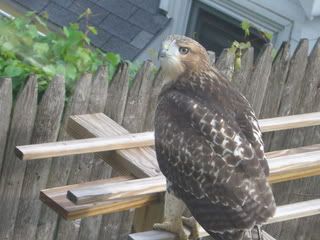 This definitely falls under the "Miscellaneous" category. This is our annual visitor. This year he/she brought a friend and the two of them have been hanging out on our grape arbor and entertaining this guy (through the window):
 I'm sorry I've been an absent blogger. I've been busy organizing conferences, serving on boards, contemplating summer hail, and very occasionally, doing research! I'd like to switch these priorities around (especially the summer hail part), but I fear the first two are only going to take up more time in the coming year. But we shall see.
But, in the meantime, while I plan to remedy my absence from the blogosphere, I offer some musicologically miscellaneous humor. You have to love the connections only Amazon can make between these two works:
"We've noticed that customers who have purchased or rated A History of Music in Western Culture by Mark Evan Bonds...have also purchased Mel Bay presents All-American Concertina Album by Alan Lochhead. For this reason, you might like to know that Mel Bay presents All-American Concertina Album is now available. You can order yours for just $9.95 by following the link below."
I suddenly find myself wanting to transcribe the Bonds anthology for concertina. A good summer project, to be sure.
NOW PLAYING: Veljo Tormis, North Russian Bylina (Estonian National Male Choir, Olev Oja)
Tuesday, May 20, 2008
Summer Plans for MMM!
Well, just as the guys over at Dial M are taking a vacation, I'm thinking it is high time I got back to blogging! Fortunately, Ralph Locke and Brent Reidy are filling the vacancy at Dial M.
Upon my graduation from college, a wise mentor of mine counseled me to "listen to as much music as possible." This has stayed with me over the past decade, but I have failed to heed it. So, this summer, I plan to rectify that. I'd love to say I could do a new piece every day, but that may not be realistic (we musicologists have to read too and I find that I cannot do both at the same time). Real listening is a time investment for me. So, I'm going to aim for at least twice a week (let's hope this goes better than my exercise goals...).
In the meantime, remember this? For those of you who have been dying to know the answers, here they are:
1. O Lord, My God, I take refuge in you
"O Sing unto the Lord" by Phyllis E. Zimmerman. Ok, so it was a loooooooooong shot. A really loooooooooooooooooooong shot.
2. Mit Staunen sieht das Wunderwerk HINT: 18th-c
I was surprised this one had no takers! Haydn, Die Schöpfung (No. 4 for soprano solo and chorus)
3. De profundis clamavi ad te...(hint: it is from the 20th-c, and relevant to my dissertation work)
Like I said, the sacred music texts were a little unfair. But, this would be from Bernstein's Mass.
4. Da die Hirten ihre Herde
Mark got this one! Schoenberg's Friede auf Erden, Op. 13
5. We met in the quiet of the meadow
Another obscurity. A song called "The Other Side of the Wood" by a former lawyer-turned folk singer-now Unitarian minister named Fred Small.
6. My life goes on in endless song HINT: new age/Celtic
Enya, "How Can I Keep From Singing?" I was hoping someone would recognize the words of the hymn.
7. Adonai, Adonai... Lo gavah libi
I gave Scott half-credit for this one since he guessed Bernstein's Kaddish Symphony. It was from the third mvt of Chichester Psalms.
8. Funny day, looking for laughter and finding it there
Again, this one went to Mark: Joni Mitchell's "I Don't Where I Stand" from the Clouds album.
9. Give me one reason to stay here and I'll turn right back around.
My friend "the Unhipster" identified Tracy Chapman's "Gimme one Reason"
10. I have spent nights with matches and knives
This one went to Svenn: Indigo Girls, "Blood and Fire"
11. Can you hear the drums... HINT: the title of the song is the next word.
I thought this one would be one of the first to go, but no dice. Dan B. finally got it: ABBA, "Fernando."
12. An old cowboy went riding out one dark and windy day HINT: country classic!
Another surprise, although I suppose an old cowboy riding on a dark and windy day isn't exactly the most unique musical experience. Johnny Cash, "Ghost Riders in the Sky"
13. Half the people are stoned
Phil, my brother in Bernstein, got this one...the famous lines written by Paul Simon and given to Lenny which he used in Mass.
14. Empty spaces, what are we living for HINT: classic rock
Queen, "The Show Must Go On"
15. No more carefree laughter HINT: same performer(s) as another already guessed item on this list
ABBA, "Knowing Me, Knowing You"
16. I cannot ask you when exactly you plan to leave (you won't know the performer, but if you get the composer, extra bonus points!!)
Really tough one but not as obscure as No. 1. Stephen Paulus, Songs of Love and Longing "From This World"
17. Hello, darkness, my old friend
Unhipster knew this one: Simon and Garfunkel, "The Sound of Silence"
18. The sky may be starless... HINT: jazz standard, popular artist
Diana Krall, "Love Letters"
19. Let us be lovers, we'll marry our fortunes together
Again, the Unhipster: Simon and Garfunkel, "America"
20. Won't you please let me go HINT: assoc. with Little Miss Sunshine
New Order, "Age of Consent." I must apologize. I think the song was used with the movie Marie Antoinette, NOT Little Miss Sunshine.
21. I've an unrest inside me HINT: showtune
Dan B. should get the top prize for correctly guessing Blitzstein's "I Wish it So," sung by Dawn Upshaw on the album of the same name.
22. Oh, play me some... HINT: classic 80s country
Alright. So I'm the only one who listens to Alabama? ("Mountain Music")
23. Goodnight my angel HINT: leave these questions for another day...
Billy Joel, "Lullaby" aka "Goodnight My Angel"
24. Barbare! Non, sans toi je ne puis vivre HINT: opera "reformer"
This one went to Deetie: Gluck's Alceste. If my students read this blog, which they do not (at least to my knowledge), they would have guessed that one...I hope.
25. Where have all the good men gone (it is for the gym, OK?)
Svenn came through with Bonnie Tyler's "I Need a Hero"
THANKS FOR PLAYING!
Upon my graduation from college, a wise mentor of mine counseled me to "listen to as much music as possible." This has stayed with me over the past decade, but I have failed to heed it. So, this summer, I plan to rectify that. I'd love to say I could do a new piece every day, but that may not be realistic (we musicologists have to read too and I find that I cannot do both at the same time). Real listening is a time investment for me. So, I'm going to aim for at least twice a week (let's hope this goes better than my exercise goals...).
In the meantime, remember this? For those of you who have been dying to know the answers, here they are:
1. O Lord, My God, I take refuge in you
"O Sing unto the Lord" by Phyllis E. Zimmerman. Ok, so it was a loooooooooong shot. A really loooooooooooooooooooong shot.
2. Mit Staunen sieht das Wunderwerk HINT: 18th-c
I was surprised this one had no takers! Haydn, Die Schöpfung (No. 4 for soprano solo and chorus)
3. De profundis clamavi ad te...(hint: it is from the 20th-c, and relevant to my dissertation work)
Like I said, the sacred music texts were a little unfair. But, this would be from Bernstein's Mass.
Mark got this one! Schoenberg's Friede auf Erden, Op. 13
5. We met in the quiet of the meadow
Another obscurity. A song called "The Other Side of the Wood" by a former lawyer-turned folk singer-now Unitarian minister named Fred Small.
6. My life goes on in endless song HINT: new age/Celtic
Enya, "How Can I Keep From Singing?" I was hoping someone would recognize the words of the hymn.
I gave Scott half-credit for this one since he guessed Bernstein's Kaddish Symphony. It was from the third mvt of Chichester Psalms.
Again, this one went to Mark: Joni Mitchell's "I Don't Where I Stand" from the Clouds album.
My friend "the Unhipster" identified Tracy Chapman's "Gimme one Reason"
This one went to Svenn: Indigo Girls, "Blood and Fire"
I thought this one would be one of the first to go, but no dice. Dan B. finally got it: ABBA, "Fernando."
12. An old cowboy went riding out one dark and windy day HINT: country classic!
Another surprise, although I suppose an old cowboy riding on a dark and windy day isn't exactly the most unique musical experience. Johnny Cash, "Ghost Riders in the Sky"
Phil, my brother in Bernstein, got this one...the famous lines written by Paul Simon and given to Lenny which he used in Mass.
14. Empty spaces, what are we living for HINT: classic rock
Queen, "The Show Must Go On"
15. No more carefree laughter HINT: same performer(s) as another already guessed item on this list
ABBA, "Knowing Me, Knowing You"
16. I cannot ask you when exactly you plan to leave (you won't know the performer, but if you get the composer, extra bonus points!!)
Really tough one but not as obscure as No. 1. Stephen Paulus, Songs of Love and Longing "From This World"
Unhipster knew this one: Simon and Garfunkel, "The Sound of Silence"
18. The sky may be starless... HINT: jazz standard, popular artist
Diana Krall, "Love Letters"
Again, the Unhipster: Simon and Garfunkel, "America"
20. Won't you please let me go HINT: assoc. with Little Miss Sunshine
New Order, "Age of Consent." I must apologize. I think the song was used with the movie Marie Antoinette, NOT Little Miss Sunshine.
Dan B. should get the top prize for correctly guessing Blitzstein's "I Wish it So," sung by Dawn Upshaw on the album of the same name.
22. Oh, play me some... HINT: classic 80s country
Alright. So I'm the only one who listens to Alabama? ("Mountain Music")
23. Goodnight my angel HINT: leave these questions for another day...
Billy Joel, "Lullaby" aka "Goodnight My Angel"
This one went to Deetie: Gluck's Alceste. If my students read this blog, which they do not (at least to my knowledge), they would have guessed that one...I hope.
Svenn came through with Bonnie Tyler's "I Need a Hero"
THANKS FOR PLAYING!
Sunday, May 18, 2008
Walk for Music!
Today I will be participating in Boston's Fifth Annual Walk for Music
This is a community-oriented event (brief 2 mile walk around the Fen) to emphasize the importance of music in education and cultural development. I'm hoping to meet a lot of fellow choristers and hear a lot of great music!
This is a community-oriented event (brief 2 mile walk around the Fen) to emphasize the importance of music in education and cultural development. I'm hoping to meet a lot of fellow choristers and hear a lot of great music!
Thursday, May 08, 2008
Boston Area Musicological/Music Events
I will be posting various events/concerts happening in the Boston area from time to time. This weekend:
1. Harvard-Lyrica Dialogues #4
The Lyrica Society for Word-Music Relations -- www.lyricasociety.org -- is
pleased to announce the fourth and final of its annual Harvard-Lyrica
Dialogues, scheduled from 4-6 PM, 9 May 2008 at Lehman Hall, Dudley House, 2nd
Floor, in Harvard Yard.
This season's Dialogues are themed "Music and Memory -- Music as Memory", and
the final Dialogue, "Revolution and its Discontents", will be an historical and
sociological round-table discussion of Francis Poulenc's opera "The Dialogues of
the Carmelites", set to the play by Georges Bernanos, in turn based upon based
on the novella "The Last on the Scaffold", by Gertrud von le Fort. Von le
Fort's story, a study in crises of conscience, recounts the massacre of the
nuns of the Carmelite convent in Compiègne during the French Revolution, and
the panel will deliberate Beranos's and Poulenc's masterful incarnations.
The event may be found online at:
www.lyricasociety.org/carmelites.pdf
Panelists will include Jeffrey Mehlman of Boston University, Mark DeVoto,
Emeritus, Tufts University, Jann Pasler, University of California, San Diego,
and Paul-André Bempéchat, Harvard University.
Admission is free, and all are welcome.
2. Ruddigore at MIT
Tonight, Tomorrow night and Sunday afternoon:
http://web.mit.edu/gsp/www/Archive/2008spring_ruddigore/index.html
3. Spectrum Singers: Shakespeare in Song: Saturday, May 17th 8pm
Emmanuel Church (15 Newbury St., Back Bay)
I've got discounted tickets! Leave a comment with contact info (blog with email enabled or e-mail address if you are comfortable with that).
http://www.spectrumsingers.org/index.htm
1. Harvard-Lyrica Dialogues #4
The Lyrica Society for Word-Music Relations -- www.lyricasociety.org -- is
pleased to announce the fourth and final of its annual Harvard-Lyrica
Dialogues, scheduled from 4-6 PM, 9 May 2008 at Lehman Hall, Dudley House, 2nd
Floor, in Harvard Yard.
This season's Dialogues are themed "Music and Memory -- Music as Memory", and
the final Dialogue, "Revolution and its Discontents", will be an historical and
sociological round-table discussion of Francis Poulenc's opera "The Dialogues of
the Carmelites", set to the play by Georges Bernanos, in turn based upon based
on the novella "The Last on the Scaffold", by Gertrud von le Fort. Von le
Fort's story, a study in crises of conscience, recounts the massacre of the
nuns of the Carmelite convent in Compiègne during the French Revolution, and
the panel will deliberate Beranos's and Poulenc's masterful incarnations.
The event may be found online at:
www.lyricasociety.org/carmelites.pdf
Panelists will include Jeffrey Mehlman of Boston University, Mark DeVoto,
Emeritus, Tufts University, Jann Pasler, University of California, San Diego,
and Paul-André Bempéchat, Harvard University.
Admission is free, and all are welcome.
2. Ruddigore at MIT
Tonight, Tomorrow night and Sunday afternoon:
http://web.mit.edu/gsp/www/Archive/2008spring_ruddigore/index.html
3. Spectrum Singers: Shakespeare in Song: Saturday, May 17th 8pm
Emmanuel Church (15 Newbury St., Back Bay)
I've got discounted tickets! Leave a comment with contact info (blog with email enabled or e-mail address if you are comfortable with that).
http://www.spectrumsingers.org/index.htm
Subscribe to:
Posts (Atom)