I'll be singing (in the Chorus) for Haydn's Harmoniemesse and Die Schöpfung here.
Back in mid-August!
Tschüss!

Sunday, July 29, 2007


Saturday, July 28, 2007
50 Book Challenge #11 & #12: HP No. 7 and What is the What
No. 11
Harry Potter and the Deathly Hallows by JK Rowling (Scholastic, 2007)
In order to be "spoiler-free" this will be necessarily brief. Suffice to say, I felt this was one of the better books in the series. Rowling did a very good job of tying up most of the loose ends. I did feel she moved too quickly through the last parts of the book, breezing through points where I wished to linger. My harshest criticism of the book is the Epilogue--I found it incredibly juvenile (it brought Harry Potter back to the level of mundane chidren's literature) and unnecessary.
No. 12
What Is The What by Dave Eggers (McSweeney's, 2006).
To call this a "novel" might underestimate its truth and urgency. This is very much a work of non-fiction. The life of Valentino Achak Deng is representative of thousands upon thousands of lives in Sudan in its tales of struggle and oppression. While the book sensitively addresses a topic that is hurendous and heartbreaking in and of itself, the narration is not overly sentimentalized. Eggers and Deng weave in humor, joy, and small victories through the tragedies of the Lost Boys of Sudan.
Valentino Achak Deng is both evidence of the resiliency of the human spirit and a beacon of hope for the future. There are moments in the book that call us out of our comfortable existence, and there are moments when we recognize that from which we also seek refuge. It is a compelling read about the human condition and should be compulsory reading for anyone wishing to remain ignorant about the struggles of Africa. To ignore Sudan is to ignore humankind.
Harry Potter and the Deathly Hallows by JK Rowling (Scholastic, 2007)
In order to be "spoiler-free" this will be necessarily brief. Suffice to say, I felt this was one of the better books in the series. Rowling did a very good job of tying up most of the loose ends. I did feel she moved too quickly through the last parts of the book, breezing through points where I wished to linger. My harshest criticism of the book is the Epilogue--I found it incredibly juvenile (it brought Harry Potter back to the level of mundane chidren's literature) and unnecessary.
No. 12
What Is The What by Dave Eggers (McSweeney's, 2006).
To call this a "novel" might underestimate its truth and urgency. This is very much a work of non-fiction. The life of Valentino Achak Deng is representative of thousands upon thousands of lives in Sudan in its tales of struggle and oppression. While the book sensitively addresses a topic that is hurendous and heartbreaking in and of itself, the narration is not overly sentimentalized. Eggers and Deng weave in humor, joy, and small victories through the tragedies of the Lost Boys of Sudan.
Valentino Achak Deng is both evidence of the resiliency of the human spirit and a beacon of hope for the future. There are moments in the book that call us out of our comfortable existence, and there are moments when we recognize that from which we also seek refuge. It is a compelling read about the human condition and should be compulsory reading for anyone wishing to remain ignorant about the struggles of Africa. To ignore Sudan is to ignore humankind.
Thursday, July 26, 2007
Edward Hopper at the MFA
 Edward Hopper has to be one of my all time favorite artists. The current exhibition at the Boston MFA is fantastic. In addition to what is arguably his most famous painting (Nighthawks, 1942), the museum hosts some of his very early works and some of his prints. Hopper was admired as a printmaker before he became known as a painter.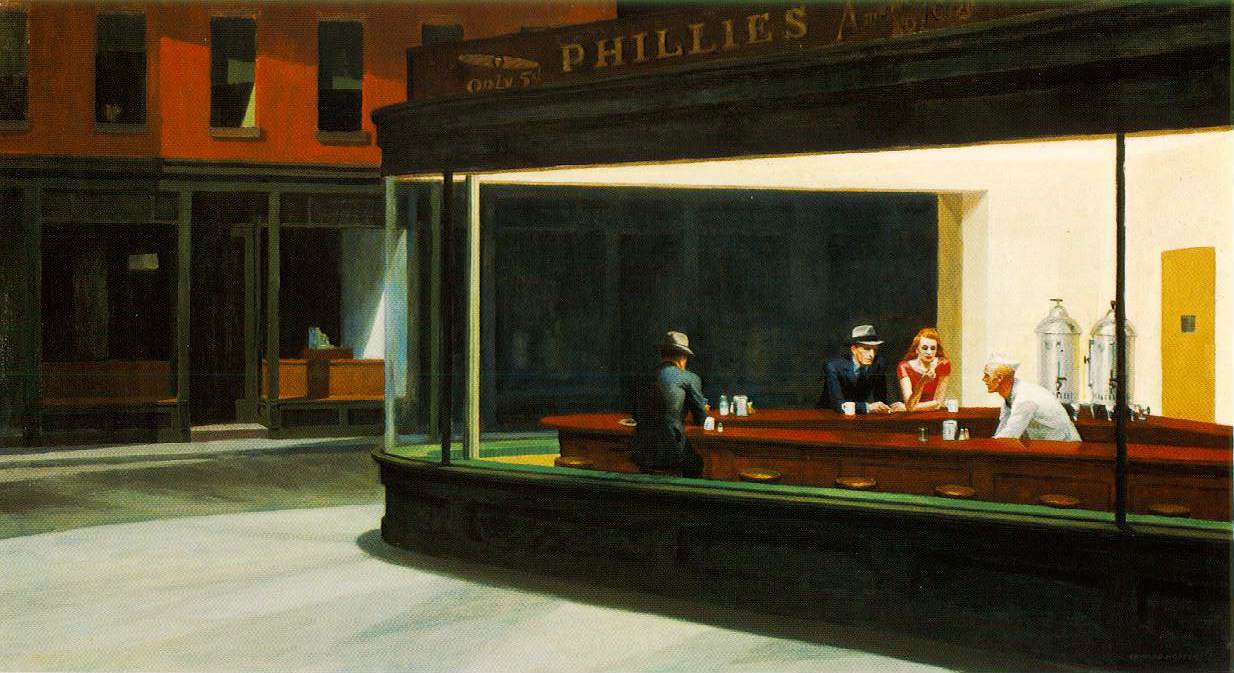
I was struck by the obvious maturation of Hopper's work. In music, we speak of the "mature style" and I sometimes feel this is unfair, as maturity, in both music and life, is a subjective concept. However, in spite of the subjectivity, we can usually agree that self-confidence is a sign of maturation. In Hopper's early work there is a sense that he is following a model, a pattern...he's painting how he is supposed to paint. As one moves into his works of the later twenties, he seems less afraid to admit shape...using watercolors almost as if they were oils, exploiting their capabilities for the opaque. In these paintings, the natural elements (such as background foliage) are given a more watery texture, whereas the solidity of man-made elements is emphasized.
I respect Hopper's eye. He isn't afraid to let tall edifices soar out of frame. While Uncle Jack's snapshots of the Eiffel Tower without its top don't quite cut it, Hopper manages to extend the idea beyond the page. We don't have to see all of the chimney in order to understand the roof.
The exhibit cited Hopper's interest in "vernacular architecture" as opposed to someone like Charles Sheeler, who, while somewhat similar stylistically, amplified the industrial (factories and the like). His paintings of lighthouses are especially exquisite...extraordinary, but not overly-romanticized.

Hopper's most intriguing paintings are those of women and couples (see Room in New York, 1932 pictured above). The sense of isolation is tangible, but not hopeless. In his famous New York Movie (1939), the usherette becomes the focus, not the movie or even those watching. Dimly illuminated by the aisle lights, we are pulled into her pensive daydreaming...the movie in her mind.
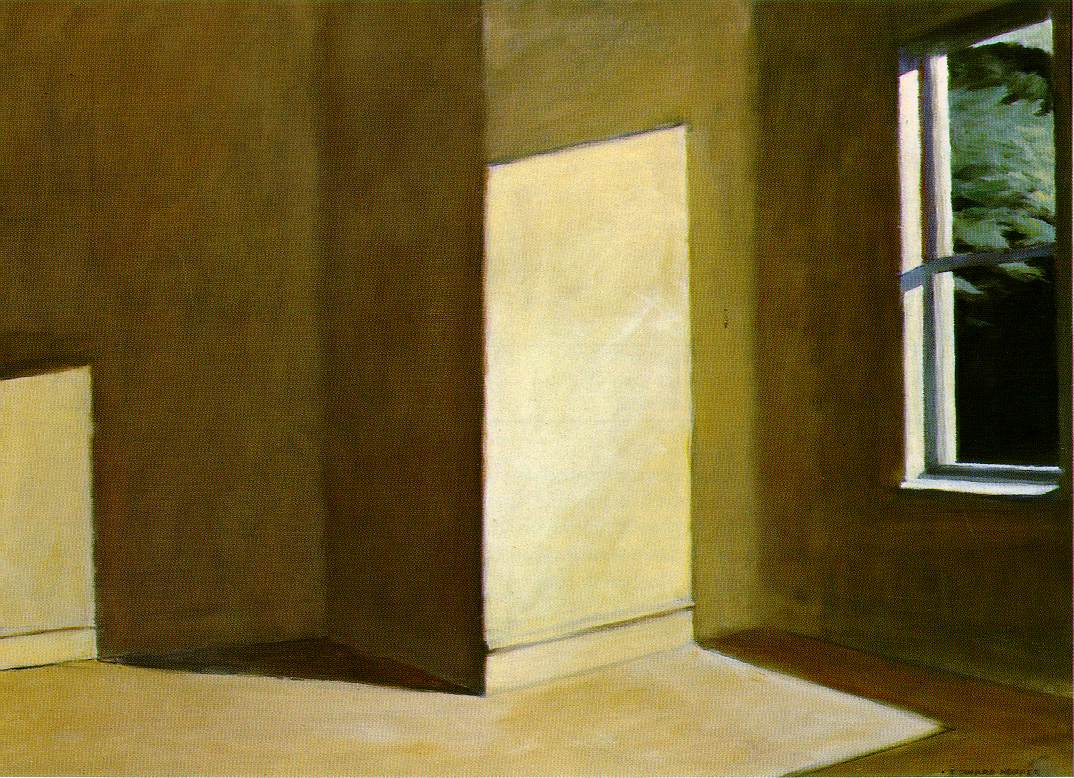
The very last painting in the exhibition chilled me for some reason...all the more ironic given that it is a painting of sunlight. Sun in an Empty Room, painted four years before he died, gave me such pause. Gone are the contemplative nudes and the estranged couples...only two elements remain...the room and light. There is a strong sense of geometry here. The three-dimensionality is subdued in favor of the demarcation of roles: shadow vs. light. The absent figures could occupy either type of space. It makes me want to seek out all of Hopper's figures to note where they stand, sit, or lounge. In the end, when we leave our rooms, the light and shadow remain. We are but visitors, with our hopes, dreams and burdens.
Monday, July 23, 2007
For Exceptional Theses Only...
 For those of you out there with mediocre and substandard theses...I'm afraid I don't know where to buy the paper. Do let us know if you find out...at the very least it should be cheaper.
Wednesday, July 18, 2007
In Memoriam: Jerry Hadley (1952-2007)
Death is always sad. And sometimes it is tragic.
Sometimes we mourn the personal connection.
Sometimes we mourn the talent, and the fact we didn't know.
Sometimes we mourn an idea, a symbol.
But we always do mourn.
Jerry Hadley
Requiescat in pace.
Thank you for sharing your voice with me through hours and hours of dissertation work on Leonard Bernstein's Mass. You always helped me reconnect with the love of my labor. Thank you for your "Simple Song."
Now Listening: Leonard Bernstein's Mass--Deutsches Symphonie-Orchester Berlin, dir. Kent Nagano, with Jerry Hadley as Celebrant. (Harmonia Mundi, 2004)
Sometimes we mourn the personal connection.
Sometimes we mourn the talent, and the fact we didn't know.
Sometimes we mourn an idea, a symbol.
But we always do mourn.
Jerry Hadley
Requiescat in pace.
Thank you for sharing your voice with me through hours and hours of dissertation work on Leonard Bernstein's Mass. You always helped me reconnect with the love of my labor. Thank you for your "Simple Song."
Now Listening: Leonard Bernstein's Mass--Deutsches Symphonie-Orchester Berlin, dir. Kent Nagano, with Jerry Hadley as Celebrant. (Harmonia Mundi, 2004)
Sunday, July 15, 2007
Because you never have a second chance...
I've decided to start a weekly (maybe more) feature called First Impressions in New Listening (FINL*).
Ideally, every day I'd like to hear a piece of music I've never heard before. At the present time, that is probably not practical.
The music can be recently composed, relatively "new," or an older piece with which I'm unfamiliar. I'm going to write down my first impressions. Keep in mind they are exactly that--FIRST impressions, based on a single hearing, without a score. My commentary will reflect that which "jumps" out at me (if anything).
If you are familiar with the piece, feel free to leave your own impressions (first or otherwise) in the comments.
This week, we start off with something relatively local:
Pozzi Escot, Concerto for Piano and Orchestra or Chamber Orchestra (1982)
ALBUM: POLYUTTERANCES
Peformers: New England Conservatory Chamber Orchestra, cond. Tamara Brooks, with Randall Hodgkinson, piano.
*The irony of the acronym is unintentional.
Ideally, every day I'd like to hear a piece of music I've never heard before. At the present time, that is probably not practical.
The music can be recently composed, relatively "new," or an older piece with which I'm unfamiliar. I'm going to write down my first impressions. Keep in mind they are exactly that--FIRST impressions, based on a single hearing, without a score. My commentary will reflect that which "jumps" out at me (if anything).
If you are familiar with the piece, feel free to leave your own impressions (first or otherwise) in the comments.
This week, we start off with something relatively local:
Pozzi Escot, Concerto for Piano and Orchestra or Chamber Orchestra (1982)
ALBUM: POLYUTTERANCES
Peformers: New England Conservatory Chamber Orchestra, cond. Tamara Brooks, with Randall Hodgkinson, piano.
More of a "concerto" in the sense of Bartok's Concerto for Orchestra, this mini-concerto (just under six minutes) of three movements could be a single movement.
The opening movement is the yin to the yang of the closing movement. The first movement draws out a motive in the trumpet, like musical taffy. The final movement takes a related motive, but squeezes it and condenses it in a rush to the finish. The piano makes rather abrupt statements, but at no time is there ever a sense that there is one soloist.
These outer movements flank an inner movement of a more obligatory inward nature...atmospheric strings (recalling Ligeti) punctuated by the piano. This slower middle movement is most revealing of the concerto conception.
The opening movement is the yin to the yang of the closing movement. The first movement draws out a motive in the trumpet, like musical taffy. The final movement takes a related motive, but squeezes it and condenses it in a rush to the finish. The piano makes rather abrupt statements, but at no time is there ever a sense that there is one soloist.
These outer movements flank an inner movement of a more obligatory inward nature...atmospheric strings (recalling Ligeti) punctuated by the piano. This slower middle movement is most revealing of the concerto conception.
I enjoyed this piece and will listen to it several times. The texture is dense, so there is much to be unearthed.
----------------------------------------------------*The irony of the acronym is unintentional.
Friday, July 13, 2007
I've been tagged to ponder...
Well, I consider myself tagged, for a meme, that is. Normally i wouldn't engage in such frivolity (stop laughing--all of you!), but because this one came from Barnet Bound, I feel I must oblige. Of course the fact that I've taken this long to do so is a clear indication of my inner struggle (sure, it is).
Like BB, I'll be limiting my selections to four. The first one is something I have pondered, and I suppose I still am. The other three are more current.
1. When Terminator is dubbed in Spanish, what happens to the line "Hasta la vista, baby"? Answer: Allegedly, the line becomes "Sayonara..." Can anyone confirm or deny?
2. Why does chocolate taste so vastly different in the UK (and Canada too!) than in the US? Answer: I've got my own ideas and opinions, of course, but here's what the NY Times had to say (just in case you tire of reading about the state of the world).
3. Why now, after moving thousands of miles away, do I have this incredible urge to visit The Presidio? Answer: Pure nostalgia.
4. Do they grant PhDs in Endurance? Leave your answer in the comments.
If you read this blog, consider yourself tagged and do what you will. (Yes, I break chain letters too...I know, I know.)
Like BB, I'll be limiting my selections to four. The first one is something I have pondered, and I suppose I still am. The other three are more current.
1. When Terminator is dubbed in Spanish, what happens to the line "Hasta la vista, baby"? Answer: Allegedly, the line becomes "Sayonara..." Can anyone confirm or deny?
2. Why does chocolate taste so vastly different in the UK (and Canada too!) than in the US? Answer: I've got my own ideas and opinions, of course, but here's what the NY Times had to say (just in case you tire of reading about the state of the world).
3. Why now, after moving thousands of miles away, do I have this incredible urge to visit The Presidio? Answer: Pure nostalgia.
4. Do they grant PhDs in Endurance? Leave your answer in the comments.
If you read this blog, consider yourself tagged and do what you will. (Yes, I break chain letters too...I know, I know.)
Sunday, July 08, 2007
On Teaching (Part I)
As someone who has taught and wants to continue to teach, when I read things like THIS it makes me terribly sad. While I know that particular example was meant as satire, it is not without a grain of truth. Academia seems to have a love-hate relationship with teaching. At some universities there is definitely more hate than love.
While I do not have vast years of experience, I do have a good sampling of different teaching environments...as a teaching assistant, as an instructor of my peers, as a lecturer for 300 students, as an instructor of record for 7 music majors at a small Christian liberal arts institution, and as an instructor for 25 non-music majors at the same institution. I have looked upon each of these opportunities as a learning experience. I hope that this does not change even when I have tenure somewhere.
I must say, I love the seminar model. While I have witnessed many wonderful lectures, my preference is for interaction...among the students and the professor. One of the best seminars I ever had was one where the professor gave an angle to the course with which he wasn't totally familiar. While "Women in Music of the Italian Renaissance" was a topic near and dear to his heart, we investigated some feminist theory which he admitted was a "stretch" for him. In the end, I think we ALL came out of it with more than if he had merely regurgitated the same syllabus of "standards" with which he was familiar.
I'm struck at how often a TAship has very little to do with merit and everything to do with financial aid. This is a huge disservice to the students and to the TA. I happen to think I've become a pretty great teacher, but I certainly didn't start out that way. When I was given my first TAship, I didn't even know what a TA was! I had never had a TA in undergrad. And there I was, expected to guide students who, in some cases, were merely a year behind me. I understand that first year TAships can't exactly be based on experience, so I'd revise my statement to say that continued TAships should be merit based. And merit? What does that mean?
The "merit" of teaching
Here are my top 5 indications of good teaching:
1. Never claiming perfection (but no self-deprecation either)
2. Willingness to learn
3. Seeing each class, no matter the subject, no matter how many times the course has been taught, as a new experience.
4. A student-centered model (as much as possible--difficult in large lecture classes).
5. A desire to teach in the first place (!) not just viewing it as an obligatory side-effect of being paid to do research.
So while it might be easy to fall into the cynicism expressed by the folks over at Rate Your Students (see first link), I'd much rather go the way of Barnet Bound.
Part II coming soon!
While I do not have vast years of experience, I do have a good sampling of different teaching environments...as a teaching assistant, as an instructor of my peers, as a lecturer for 300 students, as an instructor of record for 7 music majors at a small Christian liberal arts institution, and as an instructor for 25 non-music majors at the same institution. I have looked upon each of these opportunities as a learning experience. I hope that this does not change even when I have tenure somewhere.
I must say, I love the seminar model. While I have witnessed many wonderful lectures, my preference is for interaction...among the students and the professor. One of the best seminars I ever had was one where the professor gave an angle to the course with which he wasn't totally familiar. While "Women in Music of the Italian Renaissance" was a topic near and dear to his heart, we investigated some feminist theory which he admitted was a "stretch" for him. In the end, I think we ALL came out of it with more than if he had merely regurgitated the same syllabus of "standards" with which he was familiar.
I'm struck at how often a TAship has very little to do with merit and everything to do with financial aid. This is a huge disservice to the students and to the TA. I happen to think I've become a pretty great teacher, but I certainly didn't start out that way. When I was given my first TAship, I didn't even know what a TA was! I had never had a TA in undergrad. And there I was, expected to guide students who, in some cases, were merely a year behind me. I understand that first year TAships can't exactly be based on experience, so I'd revise my statement to say that continued TAships should be merit based. And merit? What does that mean?
The "merit" of teaching
Here are my top 5 indications of good teaching:
1. Never claiming perfection (but no self-deprecation either)
2. Willingness to learn
3. Seeing each class, no matter the subject, no matter how many times the course has been taught, as a new experience.
4. A student-centered model (as much as possible--difficult in large lecture classes).
5. A desire to teach in the first place (!) not just viewing it as an obligatory side-effect of being paid to do research.
So while it might be easy to fall into the cynicism expressed by the folks over at Rate Your Students (see first link), I'd much rather go the way of Barnet Bound.
Part II coming soon!
Thursday, July 05, 2007
50 Book Challenge #10: Audacity of Hope
50 Book Challenge #10: The Audacity of Hope by Barack Obama (Crown Publishers, 2006) 362 pp.
This book demonstrates eloquence, understanding, and an intense passion for this country and what it should stand for. Obama writes beautifully, with focus, but with the intensity of someone who is anticipating the arguments before they've been made. And that isn't such a bad thing, particularly for someone who is running for President. He does, however, need a better editor. Obama relies too heavily on anecdotes and sometimes gets a tad formulaic in his presentation of each chapter. The points are made, but then at times, run into the ground by an overabundance of examples.
That aside, the book is very well-structured. He wisely ends with "Family" to leave the reader with the best impression of a man who isn't afraid to extol his wife's domestic and professional abilities, but without the sense of hero worship. He's not afraid to express his love in real terms or to admit the struggles in their marriage. It is in this final chapter than the anecdotes ring most true.
However, for those that believe Obama is too "green" to be President, I'd hold off until you read this book. He has a better understanding of history, law, politics and social justice than most people on Capitol Hill. He's managed to move forward (up?) in his career, but has always had one foot firmly planted in the neighborhoods of his constituents.
It is a shame that those who do not support Obama are unlikely to read this book, as it is a revealing portrait...not set on changing political views, but opening up an honest dialogue...a dialogue very much absent from current American politics.
This book demonstrates eloquence, understanding, and an intense passion for this country and what it should stand for. Obama writes beautifully, with focus, but with the intensity of someone who is anticipating the arguments before they've been made. And that isn't such a bad thing, particularly for someone who is running for President. He does, however, need a better editor. Obama relies too heavily on anecdotes and sometimes gets a tad formulaic in his presentation of each chapter. The points are made, but then at times, run into the ground by an overabundance of examples.
That aside, the book is very well-structured. He wisely ends with "Family" to leave the reader with the best impression of a man who isn't afraid to extol his wife's domestic and professional abilities, but without the sense of hero worship. He's not afraid to express his love in real terms or to admit the struggles in their marriage. It is in this final chapter than the anecdotes ring most true.
However, for those that believe Obama is too "green" to be President, I'd hold off until you read this book. He has a better understanding of history, law, politics and social justice than most people on Capitol Hill. He's managed to move forward (up?) in his career, but has always had one foot firmly planted in the neighborhoods of his constituents.
It is a shame that those who do not support Obama are unlikely to read this book, as it is a revealing portrait...not set on changing political views, but opening up an honest dialogue...a dialogue very much absent from current American politics.
Sunday, July 01, 2007
Zen Habits
Recently, I've started following Zen Habits and have found it to be a wonderful resource. Leo has started a new forum for us Zen Habits readers and I've signed up--specifically to participate in the monthly challenge.
For the month of July, you pick ONE goal you'd like to maintain (daily exercise, reading, eating right, etc...) and there is a thread where you can check in daily with the other folks participating in the challenge.
My goal for July? An hour of German every day. Starts today.
For the month of July, you pick ONE goal you'd like to maintain (daily exercise, reading, eating right, etc...) and there is a thread where you can check in daily with the other folks participating in the challenge.
My goal for July? An hour of German every day. Starts today.
Friday, June 22, 2007
Teach to Learn
Sir Peter Maxwell Davies offers a three-part work* with an extended coda. I can't say I agreedwith everything, but I am grateful that someone is speaking out in defense of classical music. While I think his speech meanders a bit (it seems to cover a lot in one sitting), there are some true pearls of wisdom. This one was buried in "Part I":
Teaching is an education for the teacher, too, for you learn far more than you teach.
Good. Someone gets it. Unfortunately, I think there are far too many teachers who believe they have stopped learning (aack--what reason to live then??). When I tell people I'm getting a PhD in Musicology, the next question is usually: "So, are you going to teach?" asked in a way that insinuates "Well, what else would you do?" It just so happens that yes, I am going to teach. And yes, I WANT to teach....not just as a means to finance my research, but because I'm not done learning.
*three-part, I believe, courtesy of the Guardian.
Thanks to Elaine Fine for the original notice.
Teaching is an education for the teacher, too, for you learn far more than you teach.
Good. Someone gets it. Unfortunately, I think there are far too many teachers who believe they have stopped learning (aack--what reason to live then??). When I tell people I'm getting a PhD in Musicology, the next question is usually: "So, are you going to teach?" asked in a way that insinuates "Well, what else would you do?" It just so happens that yes, I am going to teach. And yes, I WANT to teach....not just as a means to finance my research, but because I'm not done learning.
*three-part, I believe, courtesy of the Guardian.
Thanks to Elaine Fine for the original notice.
Thursday, June 21, 2007
More Dissertation Fun
This blogpost will be short and perhaps completely boring to most people who read this blog.
You've been warned.
As I go through the task of pulling together the bits and pieces of minutiae in my dissertation, I think I can safely say this is my least favorite part. Checking citations, moving margins, and searching for typos is the most painful part of the whole process, even though it is "easy."
I'm proofreading, basically, and have discovered the following to be most helpful: reading aloud. I find, even though it is a document to be read, and not heard, not only do I catch typos and punctuation errors, but it is much easier to revise sentences that are either dull or overly lengthy. I imagine that it is the narration for a documentary, accompanied by pictures, interviews and soundclips. It makes total sense that the paper needs to sound right...I am, after all, a musician.
Of course, this is best practiced in solitude. I thankfully had a few hours of that today. Hey, at the very least, it is good practice should I need to seek employment doing voice-overs.
You've been warned.
As I go through the task of pulling together the bits and pieces of minutiae in my dissertation, I think I can safely say this is my least favorite part. Checking citations, moving margins, and searching for typos is the most painful part of the whole process, even though it is "easy."
I'm proofreading, basically, and have discovered the following to be most helpful: reading aloud. I find, even though it is a document to be read, and not heard, not only do I catch typos and punctuation errors, but it is much easier to revise sentences that are either dull or overly lengthy. I imagine that it is the narration for a documentary, accompanied by pictures, interviews and soundclips. It makes total sense that the paper needs to sound right...I am, after all, a musician.
Of course, this is best practiced in solitude. I thankfully had a few hours of that today. Hey, at the very least, it is good practice should I need to seek employment doing voice-overs.
Thursday, June 14, 2007
Nessun Dorma--Paul Potts
How absurd is it that the most mythical, magical moment of this is Simon Cowell's smile?
I want to be skeptical and dismiss it all as hype, but I'd be lying. I got "goosepimples" too.
Thanks to Alex Ross for the original post!
I want to be skeptical and dismiss it all as hype, but I'd be lying. I got "goosepimples" too.
Thanks to Alex Ross for the original post!
Tuesday, June 12, 2007
A big hole in MassCore
This is bad news for the Commonwealth, as far as I'm concerned. Why, in a state that is host to numerous conservatories and music schools, would there be no arts component in the core curriculum (MassCore)?
I get frustrated that we are still defending the value of the arts. It isn't as though the statistics don't exist--it is that no one wants to accept them. To accept them would mean changing the status quo and taking risks. It means throwing money in the direction of those forlorn painters, those stoned musicians, and those spacey actors!
Of course, I'm referring to stereotypes, but in a place where their contributions are valued so little, can we really blame them for being forlorn, stoned and spacey?
UPDATE: Some people get it.
I get frustrated that we are still defending the value of the arts. It isn't as though the statistics don't exist--it is that no one wants to accept them. To accept them would mean changing the status quo and taking risks. It means throwing money in the direction of those forlorn painters, those stoned musicians, and those spacey actors!
Of course, I'm referring to stereotypes, but in a place where their contributions are valued so little, can we really blame them for being forlorn, stoned and spacey?
UPDATE: Some people get it.
Sunday, June 10, 2007
Atlanta Journal-Constitution: Finale
Alex Ross provides a conclusion to the recent rigamarole regarding the AJC and its "reorganization." Mistakes were clearly made--evidently Robert Spano's letter to the editor slipped through, thereby instigating the perception that the AJC was doing away with arts criticism.
Klibanoff takes aim at the Arts community for screaming "fire" when it was merely smoke from a candle. While I can see his point, I do understand why the arts community is on the defensive. It isn't as though support for the arts has been a huge priority for the government. Often "reorganization" means "reprioritization" and that can mean that the arts end up on the bottom of the list. But the AJC is not the federal government. Time will tell what this reorganization will mean. But I think we should watch very carefully. Healthy skepticism is important in a world where we all struggle for legitimacy--newspaper editors and musicians alike.
Klibanoff takes aim at the Arts community for screaming "fire" when it was merely smoke from a candle. While I can see his point, I do understand why the arts community is on the defensive. It isn't as though support for the arts has been a huge priority for the government. Often "reorganization" means "reprioritization" and that can mean that the arts end up on the bottom of the list. But the AJC is not the federal government. Time will tell what this reorganization will mean. But I think we should watch very carefully. Healthy skepticism is important in a world where we all struggle for legitimacy--newspaper editors and musicians alike.
Saturday, June 09, 2007
Diapasonic shopping!
Wow! This has to beat the lazy showtunes on out-of-tune pianos I hear at Nordstrom's.
Many thanks to Lisa Hirsch for posting about it first!
Many thanks to Lisa Hirsch for posting about it first!
Thursday, June 07, 2007
Adding some GO to GTD :-)
As most of you know, I'm always looking for ways to be better organized. For the most part, I subscribe to the Gettings Things Done (GTD) method. Unfortunately, I never took the time to sit down and think about how I might apply GTD to our move. As a result, I am sitting in the midst of chaos.
A recent post by awesome organizational/workflow consultant Matt Cornell gave me some more food for thought. In his wonderful review and summary of Getting Organized by Chris Crouch, Matt highlights several interesting features of the book.
My new personal favorite is the "MIT": The Most Important Thing (the term is courtesy of Gina Trapani at Lifehacker). The general idea is to determine what the MOST important thing is to accomplish for that day and do it first, even before an e-mail check (gasp!). Yes, yes, yes....I know. Blogging is not my MIT, but I figured I'd lay out the idea first. My MIT for today will be my inbox processing because it has simply become a huge burden. I can't focus and I cringe every time the mail comes because the stack is beginning to lean.
I quote from Matt's summary of Crouch here and interpolate my comments:
# His reasons we feel overwhelmed:
* You are setting unrealistic time frames for what you are trying to do.
I find my time frames are fine if I use them effectively (therein lies the problem)
* You are procrastinating too long.
Yes.
* You are spending too much time working on things that do not matter.
Only occasionally, as a form of procrastination.
* You are over-promising what you can do for someone.
No. I think I've finally conquered that one.
* You do not have the profound knowledge needed to do the task.
OH! That explains why my complete 6 volume history of the Mass isn't published yet!
* You do not know when and how to say No.
Again, getting better at that one. Graduate school is all about saying yes, yes, yes, so I am enjoying the freedom now to say no, no, no. At least for the time being. :-)
# He lists these causes of procrastination:
* Perfectionism - the paralyzing need to get it right the first time
Big, big problem for me. I hate drafts even though I know how necessary they are.
* Impulsiveness - taking on too many things to do and overloading yourself
Yep.
* Fear of failure - rather be seen as lacking in effort than ability
I do have a fear of failure, but it isn't that I'd rather be seen as lacking in effort.
* Perception of task - seems too hard or too boring
Occasionally.
* Uncertainty - not sure what to do
I tend to err on the other side. I make hasty decisions just to move forward but then have to go back because it was the wrong choice.
Now...off to process that inbox!
A recent post by awesome organizational/workflow consultant Matt Cornell gave me some more food for thought. In his wonderful review and summary of Getting Organized by Chris Crouch, Matt highlights several interesting features of the book.
My new personal favorite is the "MIT": The Most Important Thing (the term is courtesy of Gina Trapani at Lifehacker). The general idea is to determine what the MOST important thing is to accomplish for that day and do it first, even before an e-mail check (gasp!). Yes, yes, yes....I know. Blogging is not my MIT, but I figured I'd lay out the idea first. My MIT for today will be my inbox processing because it has simply become a huge burden. I can't focus and I cringe every time the mail comes because the stack is beginning to lean.
I quote from Matt's summary of Crouch here and interpolate my comments:
# His reasons we feel overwhelmed:
* You are setting unrealistic time frames for what you are trying to do.
I find my time frames are fine if I use them effectively (therein lies the problem)
* You are procrastinating too long.
Yes.
* You are spending too much time working on things that do not matter.
Only occasionally, as a form of procrastination.
* You are over-promising what you can do for someone.
No. I think I've finally conquered that one.
* You do not have the profound knowledge needed to do the task.
OH! That explains why my complete 6 volume history of the Mass isn't published yet!
* You do not know when and how to say No.
Again, getting better at that one. Graduate school is all about saying yes, yes, yes, so I am enjoying the freedom now to say no, no, no. At least for the time being. :-)
# He lists these causes of procrastination:
* Perfectionism - the paralyzing need to get it right the first time
Big, big problem for me. I hate drafts even though I know how necessary they are.
* Impulsiveness - taking on too many things to do and overloading yourself
Yep.
* Fear of failure - rather be seen as lacking in effort than ability
I do have a fear of failure, but it isn't that I'd rather be seen as lacking in effort.
* Perception of task - seems too hard or too boring
Occasionally.
* Uncertainty - not sure what to do
I tend to err on the other side. I make hasty decisions just to move forward but then have to go back because it was the wrong choice.
Now...off to process that inbox!
Wednesday, May 30, 2007
Journal-Constitution responds...
This is a fair response to Robert Spano, but as Alex Ross points out it isn't exactly crystal clear if the newspaper is downsizing or, as they say, refocusing "staff resources on coverage of local rather than national arts." I'm all for the latter, but not at the sacrifice of good music criticism. Sometimes newspaper writers find themselves spread too thin, critics especially. It is, after all, hard to attend several concerts in a week, profile a local string quartet, and report on what's ahead.
It will be interesting to follow what happens with the AJC and to watch whether other newspapers go the same route.
It will be interesting to follow what happens with the AJC and to watch whether other newspapers go the same route.
Music-centered curriculum
Malcolm adds: "Sometimes I use music to do my math. I'll think of adding quarter-notes, half-notes. I put my notes together as math."Here is an article about a remarkable charter school in Boston that centers its curriculum around music. The children are learning how to play the violin, yes, but also discipline, social engagement, listening skills, etc. Yet, in many public schools around the country, music programs are being slashed and burned. That's because you can't measure what one learns from music in a standardized test. Sure, you could have them identify chord progressions and define musical terms, but you certainly can't measure the skills they will carry with them for the rest of their lives.
I wonder what would happen if we handed a violin to every child in every elementary school. I'm not naive enough to consider this a plan to save the world, but I do think it is time to invest in our children with renewed vigor...not by worrying about creating standards by which they should measure their achievement, but by helping them desire to achieve in the first place.
Monday, May 28, 2007
More on the Atlanta Journal-Constitution
Hopefully, the increased attention in the blogosphere will help convince the Atlanta Journal-Constitution to save their arts reviews.
See Jonathan Bellman and Elaine Fine's blogs for more.
Arts criticism (good arts criticism, that is) has always had a symbiotic relationship with the arts themselves. Critics are important for feedback, yes, but they also represent something even more important: critical thinking. This is a mode of mental operation that is becoming outdated in American classrooms. Many children are fed through a system that rewards them for memorizing state capitals rather than creative problem-solving. If our society begins to throw away the best examples of criticism, we condone the spoon-feeding model of education. Indeed, the arts are emblems of individual expression and criticism too, so one might wonder if we are not headed toward disaster here. If an orchestra is no longer worth writing about...why is it worth paying for a ticket? My point isn't to formulate great apocalyptic scenarious, but to offer that this is a very slippery slope.
See Jonathan Bellman and Elaine Fine's blogs for more.
Arts criticism (good arts criticism, that is) has always had a symbiotic relationship with the arts themselves. Critics are important for feedback, yes, but they also represent something even more important: critical thinking. This is a mode of mental operation that is becoming outdated in American classrooms. Many children are fed through a system that rewards them for memorizing state capitals rather than creative problem-solving. If our society begins to throw away the best examples of criticism, we condone the spoon-feeding model of education. Indeed, the arts are emblems of individual expression and criticism too, so one might wonder if we are not headed toward disaster here. If an orchestra is no longer worth writing about...why is it worth paying for a ticket? My point isn't to formulate great apocalyptic scenarious, but to offer that this is a very slippery slope.
Subscribe to:
Posts (Atom)